


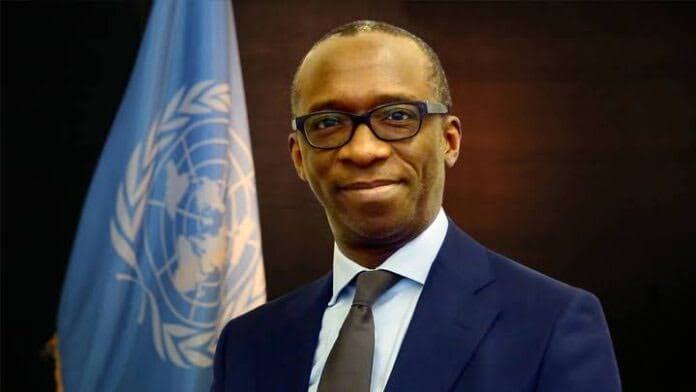
Nigerian lawyer Taoheed Elias was elected Monday to the United Nations International Law Commission during the commission’s 77th session in Geneva. The appointment fills a vacancy created by the resignation of Kenyan jurist Phoebe Okowa, according to Nigeria’s Ministry of Foreign Affairs.
The election places another Nigerian legal figure inside one of the United Nations’ most influential technical bodies, one responsible for drafting and codifying principles that often shape treaties, war crimes jurisprudence, maritime disputes, and state responsibility doctrines. The commission’s members serve in their individual capacities, but their elections are routinely interpreted as measures of diplomatic reach and legal influence within the UN system.
That matters in Abuja.
Nigeria secured the seat after a contested process involving candidates from Botswana and Ghana.
Taoheed Elias previously held senior legal roles at the UN, the World Bank Administrative Tribunal, and the Organisation for the Prohibition of Chemical Weapons.
The vacancy emerged after Phoebe Okowa resigned from the commission before the end of her term.
The appointment gives Nigeria renewed visibility inside a UN legal body that shapes the interpretation of international law.
The Geneva Election and Nigeria’s Diplomatic Push
Related News
The Ministry of Foreign Affairs confirmed Thursday that Dr. Elias emerged successful after what officials described as a “highly competitive process” involving candidates from Botswana and Ghana. The election took place during the 77th Session of the International Law Commission in Geneva.
The commission itself is not a court. It does not issue judgments or enforce sanctions. Its influence comes from drafting legal frameworks that later become conventions, reference points for tribunals, or guidance for states navigating disputes. Several legal principles now routinely cited before international courts began as draft work inside the ILC.
Nigeria’s statement framed the election as recognition of the country’s “longstanding contributions” to international law and multilateral diplomacy. The language follows a familiar pattern used by foreign ministries after successful UN appointments. Yet the timing also reflects a broader contest among African states for representation inside multilateral legal institutions, particularly as disputes over sanctions, maritime boundaries, reparations, and armed conflict increasingly return to international forums.
The vacancy itself emerged after Professor Phoebe Okowa stepped down before the expiration of her mandate. Casual vacancies inside UN bodies often trigger compressed diplomatic campaigns because member states have limited time to consolidate regional support.
Taoheed Elias’ Career Inside International Institutions
The Ministry of Foreign Affairs highlighted several positions previously held by Dr. Elias across international legal institutions. Those appointments matter because the International Law Commission typically attracts jurists with deep procedural experience inside treaty organizations, tribunals, or multilateral agencies.
Dr. Elias previously served as Legal Adviser and Director at the Organisation for the Prohibition of Chemical Weapons, the body responsible for implementing the Chemical Weapons Convention. The organization gained international visibility during investigations into chemical weapon use in Syria and other conflict zones over the last decade.
He also worked as Executive Secretary of the World Bank Administrative Tribunal and served as Legal Adviser at the United Nations Compensation Commission.
Those are technical posts.
The Foreign Ministry further noted that Elias served as Registrar of the International Residual Mechanism for Criminal Tribunals with the rank of United Nations Assistant Secretary-General. The mechanism oversees residual functions from the tribunals created after the Rwandan genocide and the Balkan conflicts of the 1990s, including appeals, witness protection, and sentence enforcement.
Our analysis of publicly available UN biographical records shows that relatively few Nigerian lawyers have occupied multiple senior legal management positions across separate UN-linked institutions at Assistant Secretary-General level or equivalent. That administrative exposure often carries weight in elections involving technical commissions where member states prioritize procedural experience over domestic political visibility.
What the International Law Commission Actually Does
The International Law Commission was established by the UN General Assembly in 1947. It consists of 34 experts elected by member states for five-year terms. The commission’s mandate is broad but technical: draft, clarify, and systematize rules of international law.
Its past work has influenced conventions on diplomatic relations, treaty law, transboundary watercourses, and crimes against humanity. Draft articles produced by the commission are frequently cited before the International Court of Justice and arbitral tribunals.
That influence is indirect but durable.
Legal scholars interviewed in prior UN proceedings have repeatedly noted that membership on the commission allows states to shape conversations long before disputes reach courtrooms. Countries with representation inside the body often gain earlier visibility into emerging legal standards concerning cyber warfare, environmental responsibility, immunities, and state conduct during armed conflict.
Nigeria has historically sought visibility inside multilateral institutions through diplomatic appointments rather than financial leverage. The country remains one of Africa’s largest contributors to UN peacekeeping missions by historical participation, though its financial and voting influence still trails permanent Security Council powers and major donor states.
The Politics Behind Technical Appointments
UN legal elections are rarely purely academic exercises. Regional blocs negotiate support arrangements months in advance, and states frequently exchange votes across separate agencies and commissions.
African representation inside international legal bodies has also become increasingly competitive. Kenya, Ghana, Botswana, South Africa, Egypt, and Nigeria have all invested heavily in legal diplomacy over the past two decades, particularly in institutions tied to arbitration, maritime law, and international criminal justice.
We tracked prior voting patterns in several recent UN legal elections and found that African candidates often face crowded regional fields because the continent’s states increasingly view legal appointments as extensions of diplomatic influence rather than symbolic honors alone.
That calculation has financial implications.
International legal bodies increasingly shape disputes involving sovereign debt restructuring, resource extraction contracts, climate obligations, sanctions compliance, and compensation mechanisms. Governments understand that legal interpretation frequently determines billions of dollars in exposure or recovery.
Nigeria’s Foreign Ministry described Elias’ election as evidence of confidence in his “expertise, professionalism, and commitment to the rule of law.” Such statements are routine after diplomatic victories. The measurable question will be whether Nigeria can convert representation into sustained influence over debates now emerging within the commission, particularly around state responsibility, environmental harm, and evolving humanitarian law standards.
Why does this appointment matter beyond symbolism?
Because the International Law Commission helps draft legal principles later used by courts, arbitrators, and treaty negotiators. Membership gives countries earlier access to debates shaping international legal standards.
Does the commission function like an international court?
No. It does not try cases or issue binding judgments. It drafts and studies legal frameworks that other institutions may later adopt or cite.
Was Taoheed Elias elected as Nigeria’s representative?
Formally, no. ILC members serve in their individual capacities. In practice, states campaign heavily for these seats and treat victories as diplomatic achievements.
The next unresolved question is whether Nigeria can retain long-term influence inside the commission when the current term structure changes again at the next full International Law Commission election cycle. That contest will be determined through UN General Assembly voting procedures, where regional bargaining, reciprocal diplomatic support, and bloc negotiations still outweigh public declarations of merit alone.
Add a Comment