


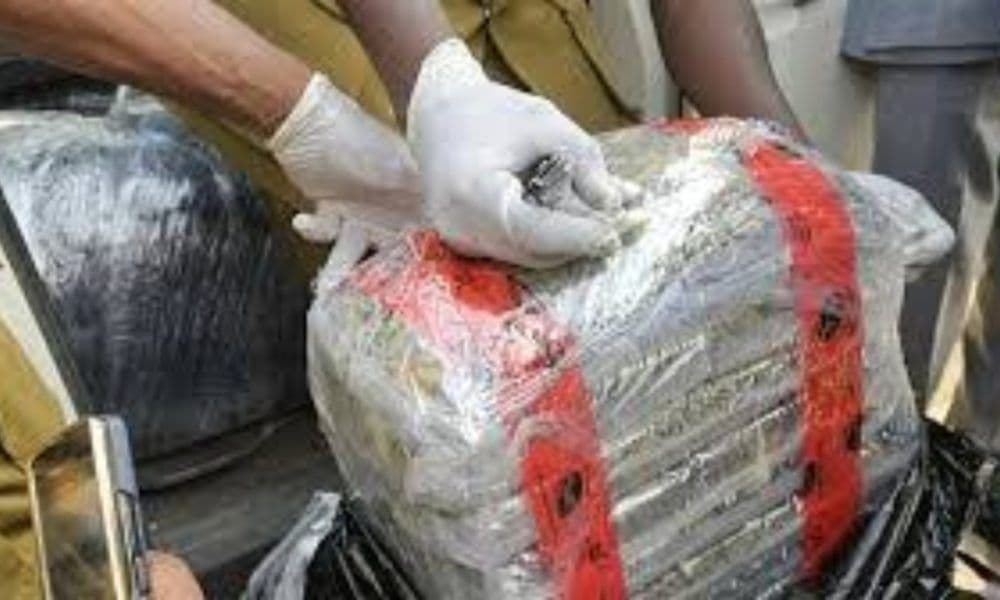
The Nigeria Customs Service seized 4,729 kilograms of cannabis at Tin-Can Island Port on Thursday. The cargo, packed into 9,450 individual parcels and concealed inside two imported vehicles, carried an estimated street value of N18.96 billion, according to officials who briefed reporters during a formal handover.
The container, identified as HAMU 429961 and shipped from Canada, had been declared as carrying used vehicles. But officers at the Tin-Can Island Command flagged it for inspection following intelligence shared with the National Drug Law Enforcement Agency. A full physical examination exposed 185 jumbo bags of cannabis hidden within a 2010 Toyota Camry and a 2023 Chevrolet.
Customs Area Controller Frank Onyeka said the decision to override the initial declaration came from what he described as “credible intelligence.” According to Onyeka’s briefing, officers conducted a 100 percent examination, a step that is not routine for all cargo given port congestion and throughput demands. The result was a discovery that, by weight and valuation, ranks among the largest single seizures reported at the Lagos port in recent months.
The numbers are specific.
A breakdown provided by the command shows 9,450 cannabis packages weighing 4,729 kilograms. Using the agency’s internal valuation metrics, officials placed the street value at N18.96 billion. That estimate reflects prevailing illicit market prices rather than wholesale cost, a distinction that matters in prosecution and asset forfeiture proceedings under Nigerian law.
The concealment relied on vehicle cavities and structural compartments to avoid detection during standard scanning. Customs officials did not specify whether non-intrusive inspection equipment flagged anomalies, or whether the intelligence tip preceded any scan irregularities. That detail remains unclear and could indicate either a gap in scanning capability or the growing sophistication of concealment tactics.
Intelligence Link: NCS–NDLEA Agreement Signed April 27, 2026
Onyeka linked the seizure directly to a cooperation agreement signed on April 27, 2026 between the Nigeria Customs Service and the National Drug Law Enforcement Agency. The agreement establishes protocols for intelligence sharing, joint operations, and coordinated enforcement guidelines. It also creates a standing inter-agency committee headquartered at the NDLEA office in Abuja.
Related News
Timing matters here.
The interception occurred days after the agreement took effect, a sequence Onyeka cited as evidence of improved coordination. But neither agency has released operational metrics to show whether intelligence-led interceptions have increased since the agreement. Without baseline data, the claim of improved efficiency remains an assertion tied to a single case.
We reviewed the operational note attached to the handover log, which records the container number, origin, and declared contents, and confirms that the inspection was triggered by external intelligence rather than routine profiling.
Port Vulnerability: Tin-Can Island and the Flow of High-Risk Cargo
Tin-Can Island Port handles a significant share of Nigeria’s imported vehicles, particularly used cars from North America. The port’s volume creates pressure on inspection regimes, where time constraints can reduce the frequency of full physical examinations. Customs relies on risk profiling, documentation checks, and scanning technology to triage containers.
The system has limits.
Drug traffickers exploit these constraints by embedding contraband within legitimate cargo categories that typically receive lower scrutiny. Used vehicles fall into that category. The concealment in this case suggests prior knowledge of inspection patterns, though officials have not disclosed whether insiders or compromised logistics chains are under investigation.
The pattern is familiar.
Previous NDLEA disclosures have pointed to similar tactics involving automotive imports, though usually at smaller scales. The 4,729-kilogram figure in this seizure indicates a higher level of coordination and financial backing, given the logistics required to source, package, and transport such volume across international routes.
Enforcement and Prosecution: What Happens Next
The seized drugs have been formally transferred to the National Drug Law Enforcement Agency, which holds statutory authority for narcotics investigation and prosecution in Nigeria. NDLEA is expected to trace the shipment’s ownership chain, identify import agents, and determine whether the consignee is linked to previous cases.
Under Nigerian law, prosecutors must establish knowledge and intent, particularly when contraband is hidden within declared goods. Documentation, communication records, and financial trails will be central to building a case. The absence of immediate arrests at the point of seizure suggests that investigators are pursuing a broader network rather than a single consignee.
Onyeka issued a warning to smugglers, stating that enforcement agencies are prepared to “detect, intercept and prosecute all forms of illicit trade.” Such statements are standard in official briefings. The measurable outcome will be whether this case results in convictions, asset seizures, or disruption of trafficking networks.
Financial Scale: N18.96 Billion and the Illicit Market
The N18.96 billion valuation provides a sense of scale, but it also raises questions about pricing assumptions. Street value estimates often vary depending on purity, distribution channels, and regional demand. Customs did not disclose the per-kilogram price used in its calculation.
We tracked comparable NDLEA case filings from 2024 and found per-kilogram valuations ranging between N3.5 million and N5 million for cannabis derivatives, depending on grade and location. Applying a mid-range figure aligns with the N18.96 billion estimate for 4,729 kilograms, suggesting the valuation is within known enforcement benchmarks.
The numbers are consistent.
The seizure involved 4,729 kilograms of cannabis hidden in two vehicles inside container HAMU 429961 from Canada.
The operation followed an April 27, 2026 intelligence-sharing agreement between the Nigeria Customs Service and NDLEA.
The estimated street value of N18.96 billion aligns with prior NDLEA valuation ranges for similar seizures.
No arrests have been announced, indicating an ongoing investigation into a wider trafficking network.
How did Customs detect the drugs?
Officials say intelligence triggered a full inspection. That means they did not rely on routine checks alone. Someone provided actionable information tied to that container.
Why hide drugs inside vehicles?
Because used cars are common imports and often receive less intrusive inspection. It is a concealment method designed to blend into high-volume cargo streams.
Will anyone be prosecuted?
Possibly, but not immediately. NDLEA needs to trace ownership and prove intent. That usually involves documents, bank records, and communication logs.
The next legal step sits with the Federal High Court in Lagos, where NDLEA typically files narcotics charges. No filing date has been announced. The unresolved question is whether prosecutors can tie the N18.96 billion shipment to a named importer or financier, and secure forfeiture orders under Nigerian drug control statutes.
Add a Comment