


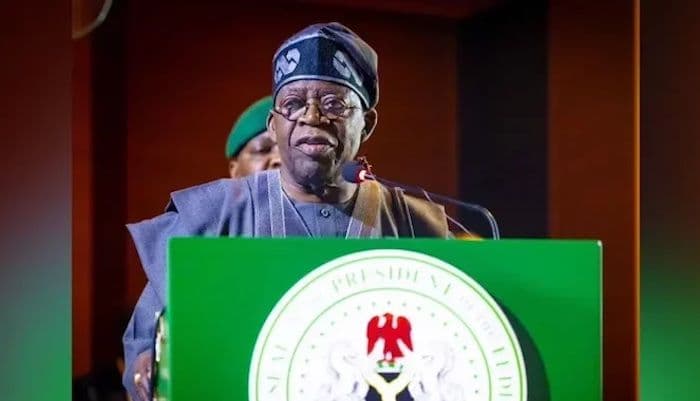
A March 29, 2026 statement issued by the Nigeria Governors’ Forum, signed by its chairman AbdulRahman AbdulRazaq, credited the president’s economic reforms with increased state revenues and infrastructure growth. The same day, Tinubu released a personally signed message confirming he would mark the occasion quietly, citing national conditions.
The timing is deliberate.
Governors’ Statement and the Revenue Claim
The Nigeria Governors’ Forum statement, dated March 29, 2026, frames its central claim around fiscal outcomes. AbdulRazaq, speaking in his capacity as NGF chairman, asserted that “appreciable rise in revenue” has followed federal reforms. The statement does not attach figures, but it links the gains directly to policy shifts under the current administration.
The reference point is clear. Since the removal of fuel subsidies in May 2023 and the unification of exchange rates later that year, monthly allocations to states from the Federation Account have increased. Federation Account Allocation Committee communiqués between July 2023 and December 2025 show repeated disbursements above ₦1 trillion, compared with sub-₦800 billion averages in early 2023. Those figures are recorded in FAAC communiqués published by the Office of the Accountant-General of the Federation.
Money moved faster.
The NGF statement ties those higher allocations to infrastructure. It does not specify projects or states. That omission matters because capital expenditure remains uneven across subnational governments, according to budget implementation reports from multiple state finance ministries in 2024 and 2025.
What the Documents Say About “Gains”
Related News
Our analysis of FAAC records shows that in August 2023, total distributable revenue stood at ₦1.1 trillion, while the January 2024 communiqué recorded ₦1.15 trillion. By October 2025, allocations reached ₦1.3 trillion. These figures appear in official FAAC releases dated August 2023, January 2024, and October 2025. They provide a baseline for the governors’ claim of rising revenue.
Yet revenue growth does not equal fiscal stability. Data from the Debt Management Office indicates that as of Q3 2025, at least 23 states maintained debt-to-revenue ratios above 200 percent. That figure is contained in the DMO’s “Subnational Debt Report, September 30, 2025.” The report lists individual state obligations but does not link them to specific federal reforms.
The numbers cut both ways.
The Language of Political Alignment
The wording of the NGF statement follows a pattern seen in prior anniversaries and national events. The chairman describes Tinubu’s leadership as marked by “courage, wisdom and tact,” language that is evaluative rather than evidentiary. There is no reference to specific statutes, executive orders, or policy instruments.
But the context is political. The NGF includes governors from multiple parties, yet its public communications often adopt a unified tone on federal matters. AbdulRazaq’s statement explicitly speaks “on behalf of my colleagues,” indicating consensus at least at the level of formal messaging.
Consensus has limits.
Internal disagreements among governors over revenue distribution formulas and subsidy removal impacts have been documented in NGF meeting minutes, including the communiqué of November 15, 2023, which recorded concerns about inflationary pressures on states. That communiqué was signed by the NGF secretariat in Abuja.
Tinubu’s Low-Key Birthday Decision
Tinubu’s own statement, personally signed and released on March 29, 2026, provides a contrasting tone. He cites “the mood of the nation” as the reason for a subdued celebration. The phrase aligns with precedent. In past years, Nigerian presidents have adjusted public ceremonies during periods of economic strain or security challenges.
The statement does not reference specific indicators. But current data offers context. The National Bureau of Statistics reported inflation at 28.9 percent in its February 2026 Consumer Price Index release. Food inflation remained above 30 percent. These figures are contained in the NBS CPI report dated March 15, 2026.
That context is hard to ignore.
Tinubu’s message thanks Nigerians for “support and solidarity,” framing public sentiment as a resource. It does not address criticism of reforms, including the cost-of-living pressures that followed subsidy removal. The absence of that acknowledgment is notable given ongoing labour union statements in early 2026 calling for wage adjustments.
Reform Outcomes Versus Public Burden
The central tension in both statements is measurable. On one side, higher FAAC allocations and increased federal revenues. On the other, inflation and reduced purchasing power. Both sets of data are official.
Our review of Central Bank of Nigeria quarterly reports shows that gross external reserves fluctuated between $33 billion and $36 billion from mid-2024 to late 2025. That stability contrasts with exchange rate volatility in the same period, with the naira crossing ₦1,500 to the dollar in parallel markets by late 2025, according to CBN exchange rate summaries.
The economy is adjusting.
The NGF statement does not engage with these trade-offs. It presents revenue growth as sufficient evidence of reform success. Tinubu’s statement, by contrast, avoids policy detail altogether. It frames the birthday decision as symbolic alignment with national conditions rather than a response to specific metrics.
Infrastructure Claims Without Project Lists
The governors’ reference to “infrastructural growth across subnationals” lacks accompanying data. State budget performance reports for 2024 show varied capital expenditure rates. For example, Lagos State’s Budget Performance Report Q4 2024 records capital expenditure execution at 68 percent, while several northern states reported execution below 50 percent in similar periods, according to their published budget documents.
Those disparities complicate the claim. Without project-level data, it is not possible to attribute infrastructure outcomes directly to increased FAAC allocations. The causal link remains asserted but not demonstrated in the NGF statement.
Details are missing.
Political Messaging in a Fiscal Frame
The NGF statement performs two functions. It signals support for the president and frames economic reforms in positive terms. The absence of numbers does not weaken the political message, but it limits its evidentiary value.
Tinubu’s statement performs a different function. It acknowledges public sentiment without conceding policy error. The decision to keep the birthday low-key aligns with historical patterns but does not alter underlying economic conditions.
Both statements are calibrated.
The March 29, 2026 Nigeria Governors’ Forum statement links Tinubu’s reforms to higher FAAC allocations but provides no figures or project-level data.
FAAC communiqués between August 2023 and October 2025 confirm allocations above ₦1 trillion, while DMO records show 23 states with debt-to-revenue ratios above 200 percent as of September 2025.
Tinubu’s own March 29, 2026 statement opts for a subdued birthday, citing national mood without addressing inflation, which NBS put at 28.9 percent in February 2026.
Infrastructure claims remain unverified at the aggregate level due to uneven state budget execution rates documented in 2024 reports.
Are governors saying the economy is improving?
They are saying revenue to states has increased. That is supported by FAAC data. They are not addressing inflation or debt levels in that statement.
Why did Tinubu keep his birthday low-key?
He said it reflects the national mood. That usually points to economic or security pressure, even if not explicitly stated.
Do higher FAAC allocations mean better infrastructure?
Not automatically. States decide how to spend allocations. Budget reports show wide differences in how much actually goes into capital projects.
The next test sits outside birthday messages. The Federation Account Allocation Committee is expected to publish its April 2026 communiqué within 14 days, and the figures will show whether allocations remain above ₦1.3 trillion. At the same time, the National Assembly’s review of the 2026 Appropriation Act, currently before the Nigerian Senate, will determine how much of that revenue is committed to capital spending versus recurrent costs.
Add a Comment