


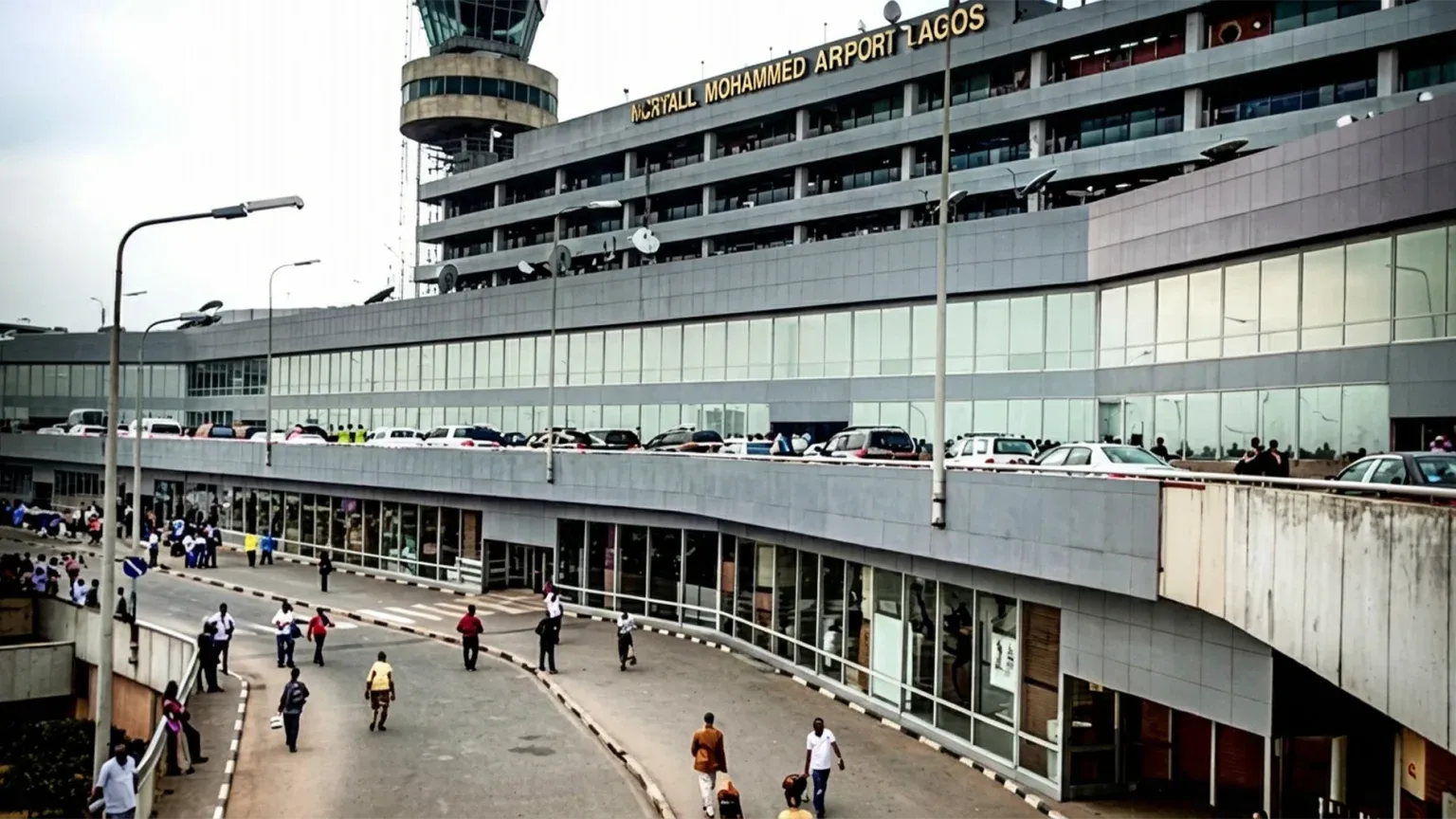
Sedan parking at Lagos’ MMA2 terminal now costs N3,500 hourly. Two months ago, the same access cost N1,300 for the first hour under Seymour Aviation Services Limited’s pricing structure.
The increase did not happen once.
Between March and April 2026, operators linked to the Murtala Muhammed Airport Terminal Two (MMA2) concession sharply revised parking charges twice, pushing some categories of users into triple-digit percentage increases. Under the latest tariff schedule, SUVs now pay N4,000 for the first hour, large buses pay N20,000, and overnight parking surged from N6,000 to N50,000.
A lost ticket attracts N25,000.
The operator, Bi-Courtney Aviation Services Limited, defended the hike as a congestion-control measure. Management argued that motorists routinely abandon vehicles for days inside the facility and that ride-hailing drivers occupy limited spaces while waiting for passengers. Company officials also cited safety concerns and the terminal’s limited capacity of roughly 800 vehicles.
That explanation leaves gaps.
The terminal operator has not publicly disclosed any independent traffic study, utilisation audit, or congestion impact assessment supporting the tariff structure. No published document from the Nigerian Civil Aviation Authority shows formal approval of the revised rates. The regulator has also not explained whether the pricing review complied with Part 19 of the Nigerian Civil Aviation Regulations, which governs consumer protection, tariffs, competition and economic oversight.
The numbers themselves are difficult to ignore.
Related News
A sedan owner entering the facility for two hours now pays N6,000 under the revised schedule. A motorist staying overnight faces a N50,000 charge, roughly equivalent to Nigeria’s monthly minimum wage benchmark of N70,000 approved in 2024. Even short pickups trigger the full first-hour charge because motorists are prohibited from collecting passengers outside the terminal perimeter.
MMA2’s road layout effectively funnels all arriving private vehicles into the paid parking structure. Unlike several international airport systems that permit brief grace periods for passenger pickup, motorists entering MMA2’s immediate access zone are billed almost instantly. BASL has not introduced a free waiting window, designated app-based transport holding areas, or differentiated short-stay pickup lanes despite citing congestion as the core problem.
The result is predictable.
Drivers seeking to avoid the new fees increasingly stop along adjoining access roads and informal pickup zones, according to transport union officials and ride-hailing operators interviewed around the airport corridor last week. Airport security personnel have repeatedly attempted to clear those areas because of traffic obstruction and safety concerns.
The financial pressure extends beyond parking.
In March 2026, the Federal Airports Authority of Nigeria raised tollgate access charges at Lagos and Abuja airports as part of a transition to a cashless payment regime. Sedan tolls rose from N300 to N500, while SUVs moved from N500 to N1,000. The rollout triggered long queues and payment failures before President Bola Tinubu ordered intervention after public backlash.
The cashless rollout struggled immediately.
FAAN later adjusted operational procedures after motorists complained of stalled gates, failed transactions and inadequate staffing. Internal aviation sector memoranda reviewed by transport unions at the time described severe traffic backups during peak travel periods at both Lagos and Abuja airports.
But FAAN’s increase now looks modest beside MMA2’s revisions.
Our analysis of the April 2026 BASL tariff sheet shows overnight parking increased by approximately 733 per cent within weeks. The first-hour sedan charge rose by roughly 169 per cent compared with the earlier March pricing schedule. No publicly available inflation benchmark or operational cost index supports increases at that scale over a one-month period.
The operator argues demand justifies the pricing.
That argument runs into another problem. MMA2’s parking shortage was not unforeseen. Passenger traffic at Lagos airports has expanded steadily over the past decade, according to Nigerian Civil Aviation Authority annual traffic reports. MMA2 itself handles a substantial portion of domestic traffic linked to carriers including Ibom Air and Air Peace.
The infrastructure did not expand at the same pace.
Airport planning experts familiar with concession agreements say modern terminal design typically anticipates scalable vehicle holding areas, pickup zones and overflow systems. Yet MMA2’s multi-storey structure was inserted into a spatially constrained terminal environment with limited surrounding circulation space. Congestion was therefore not a temporary anomaly. It was a foreseeable operational pressure.
Passengers are now paying for that limitation.
The broader cost structure inside Nigerian aviation already ranks among the continent’s highest. The International Air Transport Association has repeatedly identified Nigeria as one of Africa’s most expensive operating environments because of taxes, jet fuel costs, foreign exchange constraints and airport-related charges. Industry groups estimate that airlines operating in Nigeria face more than 30 separate taxes and levies tied to passenger tickets and airport operations.
Consumers absorb most of it.
Domestic ticket prices have climbed sharply since the naira devaluation and fuel price increases that followed subsidy removal in 2023. Data from the National Bureau of Statistics showed air transport inflation rising consistently through 2025 as operators passed operating costs directly to passengers.
Parking now joins that burden.
The regulatory silence surrounding the MMA2 increase may prove as consequential as the tariffs themselves. Under Part 19 of the Nigerian Civil Aviation Regulations, NCAA retains authority over economic oversight and consumer protection within the aviation sector. That includes ensuring charges imposed on users are fair, transparent and not exploitative.
Yet enforcement has been uneven.
The Federal Competition and Consumer Protection Commission has increasingly intervened in disputes that ordinarily fall within aviation oversight structures. During the 2025 yuletide travel season, the FCCPC publicly challenged airline fare practices after complaints over sharp ticket price spikes and passenger exploitation.
That overlap reflects institutional weakness.
NCAA has rarely exercised visible enforcement authority against airport concessionaires over access pricing, terminal service quality or passenger cost escalation. Aviation lawyers contacted for this report pointed to a broader regulatory dilemma inside Nigeria’s concession framework, where private operators manage public infrastructure while government agencies struggle to balance investment incentives against consumer protection obligations.
The political optics are worsening.
President Tinubu’s administration continues to defend painful economic reforms as necessary for fiscal recovery and infrastructure development. But airport access charges now increasingly function as an additional consumption tax imposed through concession arrangements rather than legislation. The distinction matters little to passengers already navigating inflation above 30 per cent and declining purchasing power.
The airport remains unavoidable.
Lagos airport functions as Nigeria’s primary domestic and international aviation gateway. Business travellers, tourists, logistics operators and diaspora visitors pass through facilities where even a brief passenger pickup now carries a mandatory N3,500 parking exposure at MMA2.
Bi-Courtney Aviation Services Limited raised some MMA2 parking charges by more than 700 per cent within weeks without publicly releasing a congestion study or pricing justification.
The Nigerian Civil Aviation Authority has not publicly explained whether it approved the revised tariff structure under Part 19 economic regulations.
MMA2 motorists cannot legally pick up passengers outside the terminal area, which means even brief stops now trigger the minimum N3,500 charge.
Federal Competition and Consumer Protection Commission is increasingly stepping into aviation pricing disputes that sector regulators have struggled to address themselves.
Can BASL legally raise parking fees like this?
Probably, under concession and operational agreements. But NCAA regulations still require oversight on fairness and consumer impact. The unanswered question is whether that review actually happened.
Why not just avoid the car park?
At MMA2, motorists are largely forced into it. Passenger pickup outside the terminal perimeter is restricted, and even a very short stop triggers the first-hour fee.
Is this only happening at MMA2?
No. FAAN also raised toll and parking charges at Lagos and Abuja airports in 2026. But MMA2’s increases are far steeper than what federal airport operators imposed.
The next unresolved dispute may land before regulators or the courts. Consumer advocates and aviation lawyers are already questioning whether NCAA properly exercised its oversight powers under Part 19 of the Nigerian Civil Aviation Regulations before BASL implemented tariffs that now reach N50,000 for overnight parking. No formal regulatory determination has yet been published, and no deadline for review has been disclosed.
Add a Comment