


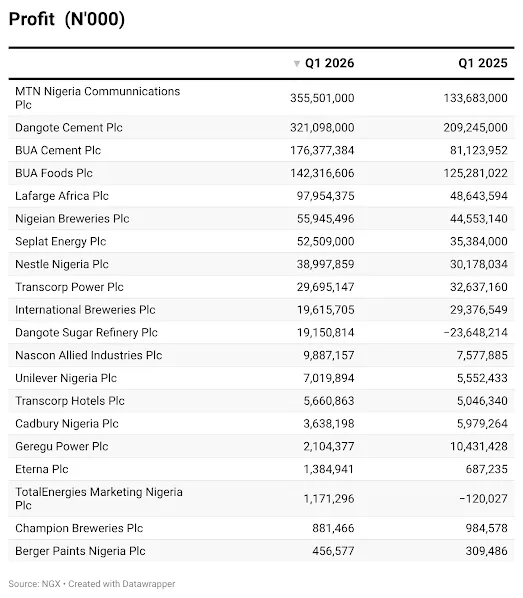
Twenty companies listed on the Nigerian Exchange Limited (NGX) generated N6.61 trillion in revenue during the first quarter of 2026, according to reviewed corporate earnings filed for the period ending March 31.
That was N710 billion higher than the N5.9 trillion reported in the corresponding quarter of 2025. Combined profit rose faster, climbing 71.3 per cent to N1.3 trillion from N782.91 billion.
The improvement came during a quarter when inflation data eased, the naira strengthened and the Central Bank of Nigeria slightly reduced benchmark interest rates.
But households still paid more.
The companies span telecommunications, cement manufacturing, petroleum marketing, electricity generation and brewing. Their earnings reports point to a common trend across sectors. Higher operating costs linked to fuel prices, foreign exchange volatility and logistics were transferred to consumers through price increases that began in 2025 and continued into early 2026.
The result was visible in topline growth.
Nigeria’s headline inflation rate slowed to 15.38 per cent in March 2026 from 27.35 per cent recorded in March 2025, according to data released by the National Bureau of Statistics. The decline followed a rebasing exercise that shifted the Consumer Price Index base year from 2009 to 2024.
That statistical adjustment changed the optics.
Related News
The rebasing reflected updated spending patterns and introduced a 12 month averaging methodology that reduced some of the sharp distortions created by earlier inflation spikes. Economists contacted by financial publications and investment firms have cautioned that the lower figure does not necessarily mean Nigerians are spending less on food, transport or electricity than they were a year ago.
Market prices suggest otherwise.
MTN Nigeria Posted N355 Billion Profit After Currency Pressures Eased
MTN Nigeria reported N1.5 trillion in revenue during Q1 2026, up 41.56 per cent from N1.06 trillion in the same period of 2025. Profit after tax climbed to N355.5 billion from N133.68 billion.
The earnings marked a reversal from earlier periods dominated by foreign exchange losses after the naira devaluation cycle of 2023 and 2024. By March 2026, the naira had strengthened to N1,387 against the dollar compared with N1,538.26 in March 2025.
The exchange rate mattered immediately.
Chief Executive Officer Karl Toriola said geopolitical tensions and rising energy prices continued to pressure operating costs. Yet the company stated that a relatively stronger naira softened part of that burden.
MTN also increased investment in network infrastructure during the quarter. The company linked those investments to higher service revenue and EBITDA margin performance, according to its Q1 filing submitted to the NGX.
Subscribers ultimately carried part of the cost.
Telecommunications firms adjusted tariffs and data pricing structures during the wider inflation cycle. Consumer advocacy groups previously warned that rising digital access costs would hit low income users hardest, particularly students and small businesses dependent on mobile internet.
The revenue growth reflected those adjustments.
Dangote Cement and Seplat Energy Showed Diverging Results
Dangote Cement posted N1.198 trillion in revenue for Q1 2026, representing a 20.4 per cent increase from N994.66 billion reported in the corresponding quarter of 2025.
Cement manufacturers continued benefiting from strong construction demand and sustained price increases across building materials markets. Retail cement prices remained elevated in Lagos, Abuja and Port Harcourt despite moderation in official inflation figures.
Construction firms noticed the disconnect.
Developers and contractors interviewed by industry groups throughout 2025 repeatedly linked rising cement prices to transportation costs, diesel expenses and exchange rate volatility affecting imported industrial inputs.
The margins held anyway.
Seplat Energy moved in the opposite direction. The company declared N1.16 trillion in Q1 2026 revenue, a 5.2 per cent decline from N1.23 trillion reported a year earlier.
That drop stood out because global oil prices remained relatively stable during much of the quarter. Company disclosures pointed instead to production and operational factors affecting output levels.
Oil producers face different constraints.
Unlike telecommunications operators or manufacturers that can revise consumer pricing frequently, upstream energy companies operate within export contracts, production quotas and regulatory structures that limit pricing flexibility.
CBN Policies Stabilised the Naira but Borrowing Costs Stayed High
The Central Bank of Nigeria reduced the Monetary Policy Rate to 26.5 per cent in March 2026 from 27.5 per cent a year earlier. The apex bank also adjusted the asymmetric corridor around the MPR and maintained aggressive liquidity management measures.
The policy direction reflected a shift.
After the naira weakened to around N1,602 against the dollar in April 2025, the currency recovered steadily from May onward. Foreign exchange reforms, tighter monetary conditions and improved inflows contributed to the rebound, according to market analysts and CBN statements.
But financing costs stayed elevated.
Commercial lending rates remained high across multiple sectors despite the marginal reduction in benchmark rates. Manufacturers and medium sized businesses continued reporting difficulty accessing affordable credit for expansion and inventory financing.
Our analysis of 20 quarterly filings found at least seven companies recorded substantial finance cost pressures despite stronger revenues. Several firms also reduced or delayed dividend expectations as cash preservation became a priority.
Shareholders noticed the restraint.
Consumers Funded Part of the Earnings Recovery
Investment banker and stockbroker Tajudeen Olayinka linked the revenue growth directly to increased fuel and diesel prices.
“There was an increase in the price of petrol and diesel and these companies passed the cost effect to customers,” Olayinka said.
That explanation aligns with broader pricing trends across consumer sectors during 2025 and early 2026. Transport fares increased nationwide after subsidy removal. Food distributors raised prices because of logistics costs. Manufacturers revised pricing structures repeatedly to offset exchange rate losses and imported input expenses.
Consumers absorbed the adjustments gradually.
Corporate earnings improved partly because companies protected margins aggressively while household purchasing power weakened. The contradiction appeared repeatedly across quarterly filings. Revenue rose in nominal terms even where sales volumes slowed or remained flat.
The distinction matters for investors.
Analysts tracking NGX performance have increasingly focused on operating cash flow, debt exposure and foreign exchange liabilities rather than topline growth alone. Higher revenue in an inflationary environment does not automatically translate into stronger real earnings or sustainable consumer demand.
MTN Nigeria, Dangote Cement and Seplat Energy generated more than N3.8 trillion combined revenue during Q1 2026, dominating earnings across the reviewed NGX companies.
The drop in headline inflation followed a rebasing exercise by the National Bureau of Statistics, not a sudden fall in living costs.
Several companies protected profits by transferring higher fuel, logistics and financing costs directly to consumers.
The naira strengthened against the dollar during the quarter, but borrowing costs for businesses remained high despite the CBN rate adjustment.
Why did profits rise faster than revenue?
Because many firms controlled costs more aggressively while increasing prices. Currency stability also reduced some foreign exchange losses that damaged earlier earnings.
Did inflation really fall to 15.38 per cent?
Officially, yes. The NBS rebased the inflation index using a newer base year. Consumers still faced high food and transport prices despite the lower reported figure.
Why is Seplat’s revenue falling while other firms grew?
Seplat operates in upstream oil production, where revenue depends heavily on output levels and export conditions. Telecom and manufacturing companies can adjust local prices more quickly.
Attention is now shifting to second quarter disclosures and monetary policy decisions expected before the next earnings cycle closes. Investors are watching whether the Federal High Court cases challenging aspects of foreign exchange reforms and outstanding energy sector obligations could affect balance sheets later in 2026, particularly among firms carrying significant dollar denominated liabilities still under renegotiation.
Add a Comment