


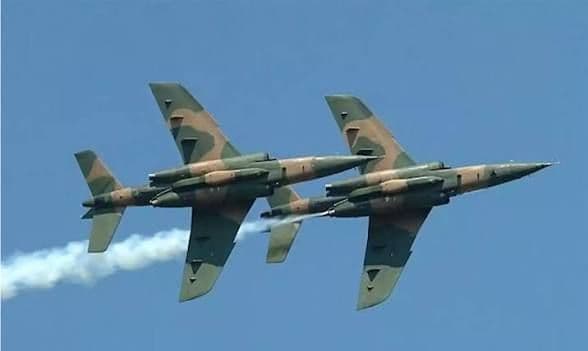
The Nigerian military said May 10 operations killed several terrorists in Tumfa Village, located in Shinkafi Local Government Area, after troops and air assets targeted armed groups hiding near a stream channel under dense vegetation.
The announcement came through a statement issued by Lieutenant Colonel Aliyu Danja, who said troops under Operation FANSAN YAMMA carried out a coordinated air-land offensive on May 10, 2026. According to the statement, troops advanced on suspected militant positions concealed beneath “thick mango trees along a stream channel” in Tumfa Village.
The military did not release casualty figures.
Security briefings from northwestern Nigeria frequently describe militants as “neutralized” without publishing names, bodies recovered, independent verification, or the number of civilians displaced during combat operations. In this case, the statement distributed by Operation FANSAN YAMMA identified neither the armed faction involved nor the specific air platform deployed during the assault.
The operation took place in a region that has become central to Nigeria’s rural insurgency problem. Zamfara State has experienced years of attacks involving mass kidnappings, village raids, cattle rustling, and extortion networks operating across forest corridors linking Zamfara, Sokoto, Katsina, and parts of Niger State. Nigerian authorities classify many of the armed groups as terrorists following federal court designations issued in Abuja in 2021.
Military officials have increasingly relied on combined aerial surveillance and rapid ground assaults to target camps hidden inside wooded areas and riverine corridors. Analysts at the Institute for Security Studies have repeatedly noted that armed groups in northwestern Nigeria favor natural concealment zones, especially tree cover and seasonal water channels, because they complicate aerial visibility and troop movement.
Danja’s statement offered unusually specific terrain details compared with prior military updates. The reference to stream-channel cover and mango-tree concealment suggests troops were acting on either aerial reconnaissance imagery or local human intelligence. Yet the military statement did not disclose whether arrests were made, whether weapons were recovered, or whether follow-up clearing operations continued after the strike.
Our analysis of Nigerian military communiqués issued since early 2024 shows a recurring pattern in northwestern operations: initial announcements emphasize successful “clearance” actions, while later updates rarely document whether targeted camps were permanently dismantled or reoccupied weeks later. That gap complicates external verification of long-term territorial control in rural districts.
Related News
Residents in parts of Shinkafi have previously reported cycles in which armed groups retreat temporarily after air raids and later return once troop presence declines. Human rights monitors, including Amnesty International, have documented cases where civilians fled farming communities after nearby bombardments or retaliatory attacks by militants accusing villagers of sharing intelligence with security forces.
The military statement did not mention civilian casualties.
That silence is significant.
Nigeria’s Air Force has faced scrutiny in previous operations after reports of mistaken strikes in conflict regions, including incidents in Kaduna, Niger, and other northern states. Military authorities have defended the broader use of air power as necessary against heavily armed groups operating across inaccessible terrain. Yet independent casualty verification mechanisms remain limited in many rural areas affected by counterinsurgency campaigns.
Operation FANSAN YAMMA itself represents part of the federal government’s attempt to consolidate fragmented security deployments in the northwest. The operation combines Army, Air Force, intelligence, and auxiliary units under a joint-task-force framework intended to improve coordination after years of criticism about slow response times and isolated deployments.
Coordination problems have persisted.
Data compiled by the Armed Conflict Location and Event Data Project has shown continued insecurity across northwestern Nigeria despite repeated military offensives. Attacks on villages, abductions along highways, and raids on farming communities continued through 2025 and into 2026, particularly in remote forest-border areas where state presence remains thin.
Military officials argue that sustained offensives have disrupted logistics networks and forced armed groups into smaller formations. But researchers tracking violence patterns say tactical victories do not automatically translate into restored civilian governance. In several local government areas across Zamfara and neighboring states, schools, markets, and primary healthcare centers have struggled to resume normal operations because of recurring insecurity.
The National Bureau of Statistics has previously linked insecurity in northern agricultural zones to disruptions in food supply chains and internal displacement. Zamfara’s farming communities, especially those dependent on seasonal cultivation near forest belts, have repeatedly faced interruptions caused by raids and military restrictions on movement.
The military has not yet released photographic evidence from the Tumfa operation. No independent monitoring group has publicly confirmed casualty figures or identified the armed faction allegedly targeted in the assault.
The Nigerian military says troops under Operation FANSAN YAMMA killed several terrorists during a May 10 operation in Tumfa Village, but it released no casualty figures or identities.
The operation targeted militants reportedly hiding near a stream channel beneath dense tree cover in Shinkafi Local Government Area.
Independent verification remains limited because authorities have not published evidence, weapons recoveries, or post-operation assessments.
Security analysts say repeated offensives in Zamfara have disrupted armed groups temporarily, but many rural areas still lack stable civilian control.
Why is the military withholding casualty numbers?
Military statements in northwest Nigeria often avoid exact figures until internal assessments are complete. Sometimes numbers are never released publicly. Officials argue premature figures can be inaccurate during ongoing operations.
What is Operation FANSAN YAMMA?
It is a joint military task force operating across northwestern Nigeria. It combines Army, Air Force, and intelligence units to target armed groups involved in kidnappings, raids, and extortion activities.
Can independent groups verify this operation?
Not easily. Rural parts of Zamfara are difficult for journalists and monitors to access safely. Verification usually depends on local testimony, satellite imagery, hospital records, or later security assessments.
The next test for Nigerian authorities may come after the immediate battlefield claims fade. No court filing or public procurement record has yet clarified how much funding remains allocated for sustained northwest air operations through the second half of 2026, while communities in Zamfara State continue waiting for permanent security deployments capable of holding territory after raids conclude.
Add a Comment