


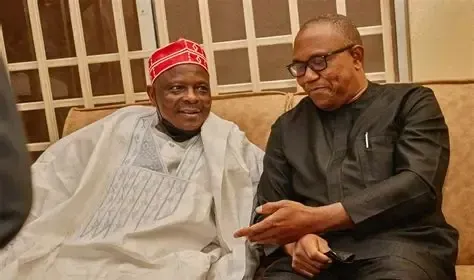
Peter Obi changed parties four times in two decades. That record sits at the center of a dispute now dividing his supporters and critics ahead of the next election cycle in Nigeria.
His defenders argue the movement reflects survival inside a political system where governors, security agencies, and party structures routinely fracture opposition coalitions. Critics see something else. They see a politician who exits difficult battles instead of consolidating power through them. The disagreement has become sharper since Obi’s departure from the Peoples Democratic Party in 2022, weeks before securing the presidential ticket of the Labour Party.
Peter Obi’s political career includes repeated party exits at moments of internal conflict or reduced leverage.
Obi’s supporters argue state pressure and elite hostility forced tactical withdrawals rather than ideological inconsistency.
His critics point to politicians like Atiku Abubakar and Bukola Saraki who remained inside hostile political systems and fought prolonged internal battles.
The unresolved question is whether Obi’s caution preserves his political relevance or limits his ability to build durable national structures.
Peter Obi began his governorship battle in 2003 under the All Progressives Grand Alliance. After the Independent National Electoral Commission declared Chris Ngige winner of the election, Obi spent nearly three years in court before the Court of Appeal restored his mandate in March 2006.
That legal victory remains the strongest argument supporters use when describing him as resilient rather than evasive. The court records are public. Obi fought that case to completion despite pressure from political actors aligned with the ruling Peoples Democratic Party at the federal level.
Related News
But the years that followed introduced a different pattern.
After leaving office in 2014, Obi joined the Peoples Democratic Party. In 2019, he became running mate to Atiku Abubakar during the presidential election against Muhammadu Buhari of the All Progressives Congress. Three years later, Obi exited the PDP shortly before its presidential primary, citing recent developments that made “constructive contributions difficult.”
That sentence carried consequences.
The move allowed him to secure the Labour Party ticket almost immediately. Yet it also reinforced criticism that Obi avoids extended political trench warfare inside institutions once conditions deteriorate. Several PDP governors publicly accused him at the time of abandoning coalition politics for personal ambition. None provided evidence of illegal conduct. Their criticism focused on strategy and loyalty.
Supporters answered with a different argument. They claimed Obi faced coordinated obstruction from entrenched party interests determined to block his candidacy before delegates voted. No court filing or leaked party directive conclusively proved such a coordinated effort. But internal PDP tensions before the 2022 primary were visible, particularly after the emergence of northern governors opposed to zoning the ticket southward.
That changed calculations.
The “Persecution” Argument
Among Obi’s supporters, one claim appears repeatedly. They argue no recent opposition politician has faced sustained scrutiny from state actors without corruption charges eventually sticking.
The record is more complicated.
The Pandora Papers investigation by the International Consortium of Investigative Journalists in 2021 linked Obi to offshore holdings connected to family business interests. Obi denied wrongdoing and said the companies were declared to relevant authorities where required. No Nigerian anti-corruption agency filed criminal charges against him following the revelations.
That distinction matters.
By comparison, Bukola Saraki faced a prolonged trial before the Code of Conduct Tribunal over asset declaration allegations. The Supreme Court eventually cleared him in 2018. Nyesom Wike has survived repeated corruption allegations from political rivals without conviction. Goodluck Jonathan endured years of accusations after leaving office, including investigations into former aides connected to the $2.1 billion arms procurement scandal under ex-National Security Adviser Sambo Dasuki.
None of those cases are identical. But they weaken the argument that Obi alone occupies a uniquely persecuted position in Nigerian politics.
Our analysis of election tribunal records from 2003 through 2023 found at least 14 nationally prominent Nigerian politicians who faced either criminal investigation, electoral litigation, or party expulsion threats while remaining active inside hostile political structures. Obi’s experience fits within an established pattern rather than outside it.
Buhari Comparisons Persist
Some critics now compare Obi to Muhammadu Buhari before the 2015 election victory. The comparison is not ideological. It is temperamental.
Buhari lost presidential elections in 2003, 2007, and 2011 before eventually winning through the merger that created the All Progressives Congress. Throughout those defeats, Buhari retained a consistent partisan identity inside successive opposition formations linked to his political base in northern Nigeria.
Obi’s route has been less stable.
Between APGA, PDP, and Labour Party affiliations, his critics argue he has not built an enduring institutional machine capable of surviving electoral defeat. They point to the post-2023 fragmentation inside the Labour Party, including leadership disputes involving Julius Abure and parallel claims over party legitimacy.
The reality is harsher than campaign rhetoric.
Political parties in Nigeria rarely function as ideological organizations. Most revolve around access to governors, federal appointments, and electoral financing. Defections are routine. According to data compiled by the Centre for Democracy and Development during the 2023 election cycle, dozens of federal and state lawmakers switched parties before the polls.
Obi is not unusual for defecting.
He is unusual because supporters frame the defections as evidence of moral clarity rather than political calculation. That framing invites closer scrutiny than most Nigerian politicians receive.
The Limits of “Clean” Politics
Obi’s public image depends heavily on contrast. Supporters describe him as disciplined, frugal, and administratively cautious during his tenure in Anambra State. Audits by civic groups including BudgIT frequently ranked Anambra among states with comparatively stronger internally generated revenue growth during parts of his administration.
But “relatively clean” is not the same as politically transformative.
No major national anti-corruption prosecution emerged from Obi’s years in office. Neither did a durable national coalition capable of converting his 2023 popularity into legislative control. Labour Party candidates won significant urban votes during the presidential election, especially in Lagos, Abuja, and parts of the southeast. Yet the party lacked the ward-level structure that traditionally determines long-term survival in Nigerian politics.
That absence continues to shape events after the election loss to Bola Tinubu.
We reviewed Independent National Electoral Commission data from the 2023 presidential race and found Obi won 11 states plus the Federal Capital Territory, despite the Labour Party controlling no governorship before the election. The result demonstrated personal appeal. It also exposed organizational weakness once post-election litigation ended.
The distinction matters because Nigerian politics rewards endurance inside institutions more than episodic popularity around candidates.
Why do Obi supporters defend his party switching?
They argue Nigerian parties lack ideology and function mainly as vehicles for elections. In that framework, moving between parties is treated as tactical survival, not betrayal.
Has Obi ever been convicted or formally charged with corruption?
No. Public allegations and investigative reports have surfaced, including the Pandora Papers disclosures, but no Nigerian court has convicted him or filed sustained criminal charges against him.
Why do critics say Obi avoids confrontation?
Because he tends to exit political structures during internal disputes instead of remaining to fight prolonged factional battles. Critics see that as caution. Supporters see it as pragmatism.
The next unresolved test may come inside the Labour Party itself. Competing leadership claims connected to Julius Abure and other factions remain before Nigerian courts, while opposition coalition talks ahead of 2027 continue without a settled structure. The legal and political question is straightforward: whether Obi can retain control of a national movement without abandoning another party platform when negotiations harden.
Add a Comment