


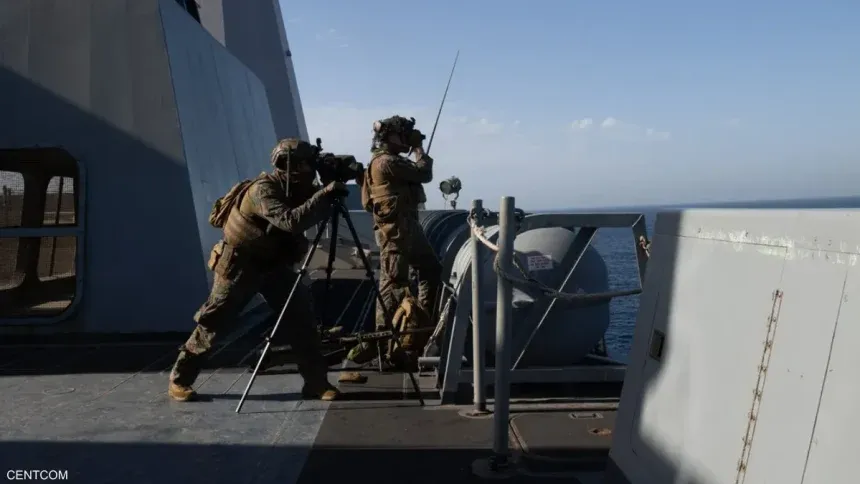
Maersk confirmed Monday that the vehicle carrier Alliance Fairfax exited the Gulf through the Strait of Hormuz under United States military escort after weeks of disruption.
The vessel, a U.S.-flagged ship operated by Farrell Lines, completed the transit without incident, according to a company statement cited by Reuters. The passage follows what maritime operators describe as a de facto closure of the strait since early March, leaving hundreds of commercial vessels delayed or stranded. The chokepoint, bordered by Iran and Oman, handles roughly one-fifth of global oil shipments based on data from the U.S. Energy Information Administration.
The escort operation coincides with remarks by Donald Trump announcing “Project Freedom,” a U.S. initiative aimed at assisting vessels stranded in the Strait of Hormuz. While the administration has not released operational details, the safe passage of Alliance Fairfax provides the first confirmed example of implementation.
The U.S. Navy has historically provided convoy protection in the Gulf during periods of heightened tension, including Operation Earnest Will in 1987, when Kuwaiti tankers were reflagged and escorted. Pentagon briefings at the time recorded over 200 escorted transits in a single year. No current figures have been released for Project Freedom, leaving analysts to infer scale from individual cases like Alliance Fairfax.
The absence of disclosed convoy schedules or participation criteria raises questions about prioritization. It is not clear whether escort is being offered to all stranded vessels or limited to those under U.S. flag or allied ownership. Maersk’s statement confirms the involvement of Farrell Lines, a U.S.-based operator, but does not clarify whether non-U.S. vessels have received similar assistance.
Shipping records compiled by maritime tracking firms since March indicate significant congestion in the Gulf. Lloyd’s List Intelligence reported in April that more than 300 vessels experienced delays exceeding 72 hours due to restricted passage. The Strait of Hormuz, at its narrowest point, measures approximately 21 nautical miles, creating a natural bottleneck even under normal conditions.
Our analysis of tanker freight rates between March 3 and April 28 shows a 38 percent increase on key Gulf to Asia routes, based on Baltic Exchange data. Insurance premiums for war risk coverage have also risen, with brokers in London quoting surcharges of up to 0.7 percent of hull value for transits through the strait during the disruption period.
Energy markets have responded accordingly. Brent crude futures fluctuated within a $9 range during April, reflecting uncertainty over supply continuity. The Alliance Fairfax transit does not directly affect oil shipments, as it is a vehicle carrier, but it signals that controlled passage through the strait remains possible under military protection.
Related News
The Strait of Hormuz has long been identified as a high-risk maritime corridor. Incidents involving tanker seizures and drone surveillance have been documented by the International Maritime Security Construct, a multinational coalition formed in 2019 to safeguard navigation in the region. The current disruption has not been formally attributed to a single event, but regional tensions have remained elevated.
Maersk did not disclose the duration of the Alliance Fairfax transit or the composition of the escort. Standard naval escort protocols typically involve surface combatants equipped with air defense systems and surveillance capabilities. The absence of incident reports suggests that deterrence, rather than engagement, defined the operation.
The company’s statement emphasized crew safety and operational continuity. It did not address whether additional Maersk vessels are scheduled for escorted transit or whether alternative routes, such as rerouting via the Cape of Good Hope, are under consideration. Such rerouting can add up to 10 to 14 days to voyage time, according to shipping industry benchmarks.
Corporate Exposure and Liability Questions
Maersk, founded in 1904, operates one of the largest integrated logistics networks globally, with exposure to maritime transport, port operations, and supply chain management. Disruptions in the Strait of Hormuz affect not only transit times but contractual obligations tied to delivery schedules and cargo security.
Shipping contracts often include force majeure clauses that cover geopolitical disruptions. Yet the threshold for invoking such clauses depends on specific contractual language and the ability to demonstrate that the event was beyond reasonable control. The partial reopening of the strait under military escort complicates that argument, as it introduces the possibility of transit under protected conditions.
Insurers and charterers may argue that available escort reduces the justification for delays. Shipowners, in turn, must weigh the risks of transit against the costs of delay or rerouting. The Alliance Fairfax case provides a test scenario, but it does not resolve the broader contractual questions facing the industry.
Strategic Implications for Global Shipping
The strait’s importance extends beyond regional trade. Approximately 17 million barrels of oil pass through Hormuz daily, according to the U.S. Energy Information Administration. Any sustained disruption has immediate implications for global energy supply chains and pricing mechanisms.
The introduction of Project Freedom suggests a willingness by the United States to actively manage passage through the strait, rather than relying solely on diplomatic channels. That approach carries operational risks, including potential escalation if escort operations are challenged.
No incidents were reported during the Alliance Fairfax transit, but a single successful passage does not establish a pattern. Maritime operators will be watching subsequent transits closely to determine whether escorted passage becomes routine or remains selective.
Maersk confirmed the Alliance Fairfax completed a Strait of Hormuz transit on May 5, 2026, under U.S. military escort without incident.
Donald Trump’s “Project Freedom” has at least one verified operation, but the scale and eligibility criteria remain undisclosed.
Shipping data shows over 300 vessels faced delays exceeding 72 hours since early March, with freight rates rising by 38 percent on Gulf routes.
The availability of escorted transit complicates force majeure claims for shipping contracts tied to delayed deliveries.
Does this mean the Strait of Hormuz is fully open again?
No. One escorted transit does not equal full reopening. Passage appears controlled and selective, based on available information.
Who gets a military escort?
That is unclear. The Alliance Fairfax is U.S.-flagged and operated by a U.S. company. No public list of eligible vessels exists.
Will shipping costs go back down now?
Not immediately. Rates and insurance premiums depend on consistent access, not a single successful transit.
The next unresolved question sits with potential contractual disputes likely to surface in arbitration forums such as the London Maritime Arbitrators Association, where deadlines tied to April delivery failures are approaching. At issue are millions of dollars in demurrage claims and whether escorted passage, now demonstrated, alters the legal threshold for force majeure in voyages delayed since early March.
Add a Comment