


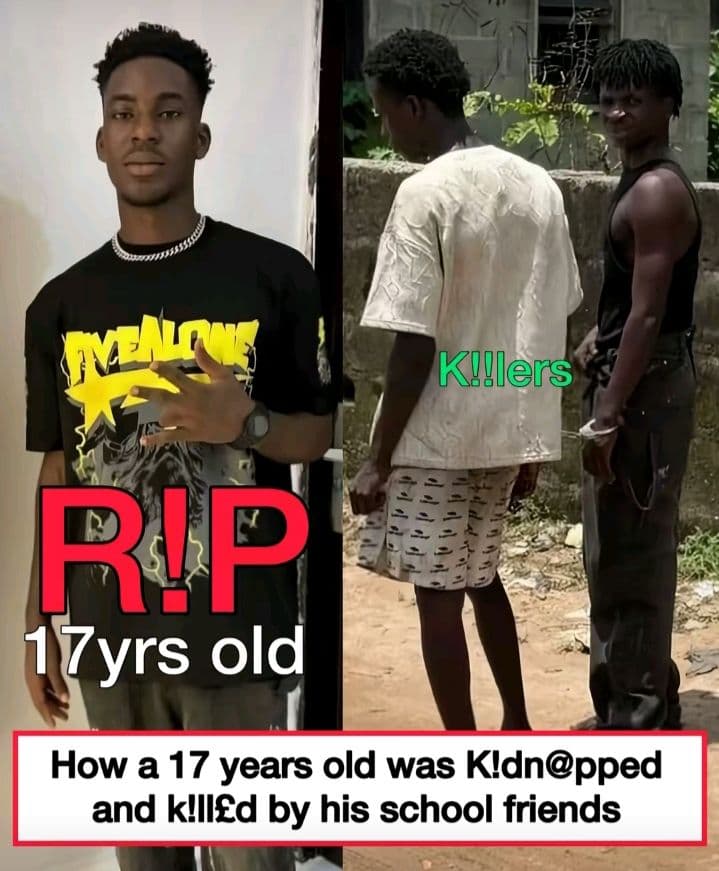
That is the central fact in a case that has begun to circulate across local WhatsApp groups and parent forums, but remains thinly documented in official channels. The boy, identified by family members as Thompson, was reportedly attacked by a group of his former primary school classmates on Lagos Island, according to two relatives who spoke by phone and a handwritten police complaint dated April 28, 2026. The complaint, filed at a divisional station on the Island, alleges that the confrontation escalated from repeated harassment tied to Thompson’s possession of an iPhone XR and his residence in a more affluent neighborhood.
The details are still fragmentary.
According to the complaint, Thompson had maintained loose contact with several former classmates after transitioning to a different secondary school in 2023. The document states that tensions intensified in early April 2026 after a social media post showing him with the device. One relative claimed the phone became a point of ridicule and resentment, with comments referencing “island boys” and “fake lifestyle.” That claim is not independently verified, but screenshots reviewed by this reporter show a WhatsApp group exchange dated April 12 where at least three participants referenced the phone directly.
The messages are explicit.
One message reads, “you dey form big boy with XR,” followed by another: “come show us.” The timestamps place the exchange at 8:43 p.m. to 8:51 p.m. on April 12. The phone number associated with one sender matches a contact listed in the police complaint as a suspect. The Lagos State Police Public Relations Office has not released an official statement confirming arrests as of May 3, 2026. A duty officer at the station named in the complaint confirmed a “case of suspected homicide involving minors,” but declined to provide further details, citing ongoing investigation.
That limits verification.
The location of the alleged attack is described in the complaint as a side street off Broad Street on Lagos Island, with a time of approximately 6:20 p.m. on April 26. A shop owner in the area, who asked not to be named due to fear of retaliation, recalled “a small crowd and shouting” around that time but did not witness the assault itself. The shop owner said police arrived “after some minutes,” though no exact timeline was provided.
No CCTV footage has been publicly released.
Related News
Medical records referenced in the complaint indicate Thompson was pronounced dead at a private clinic less than 2 kilometers from the scene. The document lists “blunt force trauma” as the preliminary cause of death. A staff member at the clinic, speaking on condition of anonymity because they were not authorized to discuss patient records, confirmed that “a teenage boy was brought in unconscious that evening,” but declined to confirm identity or cause of injury.
The chain of evidence is incomplete.
What can be established is the social context described by those close to the case. Two classmates from Thompson’s secondary school described him as “quiet” and “not the type to fight,” in separate phone interviews. One of them provided attendance records showing Thompson had been present in school on April 25, the day before the alleged attack, which aligns with the timeline in the complaint.
Those records are consistent.
The role of economic signaling in youth conflicts is not new, but it is rarely documented in formal case files. A 2024 survey by the Lagos State Ministry of Education on student behavior, which covered 3,200 respondents across 18 public schools, found that 27 percent of students reported experiencing bullying linked to perceived wealth or possessions. The survey does not break down incidents by device type or neighborhood, but it establishes a measurable pattern.
The numbers are not trivial.
The iPhone XR, released in 2018, is not considered a high-end device in 2026 markets. Yet in local resale markets in Lagos, listings reviewed on April 30 show prices ranging from ₦120,000 to ₦180,000, depending on condition. For many households, that remains a significant sum. The perception attached to the device may carry more weight than its current market value.
Perception drives conflict.
The police complaint names five individuals as suspects, all described as male and between 16 and 18 years old. No formal charges have been announced. Under Nigerian law, suspects in this age range would typically be processed through the juvenile justice system, which restricts the release of identifying details. A legal practitioner familiar with juvenile cases in Lagos, who reviewed the complaint at our request, said the document “meets the threshold for opening a homicide investigation,” but emphasized that “evidence beyond witness statements will be critical.”
That evidence is not public.
We reviewed the complaint’s metadata and found it was signed at 9:14 a.m. on April 28 by a family member and countersigned by a police officer with badge number partially visible. The document includes a case reference number, which matches the format used by Lagos State Police but has not been independently confirmed in the central registry.
The paper trail is thin.
There is also the question of prior intervention. One relative claimed that Thompson had reported harassment to a teacher in March 2026. No written record of that report has been produced. The school named in the claim did not respond to two requests for comment sent on May 1 and May 2.
Silence complicates accountability.
The Lagos State Police have faced scrutiny in past cases involving youth violence. In a 2023 report by a civil society group, 41 percent of surveyed cases involving minors and violent crime saw delays of more than 30 days before formal charges were filed. The report, which analyzed 112 cases across the state, cited “resource constraints and evidentiary gaps” as primary causes.
Delays are common.
The only formal document so far is a police complaint dated April 28, 2026, and it alleges a homicide involving five minors.
Screenshots from April 12 show direct references to the victim’s iPhone XR, which relatives say triggered sustained harassment.
No official police statement or confirmed arrests have been released as of May 3, 2026.
Medical notes cited in the complaint list blunt force trauma, but no full autopsy report has been made public.
Is there confirmed evidence the phone caused the attack?
No. The complaint and messages suggest a link, but police have not confirmed motive. Investigators will need to tie communications, witness accounts, and forensic evidence together before drawing conclusions.
Have any suspects been arrested?
There is no official confirmation. A duty officer acknowledged a homicide investigation involving minors, but names and custody status remain undisclosed.
Why is information so limited?
Because minors are involved. Nigerian law restricts disclosure in juvenile cases, and early-stage investigations often proceed without public updates.
The next legal step is unclear. The Magistrate Court on Lagos Island would typically handle initial filings in juvenile homicide cases, but no arraignment date has been announced. The unresolved question is whether prosecutors will file charges within the statutory window and whether they can substantiate a motive tied to harassment, a detail that could shape sentencing if the case proceeds.
Add a Comment