


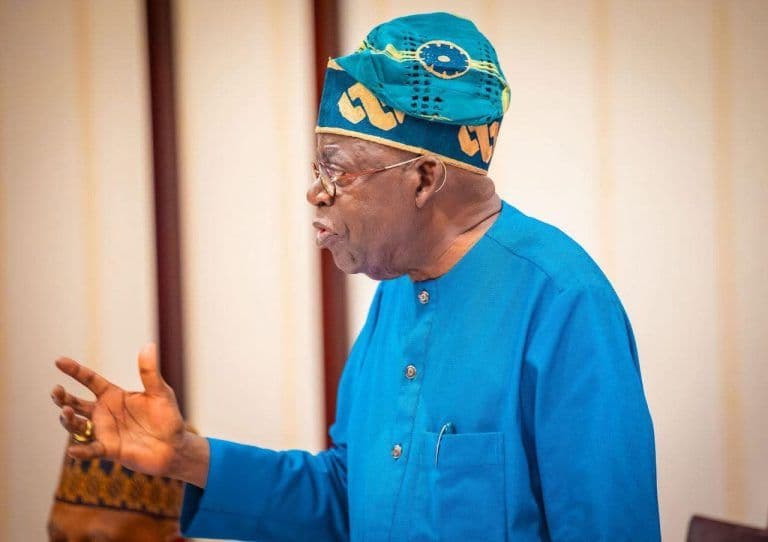
The statement, delivered at the 2026 Workers’ Day event in Eagle Square, places two longstanding crises at the center of federal policy language, with direct implications for wages, productivity, and labour stability. President Bola Tinubu framed both issues as barriers to “decent work,” echoing the International Labour Organization framework that defines employment quality beyond income alone.
Represented by Secretary to the Government of the Federation George Akume, Tinubu’s message acknowledged that insecurity disrupts farms, factories, and markets. That claim aligns with documented incidents of farmer displacement in northern Nigeria and supply chain interruptions cited in prior federal briefings. Yet the speech moves quickly from diagnosis to solution, listing federal interventions with quantified outputs rather than audited outcomes.
Numbers dominate the message.
The administration says it has recruited 45,000 young Nigerians into a Community Protection Guards Initiative. It also claims that social protection programmes now reach 15 million households, with 7.5 million people lifted out of poverty. These figures were presented without accompanying methodology, baseline definitions, or independent verification, leaving them dependent on internal government estimates.
The math is not explained.
The infrastructure claims follow a similar pattern. Tinubu cited projects including the Lagos-Calabar Coastal Highway and the Ajaokuta-Kaduna-Kano Gas Pipeline as having generated over 600,000 jobs. No breakdown was provided to distinguish temporary construction roles from long-term employment, a distinction the National Bureau of Statistics typically requires for labour market classification.
On wages, the administration pointed to a new national minimum wage and the clearance of pension arrears, alongside reactivated gratuity payments effective January 2026. The minimum wage figure, referenced by labour leaders as N70,000, is legally binding across states under Nigerian labour law. Yet implementation remains uneven, particularly outside federal payroll systems.
Compliance is uneven.
Related News
In Borno State, local government workers marked Workers’ Day with street protests over non-payment of the same minimum wage. Yusuf Inuwa, speaking for the Nigeria Labour Congress, stated that some categories of workers, including teachers and healthcare staff, have received adjustments, while local government employees have not. That split creates a two-tier wage structure within the same state system.
The gap is visible.
Governor Babagana Umara Zulum has attributed the delay to what he described as an “over-bloated payroll,” a phrase that implies structural inefficiency rather than fiscal refusal. He has directed local government chairmen across 27 councils to develop implementation mechanisms without retrenching staff. The directive attempts to balance wage compliance with employment stability, but does not resolve the underlying funding constraint.
The opposition response sharpens the contrast. Atiku Abubakar, speaking as a chieftain of the African Democratic Congress, argued that workers are experiencing “renewed hardship” rather than the promised economic relief. His criticism targets both policy substance and execution, particularly the removal of fuel subsidies, which he described as poorly implemented despite previously supporting the policy in principle.
That critique is specific.
Fuel subsidy removal has had measurable effects on inflation and household purchasing power. Data from the National Bureau of Statistics shows sustained increases in consumer prices following the policy shift, with transport and food costs among the most affected categories. Atiku’s argument links these outcomes directly to worker welfare, positioning wage adjustments as insufficient to offset rising living costs.
The administration counters with expanded social programmes and micro pension enrolment. Tinubu stated that over 800,000 informal sector workers have joined the scheme, while a N200 billion MSME fund supports small businesses. These interventions target structural gaps in Nigeria’s labour market, where informal employment accounts for a majority of jobs. Yet enrolment figures alone do not indicate contribution consistency or long-term benefit realization.
Security measures also feature prominently. The deployment of 10,000 Agro-Rangers across 19 states is presented as a response to farmer insecurity, a factor tied to reduced agricultural output and rural displacement. The link between security deployment and productivity gains is plausible, but no yield data or farming output metrics were cited to demonstrate impact.
Evidence is partial.
We reviewed the administration’s combined claims of 45,000 security recruits, 600,000 jobs from infrastructure, and 800,000 pension enrollees, totaling 1.445 million interventions. The figure aggregates distinct categories, employment, security, and financial inclusion, without clarifying overlap or duplication. That aggregation can inflate perceived scale if individuals appear in multiple categories.
Overlap is likely.
Labour leaders are pressing for dialogue but remain skeptical. Tinubu urged unions, including the Trade Union Congress, to treat strikes as a last resort. The request reflects ongoing tension between fiscal constraints and wage demands, particularly as inflation continues to erode real income.
Bola Tinubu declared insecurity and poverty national emergencies on May 1 at Eagle Square, linking both directly to labour productivity and wages.
Government claims include 45,000 security recruits and 15 million households on social programmes, but methodologies and independent verification are not disclosed.
Borno State workers protesting unpaid N70,000 wages highlight uneven implementation across Nigeria’s 36 states.
Atiku Abubakar argues policy execution, especially subsidy removal, has increased hardship despite wage adjustments.
Did the president provide evidence for poverty reduction claims?
No detailed methodology was presented. The figures come from government estimates. Independent verification or published datasets were not cited in the speech.
Why are some workers still unpaid despite a national minimum wage?
Because implementation is handled at state and local levels. Fiscal constraints and payroll issues can delay compliance even when the law is clear.
Is insecurity really affecting wages and jobs?
Yes. Disruptions to farming and markets reduce output and income. That connection is widely documented, though this speech did not provide fresh data.
The next test will likely emerge in the courts if enforcement actions follow. Labour disputes over minimum wage compliance could move to the National Industrial Court of Nigeria, where unions may seek binding orders against non-compliant local governments. No filing has been announced, no compliance deadline has been enforced, and the disputed sum, tied to N70,000 monthly wages across thousands of workers, remains undefined in total value.
Add a Comment