


Nigeria’s men’s team missed the 2022 and 2026 World Cups. Former England forward Eniola Aluko says that failure reflects deeper structural problems inside Nigerian football, particularly weak infrastructure, poor league management, and the absence of long-term investment pathways.
Aluko made the remarks during an interview with Punch and in comments circulated Friday by Soccernet.ng�. Her intervention arrives at a moment when the Nigeria Football Federation faces growing scrutiny over the condition of domestic football despite Nigeria’s continued export of elite talent to Europe.
Nigeria won the 1994 Africa Cup of Nations and the men’s football gold medal at the 1996 Atlanta Olympics. Since then, the Super Eagles have qualified for four World Cups but failed to advance beyond the Round of 16. The team also failed to qualify for the 2022 tournament in Qatar after losing to Ghana on away goals. Nigeria then missed qualification again for the 2026 edition after a damaging run of qualifiers that included dropped points against Lesotho, Zimbabwe, and South Africa.
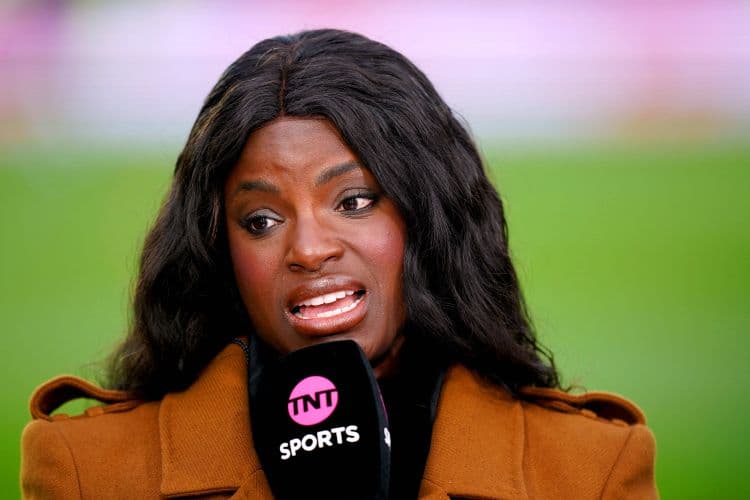
Eniola Aluko says Nigeria’s football decline is tied to facilities, league management, and weak player development systems.
The Super Eagles have now missed two consecutive FIFA World Cups after decades as one of Africa’s most consistent qualifiers.
Aluko pointed to Brazil’s domestic league as a model where returning stars strengthen local football economics and visibility.
The Super Falcons continue producing continental results despite repeated disputes over pay, bonuses, and administrative treatment.
Aluko’s Critique Targets the System, Not the Talent
Related News
Speaking to Punch, Aluko argued that Nigeria’s football problem is not talent identification but what happens after players emerge. She pointed directly to pitches, facilities, and administrative structures.
“It needs to be supported by good facilities, good pitches, good management, a pathway,” she said.
That assessment aligns with years of complaints from coaches, players, and league officials across the Nigerian football ecosystem. Domestic league matches are frequently played on uneven surfaces, clubs face delayed salaries, and several NPFL sides continue to rely on state government subventions rather than stable commercial revenue.
The Confederation of African Football has also sanctioned Nigerian venues in recent years over infrastructure deficiencies. In 2024, CAF ruled that the Godswill Akpabio International Stadium in Uyo remained Nigeria’s only stadium fully approved for certain high-grade international fixtures after inspection processes affecting other venues.
The reality is that infrastructure debates inside Nigerian football are no longer abstract development conversations. They now affect hosting rights, player safety, broadcast quality, and commercial sponsorship.
Aluko’s comments carry additional weight because she currently operates within football investment and governance circles. Beyond her playing career with Chelsea Women and Juventus Women, she has worked as a broadcaster and adviser in football development projects linked to African football networks.
Brazil Comparison Reveals Nigeria’s Economic Problem
Aluko compared Nigeria’s trajectory to Brazil, though her comparison focused less on trophies and more on domestic league economics.
Brazil has won five FIFA World Cups, the most by any country. Yet Brazil’s domestic league still retains visibility because elite players frequently return home late in their careers. Neymar rejoined Santos in 2025. Thiago Silva returned to Fluminense after nearly two decades in Europe.
Our analysis of transfer records from Transfermarkt shows that most elite Nigerian internationals spend minimal portions of their senior careers in the Nigeria Premier Football League before moving abroad permanently. Unlike Brazil or Argentina, Nigeria’s league has struggled to build the financial and broadcast structures capable of attracting veteran internationals back home.
Brazil’s Série A generated television and sponsorship revenue estimated in the hundreds of millions of dollars annually through domestic and international rights agreements. The NPFL operates on a vastly smaller commercial base. Several Nigerian clubs still lack stable merchandising systems, digital distribution, or independently audited financial reporting.
Aluko’s argument was ultimately economic. Better facilities attract sponsors. Better sponsors improve wages and broadcasting. Better broadcasting increases league visibility. Stronger leagues produce stronger national teams.
Morocco invested heavily in football infrastructure over the last 15 years through the Royal Moroccan Football Federation. That program included academy construction, upgraded stadiums, coaching pathways, and women’s football investment. Morocco reached the semi-finals of the 2022 FIFA World Cup and hosted major continental tournaments afterward.
Nigeria has produced comparable raw talent without equivalent structural investment.
The Super Falcons Keep Winning Amid Administrative Conflict
Aluko also highlighted the treatment of the Super Falcons, Nigeria’s women’s national team and Africa’s most successful women’s side.
The team has won 11 Women’s Africa Cup of Nations titles. Yet disputes over bonuses and unpaid allowances have repeatedly overshadowed tournaments. During the 2023 FIFA Women’s World Cup, players publicly raised concerns over compensation and federation management.
Those disputes are documented.
FIFPRO and several Nigerian players previously confirmed that payment disagreements between players and football authorities stretched across multiple tournaments. In some cases, players threatened training boycotts before financial settlements were reached.
Yet the team continued producing results.
The Super Falcons reached the knockout stages of the 2023 World Cup and pushed eventual finalists England to penalties. The men’s team, by contrast, continues to face instability in coaching appointments, federation politics, and qualification campaigns.
Aluko’s comments indirectly exposed a longstanding contradiction in Nigerian football administration. The country continues to produce elite athletes capable of competing globally, but institutional performance has remained inconsistent across facilities, governance, and financial planning.
Investment Language Is Replacing Football Language
One revealing part of Aluko’s interview had little to do with tactics or coaching. She repeatedly used the language of investment, trade opportunities, and infrastructure financing.
African football development discussions increasingly revolve around private capital rather than federation funding alone. Saudi-backed sports investment, private academies, and infrastructure partnerships now shape decision-making across the continent.
We reviewed CAF infrastructure licensing reports from the last five years and found repeated references to inadequate stadium conditions, weak maintenance systems, and limited commercial facilities across several African domestic leagues, including Nigeria’s.
The Nigerian government has periodically announced stadium renovation projects, but maintenance cycles remain inconsistent after political transitions or funding changes. Clubs themselves rarely possess the balance sheets needed for independent infrastructure development.
Aluko’s proposed solution, building pitches and improving facilities through investment partnerships, reflects a recognition that state-led football development alone has struggled to produce sustainable systems.
Why has Nigeria missed two World Cups despite producing elite players?
Because talent alone does not sustain qualification campaigns. Nigeria has faced coaching instability, administrative disputes, weak league structures, and inconsistent long-term planning during qualification cycles.
What exactly did Eni Aluko propose?
She focused on infrastructure. Better pitches, stronger league management, clearer player pathways, and investment partnerships. She was talking less about motivation and more about systems.
Is Brazil really comparable to Nigeria?
Partially. Brazil’s league keeps commercial relevance because stars often return home later in their careers. Nigeria’s domestic league has not created similar financial or structural incentives.
The next unresolved question sits with the Nigeria Football Federation and federal sports authorities: whether promised infrastructure upgrades before future CAF and FIFA qualification cycles will receive sustained financing or remain tied to annual budget negotiations. Several stadium renovation commitments announced after Nigeria’s failed qualification campaigns still lack publicly disclosed completion timelines, audited funding figures, or enforceable delivery contracts.
Add a Comment