


The appeal matters because it comes as Nigeria marks its second-ever leadership of the 121-year-old global service organization, and as Tinubu's administration looks for non-government partners to help fund healthcare, education and youth programs under tight fiscal conditions.
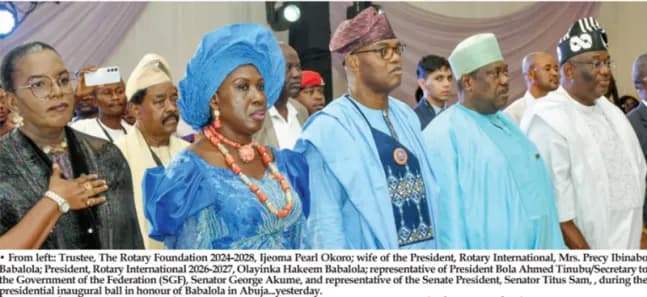
Tinubu made the remarks at a presidential inaugural dinner in Abuja honoring Olayinka Hakeem Babalola, the newly installed President of Rotary International. The president did not attend in person. His message was delivered by Senator George Akume, Secretary to the Government of the Federation.
Babalola is only the second African to hold the position in Rotary's history. The first was Jonathan Majiyagbe, who led the organization 22 years ago and has since died. Tinubu, in the message read by Akume, called Babalola's election "a national statement" reflecting Nigeria's growing influence globally, and said it was not merely a personal distinction.
A Policy Pitch, Not Just a Toast
The dinner speech doubled as a policy appeal. Tinubu asked Rotary, under Babalola's leadership, to deepen collaboration with Nigeria in primary healthcare, maternal and child health, education, literacy, youth skills acquisition and community economic development. He tied the request directly to his administration's Renewed Hope Agenda, the policy framework covering education, healthcare, youth development, job creation and service delivery.
"If we align Rotary's culture of community service with the Federal Government's policy direction under the Renewed Hope Agenda (RHA), we can create measurable results, local and lasting," Tinubu said, according to the text of his remarks. "We can deliver hope, not as a slogan but as a lived reality."
Tinubu framed the request around shared values. He said Rotary's principles, service, integrity, fellowship, diversity and leadership, align with his administration's stated goals. He added that government alone cannot achieve national transformation, a line that positions Rotary as a substitute for state capacity rather than a supplement to it. Neither the president's remarks nor the dinner program specified funding levels, timelines or which government ministry would coordinate any expanded partnership.
Polio as the Proof Point
Related News
- Rep. Riley Moore, a West Virginia Republican, said Saturday the United States will closely track Nigeria's 2027 general election.
- Former Nigerian President Olusegun Obasanjo has agreed to chair the October 4, 2026 Asaba Memorial Anniversary, adopting "Never Again" as its central theme.
- Nigeria's foreign minister pledged support Tuesday for UN programs on women's political participation and youth leadership.
Tinubu pointed to one existing partnership as evidence the model works. He credited Rotary's role in the global fight against polio, calling its contribution to Nigeria's eventual eradication of the wild poliovirus one of the strongest examples of international cooperation in public health the country has seen. He offered no case count, budget figure, or date range for that eradication effort in the remarks as delivered.
Former President Olusegun Obasanjo also addressed the dinner. He urged Babalola to govern by Rotary's Four-Way Test, the organization's longstanding internal ethical standard built around truth, fairness, goodwill and benefit to all. Obasanjo pressed the new Rotary president on three specific fronts: expanding funding access for projects in Africa and other developing regions, investing in the next generation of leaders, and promoting ethical leadership at what he described as a time of declining public trust in institutions. He did not name the institutions he meant.
Ten words capture the gap in the record: no dollar figure, no delivery date, no ministry named.
What Wasn't Said
The available accounts of the dinner, filtered through Akume's delivery of Tinubu's message and separate remarks from Obasanjo, do not include a joint statement, a memorandum of understanding, or a implementation framework between the Federal Government and Rotary International. Tinubu's invitation to "deepen collaboration" was addressed in general terms across five policy areas, healthcare, maternal and child health, education, literacy and youth skills, without specifying which existing Rotary programs in Nigeria would expand, by how much, or on what schedule.
Babalola's own response to Tinubu's appeal was not included in the material reviewed for this report. Nor was any indication of whether Rotary International's global board has approved new funding commitments tied to Nigeria specifically, as opposed to standing continental programs across Africa.
The Renewed Hope Agenda itself remains the frame through which the Tinubu government is now asking outside organizations, in this case a century-old service club with chapters in more than 200 countries, to help carry policy delivery. Whether that translates into a signed agreement, a budget line, or simply another dinner speech is not yet on the public record. Rotary International's board has not issued a statement responding to Tinubu's specific requests, and no date has been set for a follow-up meeting between the organization and the Federal Government.
Add a Comment