


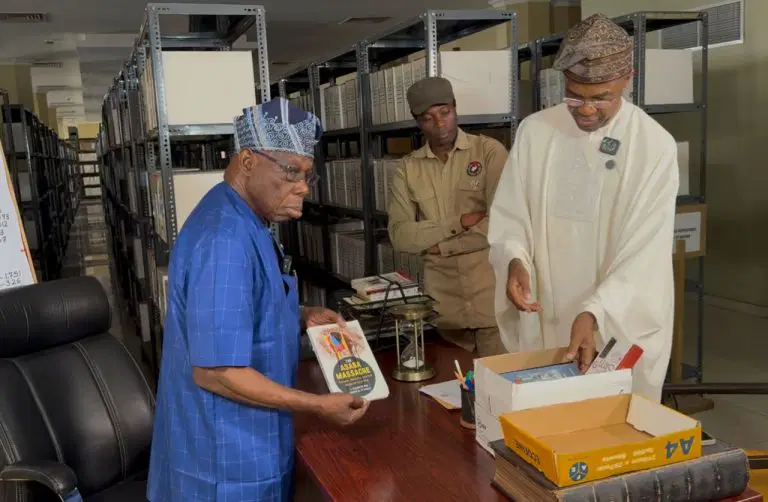
The commitment matters because it puts Nigeria's most prominent living former head of state behind a decades-old campaign to formally recognize the 1967 Asaba Massacre, a chapter of the civil war that has never received official federal acknowledgment. Obasanjo's involvement is being read by organizers as leverage toward getting the National Assembly to act.
Obasanjo made the "Never Again" declaration while receiving a collection of books, eyewitness accounts, documentary films, and archival materials on the massacre at the Olusegun Obasanjo Presidential Library in Abeokuta. The materials were presented by Chief Chuck Nduka-Eze, chairman of both the Asaba Memorial Trust and the Asaba Image Branding and Project Committee.
"Some of the things that led to the civil war are still with us," Obasanjo said, according to the presentation remarks. "We have fought one civil war too many already. God forbid there should ever be another. We must do everything humanly possible to prevent its recurrence and be able to say, 'Never Again.'"
The October 1967 killings in Asaba, in which Nigerian federal troops killed hundreds of unarmed civilians, have long lacked the kind of formal state recognition given to other civil war-era events. Nduka-Eze's presentation to Obasanjo was not simply ceremonial. Elder statesman Simon Okeke, who holds the traditional title Ochendo Amichi and formerly chaired the Nigeria Police Service Commission, said the documentation forms part of a memorandum directed at the Federal Government and the National Assembly, urging formal recognition of the massacre, preservation of documentary evidence, and support for memorial initiatives.
No date has been reported for when that memorandum will be formally submitted to the National Assembly, or which committee would receive it.
Why the venue and the man matter
Obasanjo's presidential library operates on what he described as a three-part mandate: to preserve the past, capture the present, and inspire the future. He cited that mandate directly in explaining why he agreed to accept the Asaba materials and, subsequently, to chair the memorial. That the handover took place at his own library, rather than at a government building or the site of the massacre itself, underscores that this remains a private and civil society-driven campaign rather than a state-run one.
Obasanjo has cleared his schedule to attend the October 4 commemoration in Asaba, according to organizers. His agreement to chair the event is being characterized by campaign organizers as a significant endorsement, though it does not, on its own, constitute federal recognition of the massacre. That distinction matters. A former president chairing a memorial is a gesture of moral weight. It is not legislation, and it is not an act of the National Assembly.
Related News
- Nigeria's foreign minister pledged support Tuesday for UN programs on women's political participation and youth leadership.
- The Inter-Party Advisory Council warned Wednesday that court-ordered deregistration of political parties threatens Nigeria's constitutional democracy.
- NDC Says INEC Has Granted Portal Access for 2027 Candidate Uploads
Okeke, addressing the same gathering, called the massacre "one very ugly chapter in the history of this country that nobody who witnessed it would ever want to see repeated." He added: "It is most unfortunate that such a terrible massacre was allowed to happen under whatever circumstances." Okeke's remarks, delivered alongside Nduka-Eze's presentation, framed the archival handover as evidence-gathering ahead of a formal push for recognition, not merely a commemorative gesture.
What "Never Again" is meant to do
Organizers say the theme is intended to function as, in their words, a national call for peace, justice, and unity, and to keep civil war-era lessons active in Nigeria's political conversation. That framing places the burden of follow-through on institutions beyond Obasanjo himself, particularly the Federal Government and the National Assembly, which the memorandum explicitly names as its targets.
The Asaba Memorial Trust and the Asaba Image Branding and Project Committee, the two bodies chaired by Nduka-Eze, have compiled what is described as a comprehensive archive: books, eyewitness testimony, documentary film, and other archival material. No inventory of the specific documents or their sources has been made public. Nor has any timeline been given for when, or whether, that archive will be deposited permanently at the Obasanjo Presidential Library or transferred elsewhere.
What remains unaddressed is the substance of the request itself. Fifty-nine years after the killings, Asaba's massacre still carries no formal designation from the Nigerian government, no memorial recognized in federal law, and no confirmed date for when the National Assembly will take up the memorandum organizers say is already in preparation. The October 4 commemoration in Asaba is now fixed on the calendar, with Obasanjo confirmed to chair it. Whether the National Assembly responds before or after that date is, for now, the open question the campaign has not answered.
Add a Comment