


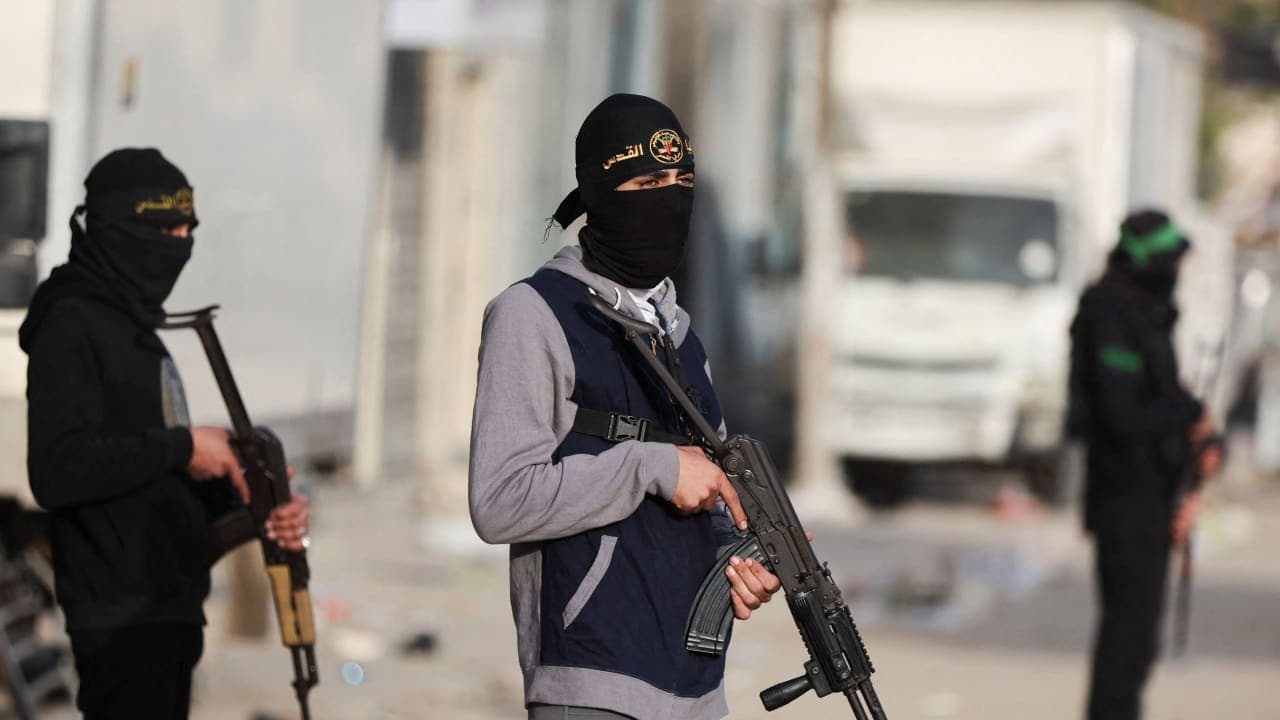
Hamas deployed armed security personnel across Gaza streets and intersections on Friday to prevent a planned civilian protest against the organization's rule, according to Israeli Defense Forces assessments reviewed following the June 26 demonstration date.
The suppression of the protest matters because it directly undercuts the diplomatic premise on which multiple external actors are currently operating. A technocratic government initiative and an active American-backed plan to build Hamas-free zones in Gaza both rest on an assumption that the civilian population can, under the right conditions, exert pressure on Hamas from within. Friday's events tested that assumption in public, in real time.
How Hamas Killed the Demonstration Before It Started
The campaign calling for protests on June 26 had circulated on social media for at least two weeks, primarily on pages affiliated with Fatah, the rival Palestinian political faction. According to the posts, demonstrators were meant to focus on two grievances: the deteriorating living conditions inside the Gaza Strip, and delays in advancing the second phase of the ceasefire agreement.
Hamas monitored the campaign and began preparing countermeasures in the days leading up to Friday. The organization publicized the executions of individuals it accused of collaborating with Israel, a move the IDF characterized as an explicit deterrence signal directed at the broader population. Hamas also launched its own countercampaign, calling for protests not against itself but against Israel and United Nations envoy Nikolay Mladenov, blaming him for the failure of talks he mediated.
The IDF's assessment is that Hamas then deployed its armed security forces visibly throughout the streets and at intersections on the day itself, threatening the population directly. The assessment concludes that this visible armed presence deterred most people from participating.
No independent verification of the street-level deployment was available from journalists operating freely inside Gaza.
The 70% Figure
Related News
The demonstrations, or rather their absence, occurred against a specific military backdrop. A report first published by the Israeli news outlet Walla, and not denied by Israeli military officials, stated that the IDF now controls approximately 70% of the Gaza Strip. The figure follows what the military describes as engineering operations designed to locate terrorist infrastructure both above and below ground, and to push threats away from what it calls the Yellow Line, the boundary zone between Israeli territory and Gaza.
IDF Chief of Staff Lt.-Gen. Eyal Zamir has approved plans presented by Southern Command chief Maj.-Gen. Yaniv Asor for a renewed military campaign should negotiations reach a dead end and Hamas refuse to disarm. The existence of those approved plans means the IDF is not waiting on diplomatic outcomes to prepare its next move. The plans exist. They have a named author and a named approver.
The expansion of ground control is running in parallel with continued air strikes on targets deeper inside the territory and ground operations along the Yellow Line perimeter.
What Hamas Did in Parallel
While suppressing internal dissent, Hamas pushed for its own street activity. According to IDF assessments, the organization actively encouraged the population to hold demonstrations near the Yellow Line, effectively trying to redirect the protest energy outward toward Israel rather than inward toward its own leadership.
The attempt to redirect public anger is a recognizable political tactic. What is less common is executing it while simultaneously running armed checkpoints to ensure the alternative protest, the one aimed at Hamas, does not take place.
The two campaigns existed in direct competition on Friday, and one of them had guns.
The Diplomatic Consequence
The source article contains a claim attributed to no named individual, that Friday "provided conclusive proof" that the two million Palestinians in Gaza do not oppose Hamas rule. That framing goes beyond what the facts establish and is not repeated here as analysis.
What the facts do establish is narrower and more consequential for current negotiations. The planned protests were organized. They were publicized for two weeks. They had a specific date and specific grievances. They did not produce visible public action.
American officials and the technocratic government working toward Hamas-free zones in Gaza have been operating on a model that requires some form of internal Palestinian political pressure to function alongside external military and diplomatic pressure. The June 26 outcome does not prove that pressure is impossible. It demonstrates that Hamas is currently capable of preventing its visible expression, using armed personnel in the streets, on the day it is scheduled to appear.
That is a data point. It is not the same thing as proof of popular support for Hamas. But it is the data point negotiators now have to work with.
What Remains Unresolved
The negotiations mediated by Nikolay Mladenov between Hamas and Israel have not publicly concluded. No deadline for the second phase of the ceasefire agreement has been announced. The IDF's approved contingency plans for a renewed military campaign are conditional on those talks failing and Hamas refusing to disarm.
Whether Mladenov's office will respond to Hamas's public campaign targeting him by name, and on what timeline the American-backed technocratic government will revise its operational assumptions following Friday's outcome, are questions none of the named parties had answered as of the time of publication.
Add a Comment