


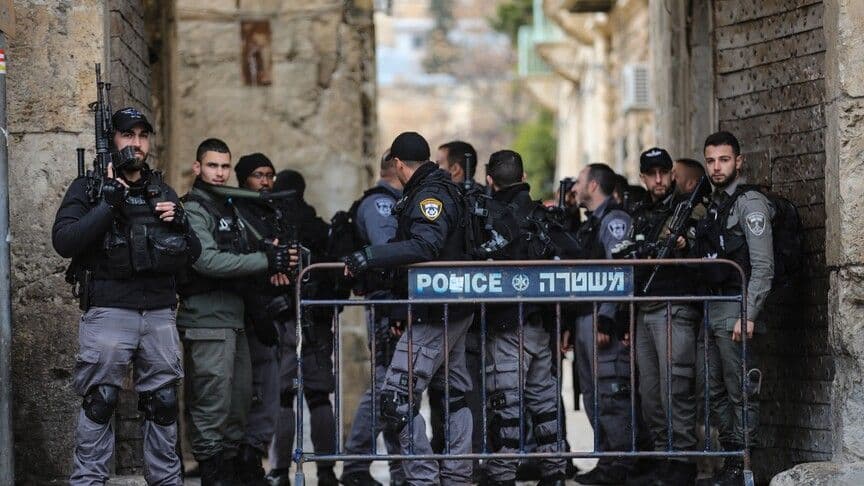
The Israeli army killed three Palestinian police officers in Gaza's Maghazi refugee camp on Friday, striking during an active ceasefire agreement that has been in place since October 10, 2025, according to statements from the Israeli military and Gaza's Interior Ministry.
The killing of Mansour Sami Shahtout, identified by the Israeli military as commander of Gaza's maritime police, marks the latest in a pattern of Israeli strikes against Palestinian security personnel during a ceasefire that both sides nominally remain party to. Gaza's Health Ministry reported that Israeli attacks have killed at least 1,038 people and injured 3,329 others since the ceasefire took effect, figures that now include these three officers.
The Israeli military's statement, released Sunday, named Shahtout specifically and said all three men "posed a threat" to Israeli forces operating in Gaza. The statement did not elaborate on the nature of the alleged threat, the operational circumstances of the strike, or what intelligence preceded it. No warning, no weapon recovered, no incident description was attached to the claim.
That formulation, "posed a threat," is the same language Israeli military statements have applied to a range of strikes since October 10. It is a legal and rhetorical posture, not an evidentiary account.
Gaza's Interior Ministry responded directly.** It mourned the three officers and said their deaths "reflect Israel's insistence on spreading chaos in Gaza." The ministry renewed its call on the international community and the ceasefire guarantors, which include Qatar, Egypt, and the United States, to pressure Israel to stop targeting the police force. As of Sunday, none of those guarantor states had issued a public statement specifically addressing Friday's strike.
The Maghazi refugee camp, where the strike occurred, is in central Gaza. It is one of the most densely populated areas of an enclave that has lost approximately 90 percent of its civilian infrastructure, according to United Nations assessments. Conducting a strike in that environment carries inherent civilian proximity risk, a fact the Israeli military's Sunday statement did not address.
The Ceasefire's Arithmetic
The ceasefire took effect October 10, 2025, ending what the source document describes as two years of war launched on October 8, 2023. In that conflict, Gaza's Health Ministry recorded more than 73,000 Palestinian deaths and over 173,000 injuries. The UN estimated that rebuilding Gaza's destroyed civilian infrastructure would cost roughly $70 billion.
Related News
The ceasefire was meant to stop that. But Gaza's Health Ministry figures show 1,038 people killed and 3,329 injured since October 10 alone. That is not a figure from the war. That is a figure from the ceasefire period.
Whether those deaths constitute ceasefire violations under the specific terms of the agreement depends on the text of that agreement, which has not been published in full. The guarantor states, Qatar, Egypt, and the United States, brokered the deal and are formally responsible for its enforcement. None has publicly characterized any individual Israeli strike since October 10 as a violation, though Gaza's Interior Ministry and Health Ministry have consistently framed them as such.
Targeting Police
The targeting of police officers raises a distinct legal question from the targeting of armed combatants. Mansour Sami Shahtout commanded Gaza's maritime police, a civilian law enforcement body. The Interior Ministry's mourning statement treated the three men as civil servants. The Israeli military treated them as threats.
Under international humanitarian law, the legal status of police forces in conflict zones is contested terrain. The determination hinges on whether they are directly participating in hostilities, a fact-specific inquiry that cannot be resolved by a press release. The Israeli military has not said it submitted its targeting decision in this case to any independent review body, and no such body has announced an inquiry.
The Interior Ministry's statement renewed a call it has made before. This was not the first time it asked ceasefire guarantors to intervene on behalf of Gaza's police. Previous calls have not produced publicly documented responses from Washington, Doha, or Cairo.
What the Numbers Represent
The 1,038 killed since October 10 averages to a substantial daily toll across the approximately eight and a half months the ceasefire has been in place. The source document does not break down that figure by category, whether combatants, police, or civilians. Gaza's Health Ministry, which has compiled casualty data throughout the conflict and whose figures have been cited by the United Nations, does not typically make that disaggregation in its summary counts.
The 73,000 killed during the preceding war, and the $70 billion reconstruction estimate from the UN, establish the scale of what the ceasefire was supposed to arrest. The degree to which it has done so remains disputed by the parties and unresolved by the guarantors.
What Remains Unanswered
The ceasefire guarantors, specifically the United States, Qatar, and Egypt, have not responded publicly to Friday's strike or to the Interior Ministry's renewed demand for intervention. No timeline for any guarantor review of the incident has been announced. The Israeli military has not said whether the Maghazi strike will be subject to internal military review, and no Israeli government official has commented on the Interior Ministry's characterization of the attack as an effort to "spread chaos."
The next question this story requires an answer to is this: do the ceasefire guarantors consider the killing of 1,038 people since October 10 consistent with the agreement they brokered, and if not, what mechanism exists to enforce it? None of them has said.
Add a Comment