


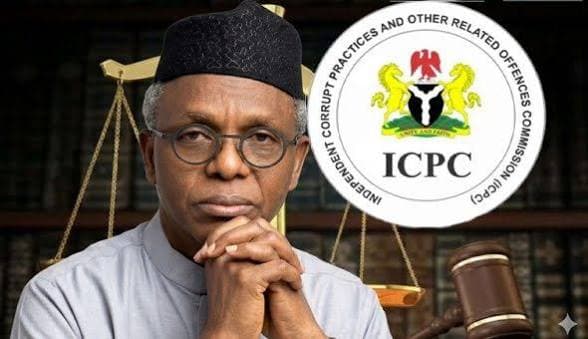
Nigeria's anti-corruption agency has filed an 11-count charge against former Kaduna State Governor Nasir Ahmad El-Rufai, alleging he approved a ₦8,682,574,054.94 contract to a company it describes as unqualified.
The case, registered as FHC/KD/93C/2026 before Justice Hauwa'u Buhari of the Federal High Court in Kaduna, represents one of the most direct corruption prosecutions of a former Nigerian state governor in recent years. Bail applications from El-Rufai and his co-defendant are pending, with a ruling scheduled for July 1, 2026.
El-Rufai was arraigned alongside Jimi Adebisi Lawal, his former Senior Special Adviser and Counsellor, and five companies: Singularity Network Security Limited, Solar Life Nigeria Limited, Knowledge Investment Nigeria Limited, Intercellular Nigeria Limited, and Noble Coast Resources Limited. A sixth individual, Bashir El-Rufai, identified in the charge as an elder brother of the former governor, is named in one count and is currently described by the ICPC as being at large.
Both El-Rufai and Lawal entered not guilty pleas during the arraignment proceedings.
The Contract
Count one of the amended charge states that El-Rufai, "sometime in December, 2015 or thereabout at Kaduna," approved the award of a contract for the "procurement of survey planning, final design and installation of CCTV at Kaduna metropolis" to Singularity Network Security Limited. The ICPC alleges the approval was made knowing the company lacked requisite experience and that it violated procurement laws.
The count charges El-Rufai under Section 21(a) of the Money Laundering (Prevention and Prohibition) Act, 2022, punishable under Section 18(3) of the same statute.
The contract's stated purpose was a closed-circuit television surveillance system for Kaduna metropolis. The approved sum, ₦8,682,574,054.94, was described in the charge as a "reviewed sum," a phrase the ICPC did not elaborate on in publicly available charge documents but which implies the figure had been revised from an earlier amount before final approval.
Related News
The ICPC did not specify in its public statements what surveillance infrastructure, if any, was ultimately delivered under the contract.
The Money Trail
Beyond the contract approval itself, the ICPC alleges that funds connected to the transaction moved through multiple companies and individuals across several years. The Commission's public statements put the figure at over ₦2 billion suspected to represent proceeds of unlawful activity, passing through the named companies between 2017 and 2022.
That five-year window spans periods both within and after El-Rufai's tenure as governor, which ran from 2015 to 2023. The allegation that transfers continued through 2022 places some of the alleged financial movements in the final year of his administration.
The ICPC's position is that these transactions were structured to conceal the origin of the funds. The charge sheet names five corporate defendants as the vehicles through which those movements occurred, but the publicly available filings do not specify which company received which sum, or on what dates individual transfers were made.
The Legal Framework
The ICPC's decision to charge El-Rufai under the Money Laundering (Prevention and Prohibition) Act, 2022, rather than solely under the ICPC Act or the Corrupt Practices and Other Related Offences Act, is a prosecutorial choice with practical consequences. Money laundering charges in Nigeria carry penalties that include significant custodial sentences and, critically for asset recovery, provisions for forfeiture of proceeds.
The 11-count structure of the charge, spread across multiple defendants including both individuals and corporate entities, follows a pattern the ICPC has used in other major prosecutions to ensure that financial flows through intermediary companies are captured within the same proceeding rather than pursued in separate actions.
Singularity Network Security Limited sits at the center of the charge as the direct recipient of the contract award. The ICPC alleges the company had no requisite technical experience at the time of the award, but the charge documents do not detail what due diligence process, if any, was conducted by the Kaduna State government before the contract was granted.
Bail and What Follows
El-Rufai's legal team applied for bail following the arraignment. Justice Buhari heard arguments from both the defense and the prosecution before adjourning for a ruling. That ruling is set for July 1, 2026, at the Federal High Court in Kaduna.
Until that date, the court has not publicly indicated whether El-Rufai will be held on remand or released pending trial. The conditions under which he currently remains, and whether any travel restrictions have been imposed, were not addressed in the ICPC's public statements.
The July 1 ruling will determine the immediate liberty of a man who, less than three years ago, governed one of Nigeria's most populous states and was publicly discussed as a potential presidential contender. What Justice Buhari decides that day will also signal how the court weighs flight risk and public interest in a case involving a sum that, at current exchange rates, represents a substantial fraction of many Nigerian states' annual budgets.
The ICPC has not yet publicly confirmed whether additional charges or defendants are under consideration. Bashir El-Rufai remains at large.
Add a Comment