


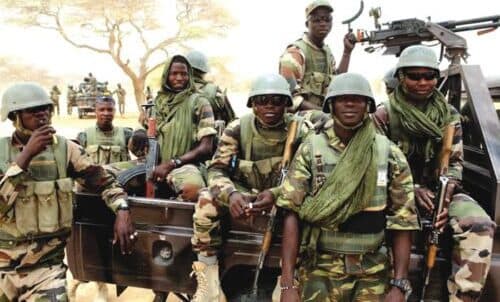
Joint Task Force troops freed mostly women and children from Kangarwa after air and ground assaults forced insurgents to abandon their positions
Forty-seven people, most of them women and children, have been freed from an Islamic State West Africa Province enclave in Kangarwa, Kukawa Local Government Area of Borno State, following military operations by Nigeria's Joint Task Force in the Lake Chad region.
The rescue matters because it offers the clearest public evidence in recent months that ISWAP continues to hold civilian captives in fortified positions along the Lake Chad shoreline, even as the Nigerian military has repeatedly declared operational momentum against the group. The timing, a statement issued Tuesday from Maiduguri, places the operation squarely in an ongoing campaign that has yet to produce a full accounting of how many people remain in ISWAP custody across the region.
The Operation
Acting Military Information Officer for Operation Hadin Kai, Captain Mohammed Goni, issued the statement attributing the rescue to "sustained aggressive pressure and relentless offensive operations" against ISWAP enclaves in the Lake Chad basin. According to Goni, combined ground and air assaults forced insurgents to vacate their positions, creating a window through which captives escaped prolonged detention.
The statement did not specify the date the operation concluded, the number of troops deployed, or whether any ISWAP fighters were killed, captured, or escaped. No independent confirmation from humanitarian organizations operating in Borno was included in the military's release.
Kangarwa sits within Kukawa LGA, a remote area hugging the Lake Chad shoreline that Nigerian security forces have repeatedly identified as an ISWAP operational corridor. The terrain, shallow lake inlets and isolated island communities accessible mainly by canoe, has historically complicated both military access and humanitarian monitoring.
Who Was Rescued
Related News
The military's statement described the 47 rescued persons as "mostly women and children" but provided no further demographic breakdown. It did not say how long they had been held, where they were taken from originally, or whether any were among persons previously reported missing in documented ISWAP abductions.
That detail matters. Human rights documentation from the region, including reporting by Amnesty International and the United Nations Office for the Coordination of Humanitarian Affairs, has tracked abductions of civilians from Lake Chad communities going back to at least 2015. Whether these 47 individuals correspond to any previously recorded cases is unknown from the military's account alone.
The rescued persons were not identified by name. Their current location, and which agency is responsible for their care, was not stated in the release.
The Broader Campaign
Operation Hadin Kai, which translates loosely from Hausa as "collective resolve," was established in 2021 as a unified command structure to consolidate counter-insurgency operations in Nigeria's northeast. It replaced Operation Lafiya Dole and brought together army, navy, air force, and police elements under a single operational theater.
Since its formation, the joint task force has issued regular statements claiming territorial gains, weapons recoveries, and civilian rescues. Tuesday's statement follows a pattern: an operation forces ISWAP fighters to withdraw from a position, captives emerge, the military announces a humanitarian success. What the statements rarely include is what happens to those positions afterward, or whether ISWAP fighters return.
A February 2024 report by the Armed Conflict Location and Event Data Project recorded continued ISWAP activity across Kukawa and neighboring LGAs, including attacks on fishing communities and military outposts, suggesting the group retains meaningful operational capacity in the area despite sustained pressure.
What the Statement Does Not Say
The Goni statement, one paragraph of operational summary and one of direct quotation, contains no information about whether any ISWAP fighters were killed or detained during the assaults. It does not name a commanding officer for the rescue operation. It does not say whether any military personnel were wounded.
It also does not address a question that has followed Operation Hadin Kai throughout its existence: the fate of civilians on ISWAP-controlled islands who have not yet been reached. The International Committee of the Red Cross, which operates in Borno, has not issued any public statement corroborating Tuesday's rescue as of this writing.
Goni did not respond to a request for additional details sent to the OPHK press office in Maiduguri.
The next question is straightforward. Nigeria's National Emergency Management Agency and Borno State Emergency Management Agency have not yet confirmed receiving or processing the 47 rescued persons. Until either agency provides that confirmation, the location, condition, and protection status of the people freed from Kangarwa remain unverified by any body independent of the military that rescued them.
Add a Comment