


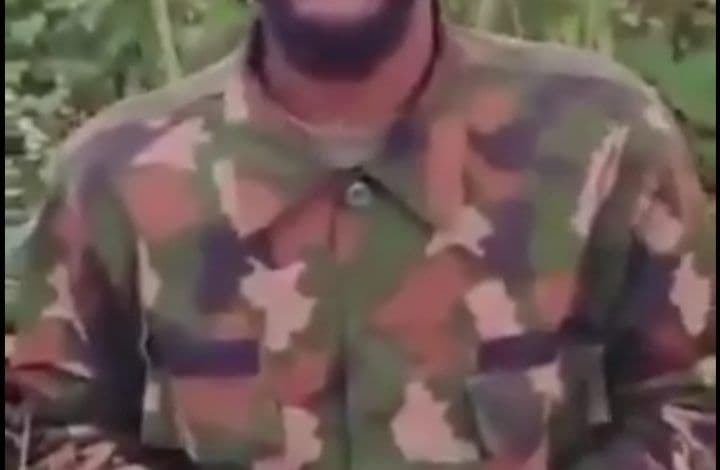
A man in military camouflage and carrying a firearm has named local political figures as the original financiers of the Biafra Revolutionary Army, in a video that has circulated online and that the speaker addressed directly to the international community and to Igbo people across the Southeast.
The video matters because it is the first publicly available footage in which an alleged member of the Biafra Revolutionary Army directly accuses named political actors of funding, equipping, and then abandoning the group. If the claims are accurate, they connect elected or influential figures in Orlu, Imo State, to a group operating under the umbrella of an organization a Nigerian court designated as a terrorist organization in 2017.
The speaker, whose identity has not been independently verified, appears in full military camouflage and holds a short firearm throughout the recording. He does not give his name. He states his purpose at the outset: to address what he describes as a deliberate rebranding of his group by the same political actors who originally enabled it.
"It was them that turned against the men on the ground, calling them unknown gunmen," he says in the video. "Let me use this opportunity to address the international community and to address the Southeast and to address Southeast people, the Igbo people, that the Biafra Revolutionary Army is not a terrorist and there's no way they would be a terrorist."
He then states his intention to name specific individuals. "I want to give you the names of the people who sponsored us, who equipped us, who encouraged us in all, but because of political interest, because of political manipulation, they turned against the men on the ground."
The video, as reported, does not confirm whether those names were actually spoken in full or whether that portion of the footage was edited or withheld. The specific names alleged have not been published in the available source report.
The Group and Its Legal Status
The Biafra Revolutionary Army presents itself as an armed affiliate of the Indigenous People of Biafra, the secessionist movement founded in 2012 by Nnamdi Kanu. IPOB draws its ideological lineage from the 1967 to 1970 Nigerian Civil War, in which the Republic of Biafra, declared in the predominantly Igbo southeast, was defeated by federal forces after a conflict that killed an estimated one to three million people.
Related News
IPOB was proscribed by a Nigerian court in 2017, which formally designated it a terrorist organization. Kanu, who remains the movement's leader, is currently in detention facing terrorism-related charges. His trial has proceeded intermittently through the courts.
The BRA operates in the terrain that IPOB's political structures cannot occupy legally. Its members in the field face criminal liability that IPOB's diaspora leadership, operating from outside Nigeria, does not. That asymmetry is precisely the grievance the speaker articulates: political figures used the armed wing for operational purposes, then distanced themselves once the designation "unknown gunmen" became a safer label than "sponsors of separatists."
The phrase "unknown gunmen" has become the standard attribution in Nigerian security reporting for armed attacks across the Southeast since approximately 2021. Security forces, state governments, and federal authorities have used it consistently, a usage pattern that, intentionally or not, strips political and organizational context from violence that may have identifiable chains of command and funding.
Orlu as an Epicenter
The speaker specifically identifies Orlu, in Imo State, as the geographic center of the alleged sponsorship network. Orlu and its surrounding local government areas have been among the most affected zones in the Southeast's security deterioration since 2020. Nigerian military operations, including helicopter gunship deployments, were reported in the Orlu area in early 2021 following confrontations between security forces and armed groups in the region.
Imo State's political environment is among the most contested in the Southeast. Governor Hope Uzodimma has faced persistent accusations from opposition figures of manipulating security conditions for political advantage, accusations his administration has rejected. The state has also been the site of attacks on police stations, correctional facilities, and electoral offices. No public investigation has produced convictions linking any named political figure to the funding of any armed group operating there.
The speaker's claim that political backers "shifted the narrative to protect their own careers" follows a logic that security analysts have noted in other insurgent contexts: armed groups that outlive their political utility to their original sponsors become liabilities to be disowned rather than assets to be acknowledged.
What the Video Does Not Establish
The footage, as available, does not provide documentary evidence of financial transfers, weapons procurement records, or any corroborating material that would independently verify the speaker's account. His identity is unconfirmed. The circumstances under which the video was recorded, who distributed it, and whether it was released by the BRA as an organizational statement or by an individual acting alone are not established in available reporting.
The Nigerian security services, including the Department of State Services and the military's Joint Task Force operating in the Southeast, have not publicly commented on the video's authenticity or its contents, based on reports available at the time of writing.
Named political figures in Orlu have not responded publicly to the allegations, which is consistent with the fact that their names, as reported, have not been published.
The video's circulation online means it has entered the public record. Whether the DSS, the Inspector-General of Police, or any legislative body with oversight over security matters in Imo State will open an inquiry into the sponsorship allegations named in the footage is the question that no agency has yet answered.
Add a Comment