


Two earthquakes measuring 7.5 and 7.2 struck Venezuela on Wednesday, killing at least 235 people, wounding 4,300 more, and collapsing more than 100 buildings in a country whose hospitals were already operating below capacity before the first tremor hit.
The death toll, and the international response it has triggered, matter now because the disaster has placed the United States, which carried out a military operation to abduct Venezuelan President Nicolás Maduro in January, in the position of deploying warships and $150 million in aid alongside Cuba, Brazil, and Colombia to rescue citizens of a government Washington has spent years trying to isolate.
The Scale of Destruction
The hardest-hit area is La Guaira, the coastal state north of Caracas that is home to Venezuela's main international airport. The airport has been closed due to structural damage. Interior Minister Diosdado Cabello said at least 70,000 families in the state have been affected. Hundreds of people are believed to remain trapped under rubble as of Friday.
Venezuela's Health Minister Carlos Alvarado described hospitals as "full of patients." That phrase carries particular weight here. Al Jazeera correspondent Alessandro Rampietti, reporting from Bogota, said many Venezuelan hospitals were already operating under capacity before Wednesday, with chronic shortages of engineers and doctors compounding the damage from the quakes themselves.
The two earthquakes were among the strongest to strike Venezuela in more than a century, and tremors were felt across the broader region, including in neighboring Colombia.
The International Response
The United Nations dispatched search and rescue teams and humanitarian aid. Tom Fletcher, the UN's aid chief, addressed survivors directly in a public statement: "know that we are determined that help gets to you." The Vatican announced Pope Leo XIV had sent an initial emergency contribution of 100,000 euros, or approximately $114,000.
Related News
The U.S. response is the largest single national pledge. Secretary of State Marco Rubio said it would be "big, fast and effective," and the State Department described a whole-of-government deployment that includes warships, transport aircraft, helicopters, and $150 million in humanitarian aid. The mechanics of how that aid reaches Venezuelan territory, given the absence of normal diplomatic relations and January's military operation, have not been publicly explained by either government.
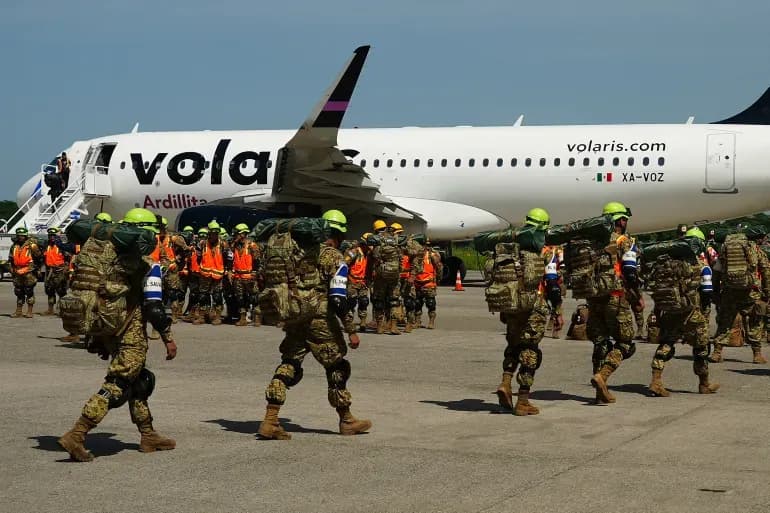
Brazil is sending a field hospital along with dozens of firefighters and support personnel, announced by President Luiz Inácio Lula da Silva. El Salvador's President Nayib Bukele said 300 rescuers and paramedics were readied, backed by 50 tonnes of equipment, medicines, and basic supplies. Mexico's President Claudia Sheinbaum confirmed the dispatch of a military rescue and medical team, with further assistance conditional on assessed need. Colombia's national disaster management agency said it would send more than 60 rescuers and 12 tonnes of humanitarian aid. Cuba's Foreign Minister Bruno Rodriguez stated that Cuban health workers were already "fully mobilised and providing medical services to the affected population" as of Friday.
The Infrastructure Problem
Rampietti's on-the-ground assessment points to a compounding crisis. Venezuela entered Wednesday with frequent power outages, public services he described as being in "shambles," and a healthcare system that could not fully staff its own facilities in normal conditions. The earthquakes did not create those deficiencies. They exposed them under pressure.
More than 100 buildings have collapsed in La Guaira alone. The closure of the international airport restricts the speed at which foreign field hospitals, equipment, and personnel can reach the affected zone, forcing aid convoys onto road and sea routes whose own integrity after two major tremors has not been publicly assessed by Venezuelan authorities.
The economic context reinforces the infrastructure problem. Years of contraction, hyperinflation, and the departure of trained professionals have left Venezuela with fewer domestic resources to mount a recovery than comparable nations struck by earthquakes of similar magnitude. The 7.5-magnitude quake alone would test a well-resourced government. Venezuela is managing it with hospitals already at capacity before the first casualty arrived.
The Political Dimension
The composition of the relief coalition is its own story. The United States, Cuba, Brazil, Colombia, Mexico, El Salvador, and Canada are sending assistance simultaneously to a government that Washington designated as a hostile actor less than six months ago. The January operation that resulted in Maduro's abduction has not been formally resolved in any legal or diplomatic forum that has been made public.
Whether Venezuelan authorities will accept U.S. military assets, specifically the warships and transport planes Rubio described, on or near Venezuelan territory remains an open question. Neither the Venezuelan government nor the U.S. State Department had publicly confirmed the logistics of that arrangement at the time of publication.
The figure still outstanding is the 4,300 wounded, many of them in hospitals Alvarado acknowledged are already full. The PAHO, the Pan American Health Organization, has not yet issued a public assessment of whether the combined international medical response, including Brazil's field hospital and Cuba's mobilised health workers, is sufficient to close that gap. That agency has not responded to the question.
Add a Comment