


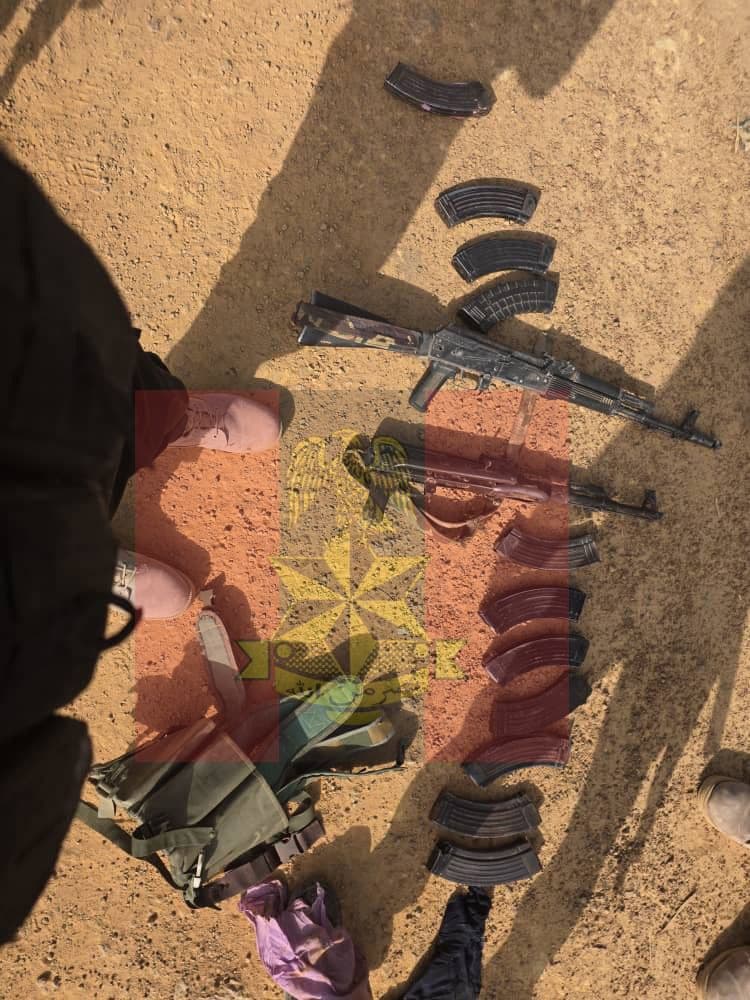
Nigerian troops killed two suspected Lakurawa terrorists in Kebbi State after acting on intelligence that the group was preparing to attack a rural community, the Joint Task Force for the North-West said in a statement attributed to Lt. Col. Aliyu Danja, the operation's Media Information Officer.
The engagement marks the latest direct military contact with the Lakurawa, a militant group that has drawn increasing security concern across Nigeria's North-West, a region already under sustained pressure from banditry and kidnapping networks.
The Ambush
Personnel from the Chief of Army Staff Intervention Battalion 7 mounted a tactical ambush near Sabarumawa community after receiving intelligence that terrorists were planning an imminent attack on the settlement, according to Danja's statement. Troops engaged the militants in a firefight. Two were killed. The rest withdrew into the forest.
Surviving fighters retreating into forest cover is a recurring pattern in North-West operations, one that limits the conclusive security value of individual engagements, however tactically successful.
From the scene, troops recovered two AK-47 rifles, magazines, 143 rounds of ammunition, and one motorcycle.
The motorcycle recovery is a small but telling detail. Across the Sahel and Nigeria's north, motorcycles are operational infrastructure for militant groups: they enable rapid movement across terrain that vehicles cannot easily traverse, and their seizure, when documented, gives analysts a concrete indicator of group mobility and logistical capacity.
Who Are the Lakurawa?
Related News
The Lakurawa are a relatively recently named threat in the Nigerian security landscape. Unlike Boko Haram or the Islamic State West Africa Province, which operate primarily in the North-East, the Lakurawa have been identified by Nigerian security officials as operating in the North-West, with reported links to jihadist networks active in the Sahel. The Nigerian government formally listed the group as a terrorist organization in late 2024, a designation that preceded a stepped-up military posture in the region.
Danja's statement did not specify whether the two killed fighters were identified by name, rank, or affiliation documentation recovered at the scene. That absence is standard in Nigerian military press releases, but it limits independent verification of the Lakurawa designation.
The Broader Operation
Operation Fansan Yamma, the Joint Task Force umbrella under which this action falls, was established to address the compounding security crises across Zamfara, Kebbi, Sokoto, Katsina, and Kaduna states. The region has experienced years of mass kidnappings, community attacks, and the displacement of rural populations. Kebbi State, where this operation took place, sits on Nigeria's northwestern edge, bordering Niger to the north, a geographic reality that complicates containment of cross-border militant movement.
Danja said the military would "sustain offensive operations against terrorists and other criminal elements operating across the North-West." That phrasing is consistent with public messaging from the Joint Task Force over recent months, which has emphasized continuity of pressure rather than claims of resolution.
The Chief of Army Staff Intervention Battalion 7, identified in the statement as the unit that conducted the ambush, is one of several specialized formations deployed under the operation. Its specific mandate, composition, and area of responsibility were not elaborated in the public statement.
What the Statement Does Not Say
No civilian casualties were reported. No troops were reported wounded or killed. The statement does not address whether the intelligence that triggered the ambush came from local informants, signals collection, or aerial surveillance, a distinction that matters for assessing the durability of the military's information advantage in the area.
The community of Sabarumawa, identified as the intended target of the foiled attack, is a rural settlement in Kebbi. No statement from local government officials or community leaders was included in the military's release, and no independent account of the engagement had been published by Nigerian press outlets at the time of this report.
That gap is not unusual. Much of the fighting in Nigeria's North-West occurs in areas with limited press access, and the primary public account of military operations typically comes from Joint Task Force communiqués.
The unresolved question is operational continuity. Two fighters are dead, and others are unaccounted for in the surrounding forest. Whether follow-on operations were mounted to pursue them, and whether the Sabarumawa community received any security presence in the aftermath of a foiled attack, was not addressed in Danja's statement.
The Joint Task Force has not announced a press briefing. No timeline for an updated operational assessment has been made public. And the Lakurawa, as an organization, remain active across a theater where the forest cover, porous borders, and limitations on rural press access make independent accounting of military claims difficult to conduct in real time.
Add a Comment