


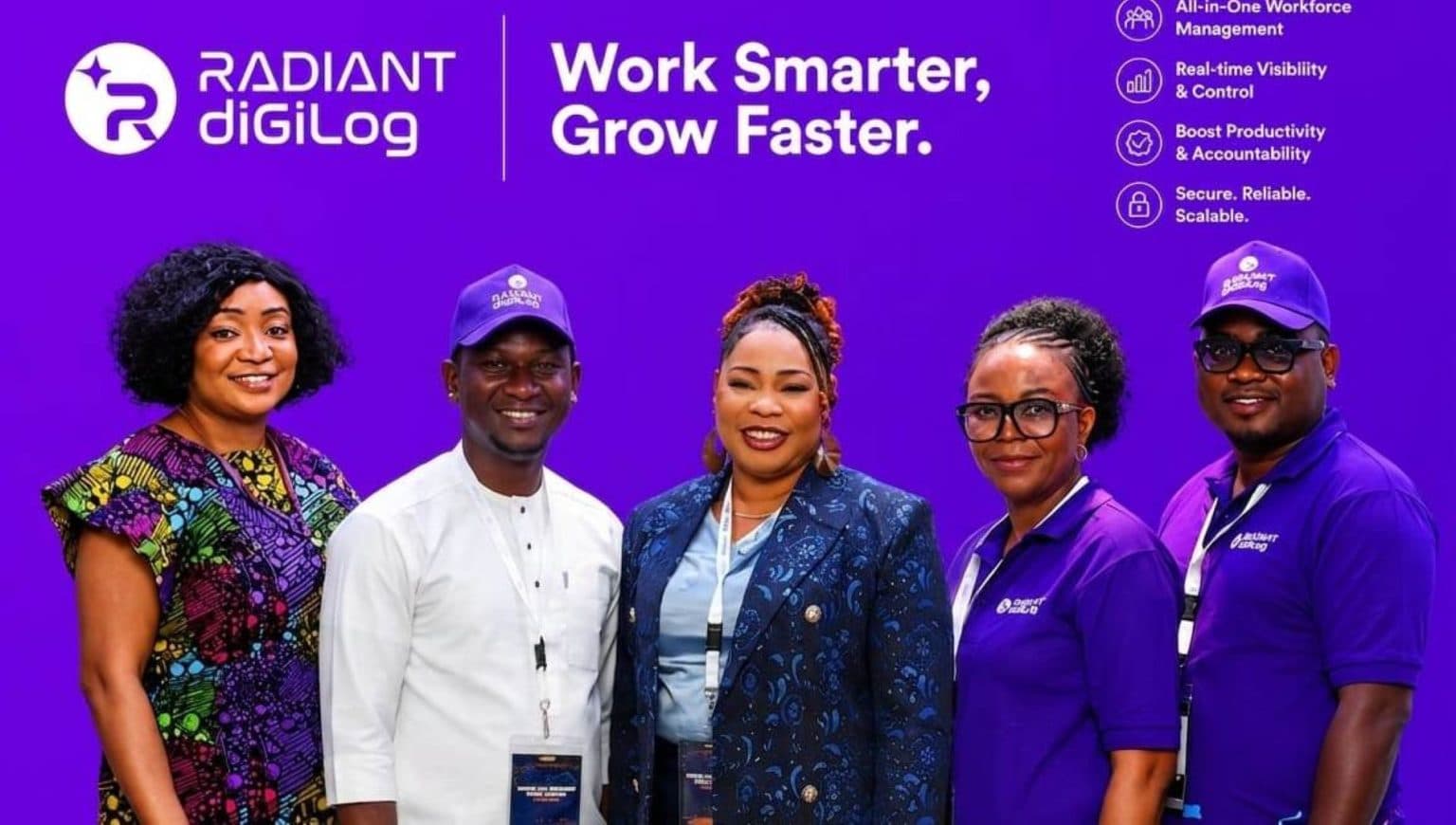
Radiant diGiLog, a workforce management platform developed in Nigeria, has launched simultaneously in Nigeria, the United Kingdom, South Africa, Uganda, and Canada, positioning itself against the spreadsheets and messaging apps that millions of small businesses still use to track staff.
The launch comes as workforce technology investment accelerates globally, with demand increasingly coming from markets where large enterprise software has historically been too expensive or too complex for the businesses that need it most. For Nigerian SMEs in particular, the announcement represents a rare instance of a locally built platform targeting the operational realities of the African business environment first, rather than adapting a Western product after the fact.
The company made the announcement at the Route to Market West Africa Exhibition 2026, a gathering of distributors, business operators, and commercial professionals focused on market development across the region.
What the Platform Does
Mrs. Tayo Babatunde, Managing Director of Radiant diGiLog, described the platform as a single digital environment for attendance tracking, task management, workforce reporting, and productivity monitoring. The core argument is straightforward: businesses managing ten or more employees through a combination of phone calls, paper logs, and WhatsApp groups are operating with blind spots that cost them money and accountability.
"Many organisations continue to manage work using disconnected systems and manual processes," Babatunde said at the launch. "As businesses grow, maintaining visibility across teams, locations and daily operations becomes more challenging."
The platform launches with three pricing tiers. The Starter Plan covers scheduling, attendance, leave management, a staff directory, and basic reporting, positioned as a direct replacement for spreadsheets in small businesses and startups. The Pro Plan adds location tracking, geofencing, compliance tools, multi-location support, and a proprietary internal communications feature called diGi-Chat, with Babatunde naming healthcare, hospitality, logistics, and construction as the primary target sectors for that tier. The Advanced Plan layers in recruitment tools, digital signatures, expense tracking, API integrations, and custom workflows, aimed at large multi-site operations.
Pricing figures were not disclosed at the launch event.
Related News
The Connectivity Question
The most immediate practical challenge for any software operating in Nigerian and broader African markets is infrastructure. Power outages, inconsistent mobile data, and patchy internet coverage are not edge cases; they are daily operational conditions for millions of businesses.
Babatunde acknowledged the gap directly. "Our team is actively building offline capability into core features," she said, specifying that clock-in functions can operate without a live connection and will sync automatically once connectivity is restored. She described the offline capability as still being expanded across the platform, meaning it is not yet comprehensive at launch.
That candor matters. Workforce platforms that cannot function during a network outage are functionally unreliable for field teams, construction sites, and healthcare workers in rural settings, precisely the users Babatunde named as the platform's most immediate audience.
She also pointed to an in-house engineering team available continuously, contrasting that with what she called "a support ticket queue." Whether that support capacity scales as the platform grows across five markets simultaneously is a question the company has not yet had to answer publicly.
The Performance Record Argument
One feature Babatunde emphasized is the platform's longitudinal data function. Because the system logs every task, including assignment date, deadline, and completion status, it builds what she described as "an unbiased performance record over time." A manager, she said, can retrieve twelve months of data and assess objectively which employees consistently deliver and which do not.
That framing will resonate with any business owner who has tried to make a termination or promotion decision using memory and informal observation. It will also raise questions among labor advocates about how algorithmically generated performance scores interact with existing employment law in each of the five launch markets, particularly the UK and South Africa, where data protection and worker rights frameworks are significantly more developed than in Nigeria.
The company did not address data storage, data residency, or compliance with the UK's General Data Protection Regulation or South Africa's Protection of Personal Information Act at the launch event.
Free Trial and Market Entry
As part of the launch, Radiant diGiLog is offering a 30-day free trial period. The trial is the company's primary acquisition mechanism for businesses evaluating whether the platform addresses their specific operational problems before committing to a paid plan.
The five-market simultaneous launch is an ambitious entry posture for a platform that, by Babatunde's own description, still has features under active development. Executing support and onboarding across time zones that include Lagos, London, Johannesburg, Kampala, and Toronto, with a single in-house engineering team, is a logistics challenge the company will face in practice rather than in press releases.
Radiant diGiLog has not announced a funding round, a partnership with a telecommunications carrier, or a regulatory filing in any of its launch markets. The next material test of the platform's viability will be the conversion rate from the 30-day trial to paid subscriptions, a figure the company has not committed to disclosing publicly.
Whether the UK Information Commissioner's Office or South Africa's Information Regulator will require the company to formally register as a data processor operating in those jurisdictions, and under what timeline, remains an open question the company has not yet addressed.
Add a Comment