


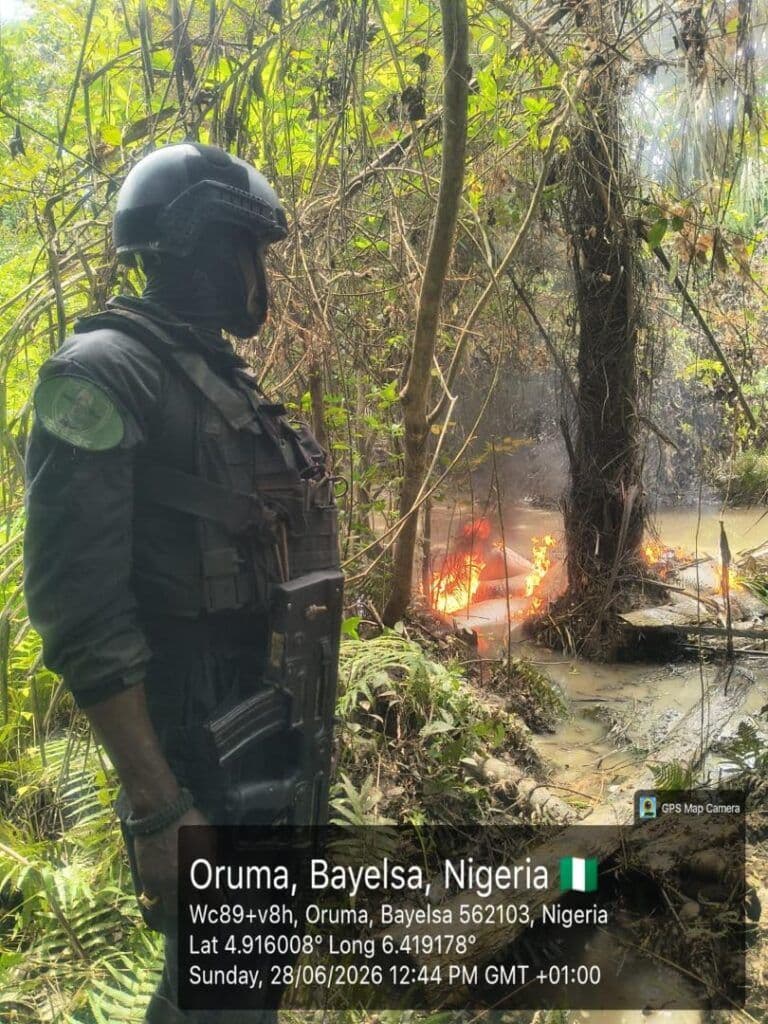
Nigerian Navy personnel recovered 22,870 litres of suspected illegally refined diesel from a wooden boat and two concealed stockpiles in the Orashi Forest area of Rivers State, the Director of Naval Information announced following the operation.
The seizure is the latest action under Operation DELTA SENTINEL, the Navy's standing anti-crude oil theft campaign in the Niger Delta, a region where illegal refining has cost Nigeria billions of naira in lost petroleum revenue and caused sustained environmental damage to creek ecosystems across Rivers and Bayelsa states.
How the Operation Unfolded
Navy Captain Abiodun Folorunsho, the Director of Naval Information, said the operation began with credible intelligence on the movement of illegally refined petroleum products through creek channels in Rivers State. Personnel from Nigerian Navy Ship SOROH were deployed to the Orashi Forest area of Okolomade Community in Abua/Odual Local Government Area, a location that sits on the border with Ogbia Local Government Area in neighboring Bayelsa State.
The patrol team intercepted a wooden boat on an adjoining creek. The boat was carrying 36 sacks of suspected illegally refined Automotive Gas Oil, the grade of diesel used in commercial vehicles and generators. That interception alone would have constituted a reportable seizure.
But the operation did not stop there.
Aerial surveillance conducted using a drone revealed additional stockpiles that the patrol team would not have found from water level. The drone located product concealed under vegetation and inside ponds within the surrounding forest area. A subsequent ground search recovered 45 more sacks, bringing the combined total to 81 sacks and approximately 22,870 litres.
The wooden boat was also seized and processed under what Folorunsho described as "extant anti-crude oil theft procedures," removing it from use as a logistics vessel for future product movement.
Related News
What the Operation Reveals About Method
The operational detail that warrants attention is the concealment technique. Stockpiling illegally refined product inside ponds and under forest vegetation is not improvised. It requires prior knowledge of the terrain, deliberate staging of product away from transit routes, and an expectation that surface-level patrols will not locate it.
The fact that a drone was required to find the secondary stockpiles suggests the concealment was effective against conventional creek patrol methods. It also suggests that the 45 sacks recovered from the forest were not part of the same immediate consignment as the 36 sacks on the intercepted boat. They may represent a separate cache, staged for a separate movement, that the boat crew either did not know about or was not yet collecting.
Folorunsho did not specify how many individuals were aboard the wooden boat at the time of interception, whether any arrests were made, or whether anyone found in the area was detained for questioning. The statement confirmed that the products and the boat were processed in line with procedure. It did not confirm any prosecutions or identify any suspects by name.
The Broader Context
The Niger Delta has been the site of industrial-scale crude oil theft for years. The Nigerian Upstream Petroleum Regulatory Commission estimated in 2022 that Nigeria was losing between 400,000 and 600,000 barrels of crude oil per day to theft and sabotage, though figures from different agencies have varied significantly. Illegally refined products, often called "kpo-fire" locally, are processed at makeshift bush refineries and distributed through creek networks precisely because the waterway geography makes interdiction difficult.
Operation DELTA SENTINEL was established specifically to address that geography. Navy Ship SOROH, from which Friday's patrol was deployed, is one of the forward-operating assets positioned in the delta to enable rapid response to intelligence on product movement.
The use of drone surveillance in this operation is consistent with a broader shift in Nigerian security operations toward aerial reconnaissance in terrain where ground and water patrols have limited visibility. Whether drone assets are available to SOROH on a routine basis or were specifically requisitioned for this operation was not addressed in Folorunsho's statement.
What the Navy Did Not Say
The statement, as released, contains no information on the estimated street value of the 22,870 litres recovered. At current pump prices for AGO in Nigeria, the figure would run into several million naira, but no official valuation was provided.
No information was provided on the origin of the product, meaning which bush refinery or crude source it was traced to, if any investigation into the supply chain is underway, or whether the interception is connected to any named syndicate under active investigation.
Folorunsho reaffirmed the Navy's commitment to "dismantling crude oil theft syndicates," but the statement identified no syndicate by name and made no reference to any ongoing prosecution arising from this or prior DELTA SENTINEL operations.
The next question this operation leaves open is whether the concealed forest stockpiles and the intercepted boat crew are now the subject of a criminal investigation, and if so, which prosecutorial authority in Rivers or Bayelsa State has received the case file.
Add a Comment