


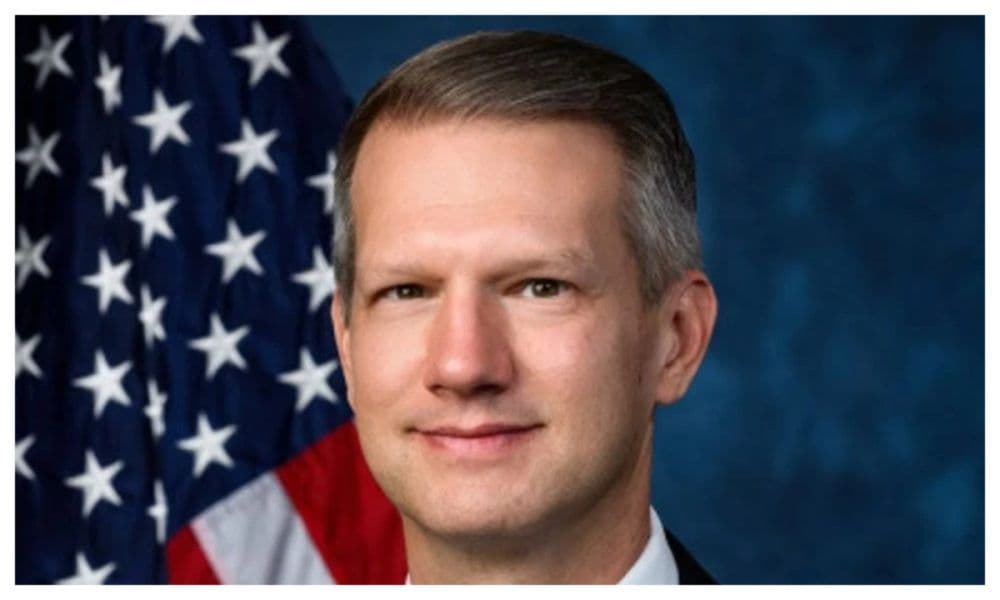
Moore made the remark during an interview on Noire TV.
The statement lands as Moore's involvement in Nigerian affairs has moved well past rhetoric. Over the past eight months he has authored sanctions-enabling legislation, led a White House-directed investigation, and helped secure Nigeria's redesignation as a "Country of Particular Concern." A campaign promise to "watch" an election two years out is the mildest thing he has said about the country all year.
Asked on Noire TV whether Washington had a role to play in Nigeria's next vote, Moore did not commit to a specific program or funding line. He offered only a pledge of attention. "We will be paying close attention to Nigeria's 2027 election," he said, adding that his office would track "how these elections will unfold and how they are executed." He did not name an election observation mission, a State Department initiative, or a dollar figure. There isn't one on record yet.
That vagueness is notable given how specific Moore has been on nearly every other Nigeria-related file this year. In February, he and Rep. Chris Smith (R-NJ), chairman of the House Foreign Affairs Africa Subcommittee, introduced the Nigeria Religious Freedom and Accountability Act of 2026, designated H.R. 7457. The bill would require the U.S. Secretary of State to compile and submit to Congress a report on U.S. efforts to address religious persecution and mass atrocities against Christians in Nigeria. Cosponsors include House Appropriations Committee Chairman Tom Cole and House Foreign Affairs Committee Chairman Brian Mast, giving the measure institutional weight beyond a single backbencher's bill.
The legislation's text is where the numbers live. According to reporting on the bill's language, it alleges that Fulani ethnic militias killed more than 9,500 people, mostly Christians, and displaced over half a million others between May 2023 and May 2025, citing attacks in Benue and Plateau states during Christmas and Easter periods. Separately, advocacy groups cited in congressional statements put this year's death toll at more than 7,000 Christians killed in Nigeria this year alone, a figure Moore's office has not independently disputed or confirmed through its own count.
Moore has told at least three American outlets this year that the bill's teeth are its sanctions provisions. In an interview on Newsmax, Moore said the legislation "focuses on looking at some of the bad actors there, specifically the Fulani," describing the group as engaged in violence against Christians. Sahara Reporters, a Nigerian outlet, reported that the bill would also weigh designating Fulani ethnic militias a Foreign Terrorist Organization and examine whether U.S. assistance in Nigeria was inadvertently enabling persecution. The bill separately names former Kano State Governor Rabiu Kwankwaso as a figure whose conduct could fall under its sanctions review, according to Daily Post's account of the legislation.
None of this happened in isolation from the executive branch. Moore has said repeatedly that his work followed a direct assignment. "As part of the investigation President Trump asked me to lead, I visited Nigeria and witnessed firsthand the horrors our brothers and sisters in Christ face," he said when the bill was introduced. That investigation culminated in a report Moore says he delivered to the White House in late February. Moore posted the report to his X account on a Tuesday, describing it as the product of a bipartisan congressional fact-finding visit, hearings with expert witnesses, and meetings with internally displaced persons and senior Nigerian officials. The report called for sanctions and for Nigeria to repeal its blasphemy and Sharia statutes.
By that point, the underlying diplomatic status had already shifted. President Trump redesignated Nigeria a Country of Particular Concern, a State Department classification reserved for the world's worst religious-freedom violators. Moore has cited that redesignation as validation of his own findings, telling supporters in a November resolution announcement that the designation gave Congress "a roadmap for action." Reaction from advocacy groups was immediate. Faith McDonnell, director of advocacy at Katartismos Global, said "Nigeria should not have been taken off the CPC list in the first place" and called for "severe sanctions" against the government.
Related News
- Former Nigerian President Olusegun Obasanjo has agreed to chair the October 4, 2026 Asaba Memorial Anniversary, adopting "Never Again" as its central theme.
- Nigeria's foreign minister pledged support Tuesday for UN programs on women's political participation and youth leadership.
- The Inter-Party Advisory Council warned Wednesday that court-ordered deregistration of political parties threatens Nigeria's constitutional democracy.
Not every claim attributed to Moore has held up. In early February, a viral document purporting to show Moore citing a "British 100-year Nigeria division" plan circulated widely online. TELL Magazine, a Nigerian publication, examined the claim and found no evidence Moore had presented such a document, a distinction that matters given how much of the Moore-Nigeria story now travels through social media clips and secondhand paraphrase rather than official transcripts.
The bilateral track has continued alongside the legislative one. In January, Moore praised the establishment of a US-Nigeria Working Group aimed at strengthening security cooperation, calling it "an encouraging and necessary step" in a statement posted to his official X account. That working group's plenary session was co-chaired by National Security Adviser Nuhu Ribadu and U.S. Under Secretary of State for Political Affairs Allison Hooker, held at the Office of the National Security Adviser in Abuja. Nigerian officials have described the sessions as the third high-level engagement with U.S. officials since November 2025.
What none of this settles is what "watching" a 2027 election actually means in practice. Moore's Noire TV comments contained no reference to funding for election observers, no mention of a specific State Department program, and no timeline for when his office might issue findings. H.R. 7457 remains in committee, without a floor vote scheduled. The White House has not published Moore's February report in full, and the State Department has not said whether the CPC designation will factor into any election-related posture toward Abuja. Nigeria's Independent National Electoral Commission has not responded to Moore's remarks. The election itself is roughly a year and a half away.
Add a Comment