


under a tax credit arrangement that lets private companies build public infrastructure in exchange for offsetting their tax bills.
The announcement matters because it expands, by two more projects, a financing model that already accounts for roughly N3 trillion in road construction nationwide, according to the company's own tally, at a time when the federal government has limited fiscal room to fund reconstruction in Nigeria's insurgency-scarred northeast.
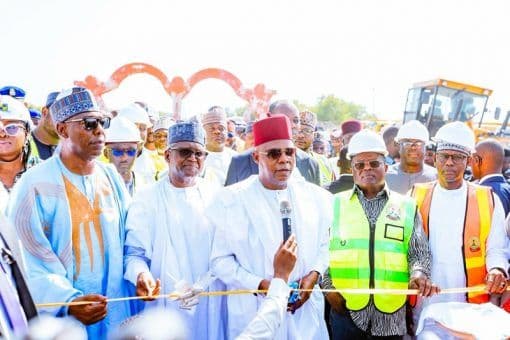
President Bola Ahmed Tinubu flagged off rehabilitation of the Bama–Banki and Dikwa–Gamboru Ngala roads in Borno State, according to a statement issued yesterday by Mohammed Ahmed, Director of Information and Public Relations at the Federal Ministry of Works. Dantata & Sawoe Nigeria Limited will serve as subcontractor on both projects. Neither the ministry's statement nor Dangote's remarks specified the individual cost of the two Borno roads.
A Scheme, Not a Contract
The projects fall under the Infrastructure Tax Credit Scheme, a federal program that allows companies to fund road construction directly and recover the cost through credits against future tax liabilities. It is not a conventional public works contract paid from budgeted capital expenditure.
Aliko Dangote, President and Chief Executive Officer of Dangote Group, said his conglomerate is currently executing 12 road projects worth about N3 trillion under the scheme. That figure, if accurate, would represent a substantial share of Nigeria's federal road financing in the current fiscal environment. It comes from Dangote himself, not from an independent audit or from the Federal Inland Revenue Service, which administers the tax credit mechanism.
Dangote called the scheme "a transformative model for financing critical infrastructure," according to the ministry's statement. He said quality roads and bridges stimulate economic activity, attract investment, and promote national prosperity. He added that his company is ready to undertake additional infrastructure projects across the country, a statement that, if acted on, would deepen private sector involvement in a policy area traditionally reserved for government procurement.
Security and Reconstruction
Related News
- The House of Representatives Committee on Crude Oil Theft called Thursday for a special court to try oil thieves and saboteurs, arguing existing legislation is too weak to deter the crimes.
- Tinubu Mourns Death of Ex-Ondo Commissioner, Wife of Lagos Ally "Baba Eto"
- Bengaluru police have seized 10.27 kilograms of MDMA crystals from a house in the Madanayakanahalli jurisdiction
The two roads chosen for yesterday's flag-off carry weight beyond asphalt and drainage. Bama, Banki, Dikwa, and Gamboru Ngala are towns that endured years of Boko Haram and Islamic State West Africa Province activity, and the corridors connecting them have been damaged or rendered unsafe for long stretches since the insurgency began in 2009. The ministry's statement described the projects as critical to improving security, reviving economic activity, and reconnecting communities.
Reopening those corridors would restore commercial links between Borno's population centers and the Cameroonian border crossing at Gamboru Ngala, a route that was historically a major artery for cross-border trade before militant attacks closed it. The statement did not include a construction timeline or completion date for either road.
Dangote also praised Works Minister David Umahi, describing him as "a conqueror" for his commitment to infrastructure delivery, according to the ministry's account of the event. Umahi has overseen an expansion of the tax credit scheme since taking office, though the ministry's statement did not detail how many companies besides Dangote currently hold active tax credit road agreements, or what portion of the scheme's total value the Dangote contracts represent.
What the Statement Leaves Out
The ministry's release, distributed under Ahmed's byline, functions largely as a record of remarks made at the flag-off ceremony rather than a technical briefing on contract terms. It does not name the government agency responsible for verifying construction quality on tax credit projects, nor does it disclose the tax offset value Dangote Industries will receive against its liabilities. It does not say whether the Borno contracts were competitively bid or directly negotiated, a distinction that matters under Nigeria's Public Procurement Act.
Dantata & Sawoe's role as subcontractor is stated once, without elaboration on the scope of work the firm will perform relative to Dangote Industries. The company has a long history of federal road construction in Nigeria, including projects in the northeast, but the statement does not specify prior work on these particular corridors.
Six words summarize what is publicly verifiable so far: two roads, one scheme, no figures.
The tax credit model itself has drawn scrutiny before. Because credits are applied against a company's future tax obligations rather than paid out in cash, independent tracking of the scheme's fiscal cost falls largely to FIRS internal reporting, which is not typically published in a form that allows outside verification of individual project valuations.
What happens next is where the story is unresolved. The Federal Ministry of Works has not published a signed contract, a cost schedule, or a completion date for the Bama–Banki and Dikwa–Gamboru Ngala roads. FIRS has not confirmed the tax credit value attached to either project. And Dangote's claim of N3 trillion in road works across 12 projects nationwide has not been matched, in the public record, against an independent government accounting of the scheme's total size. Until one of those numbers surfaces, the size of the tax break behind yesterday's ceremony in Borno remains the government's word against itself.
Add a Comment