


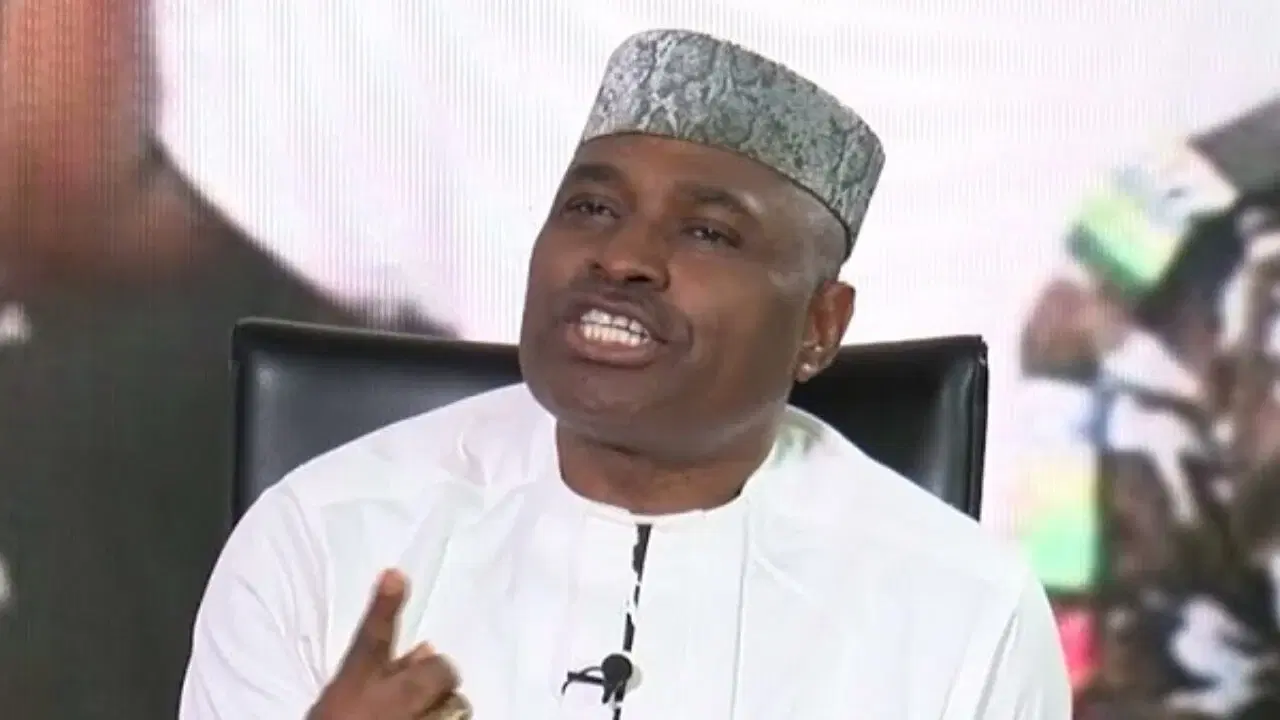
Former Labour Party presidential campaign spokesman, Kenneth Okonkwo, has said that defeating President Bola Tinubu in the 2027 general elections will only be possible if opposition forces unite under a broad coalition, warning that fragmented opposition efforts would hand the ruling All Progressives Congress a clear path to victory.
Okonkwo, who served as a spokesperson for the Labour Party Presidential Campaign Council during the 2023 elections, made the remarks in an interview with journalist Chibuike Chukwu, where he spoke extensively on the emerging African Democratic Congress coalition, the risks of internal rivalry, and why zoning the presidency could weaken the opposition’s chances.
According to him, the recent convergence of opposition figures around the ADC represents the first serious political threat to the Tinubu administration since it assumed office.
Why Okonkwo Believes a Coalition Changes the Equation
Okonkwo argued that the ruling APC’s long-term strategy has been to weaken opposition parties individually to ensure President Tinubu faces no formidable challenge in 2027. However, he said the formation of a coalition has disrupted that calculation.
According to him, the APC underestimated the possibility that opposition leaders would overcome internal divisions and work together.
“The assumption was that the opposition would never come together,” Okonkwo said. “Now that they have, it means that what the APC thought it knew about the opposition is not correct.”
He added that widespread economic hardship has created conditions that could fuel electoral change if voters are presented with a credible alternative.
To illustrate the impact of rising living costs, Okonkwo cited the expense of domestic travel, accommodation, and logistics, arguing that such realities have made governance failures tangible to everyday Nigerians.
Related News
According to him, hardship without a political alternative breeds frustration, but hardship combined with a viable platform creates momentum for change.
Background: Opposition Fragmentation and the 2023 Experience
Nigeria’s opposition landscape has historically struggled with unity. In the 2023 elections, votes were split among multiple challengers, a factor analysts say benefited the APC.
Okonkwo said the coalition effort is an attempt to correct that structural weakness ahead of 2027.
Political observers note that coalition-building has become more urgent as incumbency advantages, including access to state resources and influence over institutions, make it increasingly difficult for fragmented opposition parties to compete.
Concerns Over INEC and Electoral Credibility
Asked about fears that the same Independent National Electoral Commission and judicial system would oversee the 2027 elections, Okonkwo said those concerns were precisely why unity was essential.
He recalled his earlier calls for coalition politics, which he said were initially dismissed but later embraced by opposition figures.
According to Okonkwo, competing against an incumbent without unity would leave the opposition vulnerable to manipulation.
He reiterated criticisms of the conduct of the 2023 elections, particularly the failure of electronic result transmission, which INEC attributed to technical issues.
Okonkwo disputed that explanation, arguing that genuine technical failures are usually transparent and accompanied by corrective measures.
He contrasted INEC’s handling of the 2023 elections with how the Joint Admissions and Matriculation Board addressed technical issues in past examinations, noting that JAMB publicly identified affected centres and rescheduled exams.
According to him, the absence of similar corrective steps in the election process has deepened mistrust.
Why Reform Alone May Not Be Enough
While acknowledging the importance of electoral reforms, Okonkwo said waiting for legislative changes alone would be unrealistic, especially as electoral amendments are unlikely close to an election year.
Instead, he argued that overwhelming voter turnout combined with a united opposition could reduce the effectiveness of any attempts at manipulation.
“The power of the people will always be stronger than the people in power,” he said, referencing the defeat of former President Goodluck Jonathan in 2015 as evidence that incumbents can be unseated under the right conditions.
Managing Ambition Within the Coalition
Political analysts have raised concerns that individual ambitions among coalition members could fracture the alliance, given that figures such as Atiku Abubakar, Peter Obi, and Rotimi Amaechi have all previously harboured presidential ambitions.
Okonkwo acknowledged the risk but described ambition as an unavoidable element of democratic politics.
“Politics is about ambition,” he said, adding that coalition members must focus on building grassroots support and allow the primary process to determine candidates.
According to him, internal competition does not automatically doom a coalition, provided the rules are clear and accepted by all participants.
Why Okonkwo Rejects Zoning for the Opposition
One of Okonkwo’s most controversial positions is his opposition to zoning the presidency within opposition ranks.
He argued that zoning is a luxury for ruling parties, not opposition movements trying to dislodge an incumbent.
Tracing Nigeria’s post-1999 political history, Okonkwo said the informal zoning arrangement has been repeatedly disrupted by unforeseen events, including the death of President Umaru Musa Yar’Adua and subsequent political realignments.
He maintained that the constitution clearly defines presidential tenure as four years, not eight, and that claims of entitlement based on zoning must give way to strategic realities.
According to Okonkwo, the current political moment represents what he described as a “supervening event,” driven by widespread dissatisfaction with governance.
In such circumstances, he said, opposition parties should field their strongest candidate, regardless of region, while committing to a single four-year term if necessary to restore balance.
Strategic Lessons From Past Elections
Okonkwo also pointed to President Tinubu’s own political calculations in earlier elections, noting that Tinubu did not contest against an incumbent when conditions were unfavourable.
Instead, he supported a candidate capable of mobilising broad regional support, positioning himself for a future contest.
According to Okonkwo, opposition parties must adopt a similarly strategic approach rather than relying on sentiment or entitlement.
What to Watch as 2027 Approaches
As coalition talks continue, attention will focus on whether opposition leaders can manage internal rivalry, agree on transparent primary processes, and maintain unity through the election cycle.
Observers will also be watching how economic conditions evolve and whether public dissatisfaction translates into sustained political mobilisation.
For Okonkwo, the stakes are clear. Without unity, he said, the opposition risks repeating past mistakes.
Kenneth Okonkwo’s argument places coalition politics at the centre of Nigeria’s 2027 electoral calculations. While acknowledging the challenges of ambition, distrust, and institutional credibility, he insists that unity remains the opposition’s most powerful tool.
Whether that unity can be sustained may ultimately determine whether President Tinubu faces a serious challenge or secures a second term.
Add a Comment