


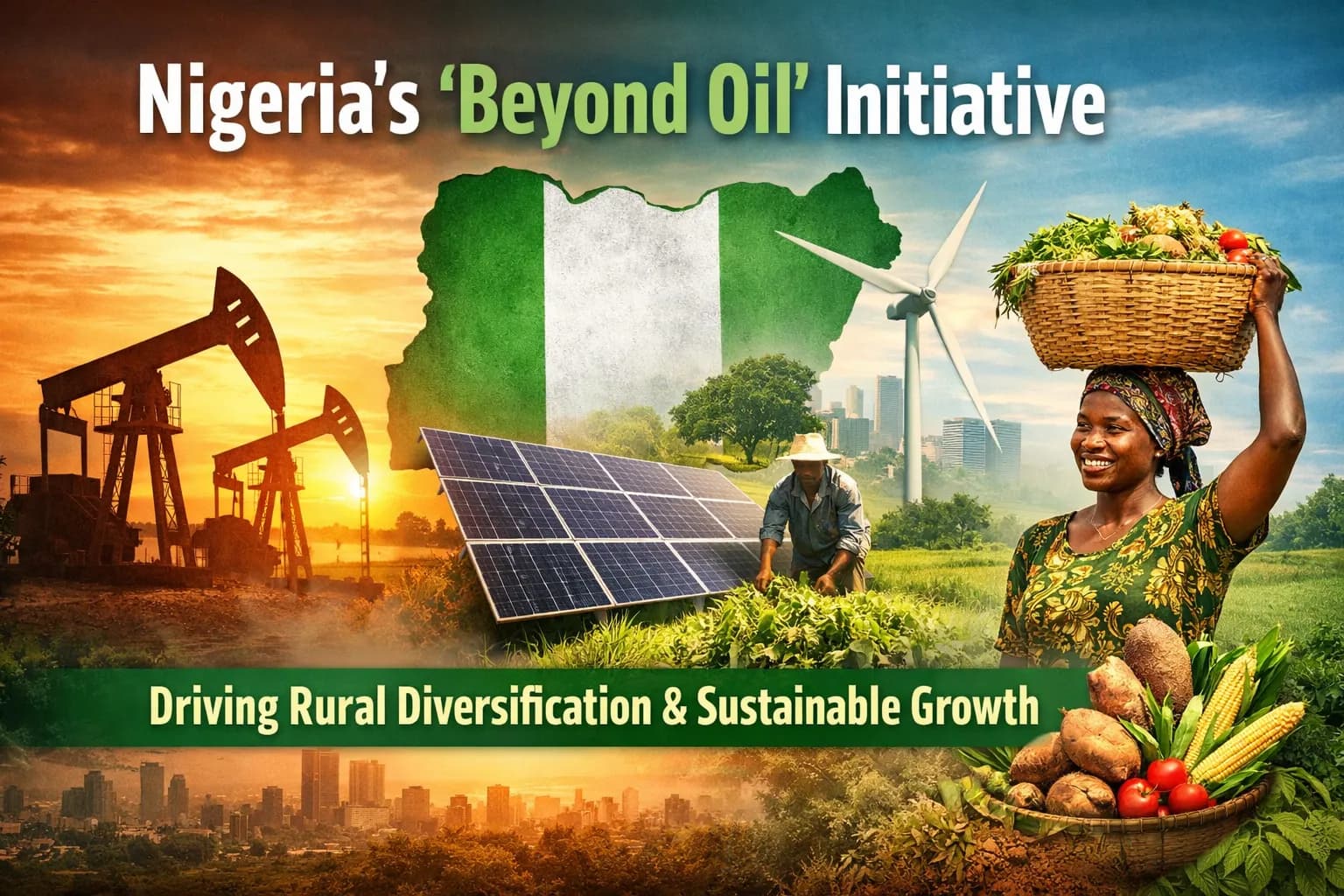
Nigeria launches the Beyond Oil Fund to drive economic diversification, renewable energy, and rural growth through sustainable climate-smart policies.
Abuja, Nigeria — In a strategic effort to reduce the nation’s long-standing dependence on oil and gas revenues, the Federal Government has formally unveiled the Nigeria Beyond Oil and Gas Alliance Fund Programme. The two-year initiative is designed to assess the risks and opportunities posed by the country’s changing energy sector and to guide evidence-based policies that support economic diversification across Nigeria’s rural communities and broader economy.
Unveiled at the Abuja Continental Hotel on February 12, the programme brings together key government ministries, development partners, civil society groups, and private sector representatives to tackle the structural challenges of an economy historically dominated by hydrocarbons. According to organisers, the initiative is intended not just as a study exercise but as a catalyst for reshaping Nigeria’s economic foundations in a manner consistent with climate commitments, including its Nationally Determined Contribution (NDC) under the Paris Agreement.
Background: Why Nigeria’s Economy Needs Diversification
For decades, Nigeria’s economic fortunes have been closely tied to oil and gas, which account for a significant share of government revenue and foreign exchange earnings. However, this dependency has made the economy vulnerable to global price shocks and volatility. As global energy markets shift and net-zero goals take shape, policymakers increasingly see diversification as essential for long-term stability.
Nigeria also recently updated its climate strategy to feature fossil gas as a transitional energy source while pursuing renewable expansion, acknowledging that the transition away from hydrocarbons will be gradual. Critics argue that prioritising gas could entrench fossil fuel reliance without adequate investment in renewables and clean energy infrastructure.
Programme Goals and What It Seeks to Achieve
The Nigeria Beyond Oil and Gas Alliance Fund Programme aims to:
- Evaluate transition risks and identify potential economic opportunities outside oil and gas.
- Strengthen analytical foundations for policy-making.
- Support coordinated dialogue among stakeholders, including government, private sector, and civil society.
- Translate research findings into actionable recommendations aligned with national climate and development goals.
Officials say the programme will examine impacts across the oil and gas value chain while highlighting alternative sectors that could drive future growth. Activities will include scenario analysis, transition risk assessments, stakeholder engagement, and identification of viable economic alternatives for affected regions and workers.
Voices from the Launch: Policy Leaders Weigh In
At the launch, Senator Abubakar Atiku Bagudu, Minister of Budget and Economic Planning, underscored the importance of marrying economic diversification with environmental responsibility. He argued that while Nigeria cannot abandon its status as an energy producer, it must apply technology and innovation to traditional sectors such as agriculture, fishing, artisanal mining, and woodwork to unlock added value.
“Effective diversification must be anchored in strong climate consciousness and leverage the innovations available to us,” Bagudu said, noting that this approach could strengthen Nigeria’s resilience while creating sustainable jobs for its growing population.
Related News
Omotenioye Majekodunmi, Director-General of the Nigerian Council on Climate Change (NCCC), described the launch as a milestone on Nigeria’s transition journey. She said the programme represents an evolution toward a climate-smart economic model rather than a retreat from energy prominence.
From the international perspective, Sian Bradley, Head of the Beyond Oil and Gas Alliance (BOGA) Secretariat, emphasized BOGA’s role in supporting countries at early stages of transition planning, particularly to ensure equity and justice for workers and communities affected by change.
Dr Olumide Abimbola, Executive Director of the Africa Policy Research Institute (APRI) — the programme’s lead implementing partner — said the initiative would help Nigeria better understand how global energy shifts could influence jobs, revenues, and industries, and what policies could support competitiveness in emerging sectors.
Nigeria’s recent economic performance has been marked by challenges including fiscal pressure, inflation, and unemployment. Analysts have warned that without diversification, the country could face heightened economic vulnerability as global energy demand evolves. By investing in structural transformation now, policymakers hope to reduce dependency on volatile oil revenues and expand opportunities in sectors like agriculture, manufacturing, and clean energy.
A 2024 study of rural electrification preferences showed that households and small businesses in remote areas value reliable, low-cost energy solutions, highlighting demand for investments in renewable energy and connectivity that could be supported under diversification programmes.
Implications for Rural Nigeria
Rural communities in Nigeria account for a large share of agricultural output but often lack access to modern infrastructure, finance, and markets. For example, in the northern states, farmers struggle with inconsistent power supplies which limit irrigation and processing capacity. Analysts suggest that programmes like the BOGA Fund can help design policies that provide targeted support, such as improved energy access, climate-resilient farming practices, and value-chain development.
Data point suggestion for an infographic: Percentage of Nigeria’s GDP currently derived from oil and gas vs agriculture and services (e.g., oil & gas share vs. non-oil sector growth).
Potential Challenges and What to Watch Next
While the programme is intended to drive policy coherence and evidence-based solutions, experts caution that actual impact will depend on implementation. Key factors to monitor include:
- Funding transparency and accountability
- Integration of local stakeholder inputs into policy recommendations
- Progress in aligning diversification strategies with national climate goals
Civil society groups have also called for clear benchmarks and timelines to ensure that policy recommendations translate into concrete actions on the ground.
Nigeria’s Beyond Oil and Gas Alliance Fund Programme represents a significant policy push toward economic resilience and climate-informed development. By placing analytical rigour, stakeholder engagement, and policy innovation at the heart of diversification planning, the initiative sets a foundation for long-term transformation. However, translating high-level dialogue into tangible benefits for rural communities will be the true test of its success.
Add a Comment