


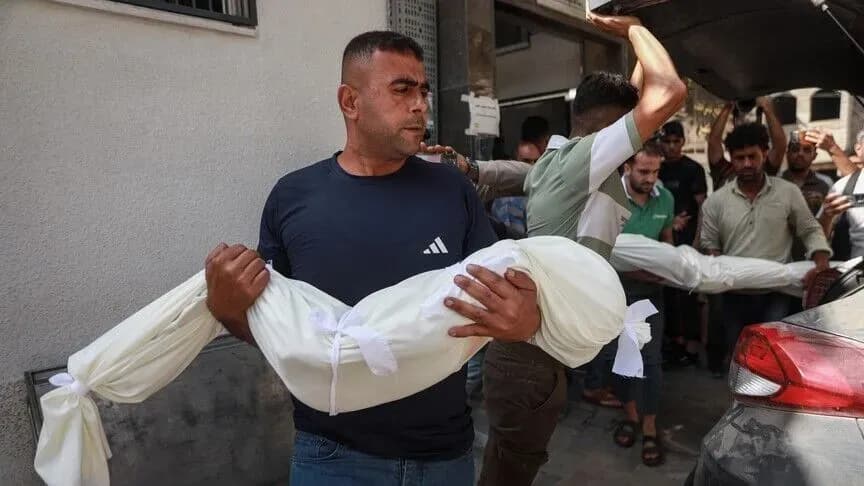
The killings matter because they are not exceptional. They are routine. Since the truce took effect on October 10, 2025, Israeli attacks have killed at least 1,084 Palestinians and injured 3,491 others, according to Gaza's Health Ministry, a toll that keeps climbing under an agreement both sides still describe as holding.
Wednesday's dead were spread across five locations. A drone strike hit a civilian vehicle west of Gaza City, killing one Palestinian and wounding two others, a medical source told Anadolu. A separate drone strike targeted a gathering of civilians on Al-Oyoun Street in the Sheikh Radwan neighborhood, killing one person and injuring another. In Zeitoun, south of Gaza City, a six-year-old child died of wounds sustained from Israeli gunfire.
The single deadliest strike came in the south. An Israeli airstrike hit a tent sheltering displaced civilians in Al-Mawasi, west of Khan Younis, killing four Palestinians, among them a father and his son, and wounding ten others.
A sixth death came by a different method entirely. An aid truck driver, identified by local sources as Ahmad Nasser Isleem, was shot in the head by Israeli forces in Rafah while waiting inside his truck to load aid, a medical source said. His body was taken to Nasser Hospital in Khan Younis.
A pattern, not an anomaly
Wednesday's toll folded into a week already marked by lethal incidents. An eight-year-old child died Tuesday evening of wounds from an Israeli strike that hit a civilian vehicle in the Sabra neighborhood of Gaza City, a medical source said. Gaza's Civil Defense separately reported that a woman was wounded by fire from Israeli gunboats west of Gaza City, though it gave no detail on the nature of her injury.
Not every incident Wednesday produced casualties. The Israeli army fired several artillery shells toward the eastern and southern edges of the Bureij refugee camp in central Gaza, according to local sources and eyewitnesses. Israeli vehicles opened fire toward displacement tents in Al-Mawasi, northwest of Rafah, but no injuries were reported there.
That mix, lethal strikes in some neighborhoods, unclaimed shelling in others, mirrors a broader tally that outside monitors have tracked since October. Gaza's Government Media Office recorded 3,465 ceasefire violations between October 10, 2025, and June 29, 2026, including 921 instances of shooting at civilians and 1,109 bombings or shelling incidents, according to figures reported by Al Jazeera. By that count, Israel struck Gaza on 244 of the truce's first 271 days, leaving only 27 days without a violent incident.
Related News
The figures in Wednesday's report track closely with the most recent independent tallies. Al Jazeera reported on July 1 that 1,072 Palestinians had been killed and 3,463 wounded since the ceasefire began, sourced to the Palestinian Ministry of Health. The nine deaths and roughly 28 injuries reported here would move those totals to the 1,084 killed and 3,491 injured cited in Wednesday's account, a difference consistent with the week that elapsed between the two counts.
The wider death toll
Wednesday's nine deaths sit inside a far larger figure. The Israeli military has killed more than 73,000 Palestinians and injured over 173,000 others since October 2023, according to the same Health Ministry tally, which United Nations agencies have described as generally reliable despite being maintained by a ministry operating under Hamas-led administration. The Ministry of Health's own count reached 73,098 confirmed dead as of the most recent tracking cited by Al Jazeera, including at least 21,500 children.
The destruction underlying those numbers is not confined to casualties. About 90% of Gaza's civilian infrastructure has been affected by the offensive, according to the toll reported alongside Wednesday's killings, a level of damage the Brookings Institution has estimated will cost roughly $70 billion to reverse.
None of this is occurring in a legal vacuum, at least on paper. The ceasefire took effect at noon on October 10, 2025, following a signing ceremony attended by representatives of roughly 30 countries and brokered with the involvement of Egypt, Qatar and Turkiye. Its first phase called for an end to hostilities, the lifting of Israel's blockade on aid, the release of all captives held in Gaza, and a partial withdrawal of Israeli forces to what negotiators termed the "yellow line." The Israeli military disputes that the strikes constitute violations, and has characterized many of its actions since October as retaliatory, responding to what it calls breaches by Hamas or armed groups operating from Gaza.
Whatever the legal framing, aid delivery has fallen well short of what the ceasefire promised. Between October 10 and June 20, only 55,539 aid trucks entered Gaza out of an allocated 156,000, according to the Gaza Government Media Office, a shortfall of 64 percent against the volume the agreement called for.
The truce's second phase, which was meant to include Hamas's disarmament and a fuller Israeli military withdrawal, has not moved forward. Nickolay Mladenov, the high representative overseeing implementation for the Board of Peace, said in May that the plan remains paralyzed over the disarmament question, with no resolution date set by either side.
What remains unresolved after Wednesday's deaths is the same question that has hung over the ceasefire since October: whether the mediating powers, the United States, Egypt, Qatar and Turkiye among them, will treat a toll now exceeding 1,080 dead since the truce as a violation requiring enforcement, or continue to describe the agreement as holding. No mediator had issued a public response to Wednesday's strikes as of this writing.
Add a Comment