


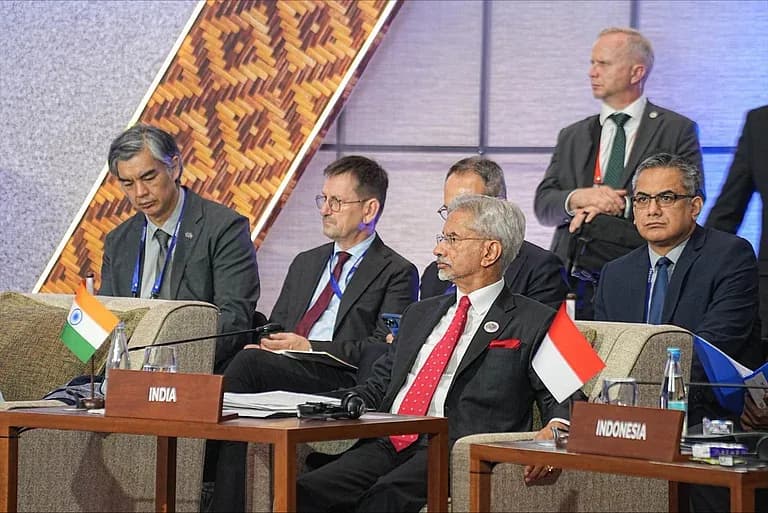
External Affairs Minister S Jaishankar told the 33rd ASEAN Regional Forum on Thursday that acts of terrorism will have consequences and there must be zero tolerance towards terror.
The statement matters because it was delivered inside a security forum that includes China, at a summit devoted to exactly the maritime and territorial disputes Beijing has spent a decade managing bilaterally rather than multilaterally. The visit falls within 2026, which India and ASEAN have designated the Year of Maritime Cooperation, giving Jaishankar's remarks on shipping lanes and the South China Sea more institutional weight than a routine bilateral statement would carry.
The terrorism language
Addressing the ARF Ministerial Meeting in Manila, Jaishankar said: "There must be zero tolerance for terrorism. Nor should there be any doubt that acts of terrorism will have consequences." He did not name a country or an incident. He said the priority now should be choking off the financial resources that sustain terrorist networks.
That line connects to an existing structure, not a new one. India co-chairs the Experts' Working Group on counter-terrorism with Malaysia, under the ASEAN Defence Ministers' Meeting Plus framework, and is leading preparation of a compendium of best practices on the subject. No release date for that compendium has been given.
This is not the first time Jaishankar has used this exact phrase this year. In January, during talks with Spanish counterpart José Manuel Albares Bueno in New Delhi, he called for a "zero-tolerance approach towards terrorism," and in October last year, at the East Asia Summit in Kuala Lumpur, he made a similar call, describing terrorism as one of the biggest threats to global peace and stability. The Manila remarks extend a position India has stated repeatedly across three different summits in nine months.
Shipping lanes and an unnamed threat
Jaishankar described attacks on merchant shipping and civilian infrastructure as "unacceptable," stressing that commerce through international waterways must remain safe and free from disruptions. The comment did not identify a specific attack or actor.
Related News
- Lobbyist Sends Old DOJ Drug Records on Tinubu to Trump, Congress
- Sheikh Hamad bin Khalifa Al Thani, who ruled Qatar for 18 years, died Sunday morning at age 74.
- At least nine Palestinians were killed by Israeli fire in Gaza on Wednesday, medical sources told Anadolu, in the latest breach of a ceasefire now in its ninth month.
He tied that statement to India's broader Indo-Pacific approach, posting on X that the Manila Plan of Action's five pillars align with India's own framework, and that India favors a collaborative model for disaster relief built on shared best practices and joint exercises.
He then listed the operational tools India says back that framework. Those include the Information Fusion Centre and the Indo-Pacific Maritime Domain Awareness initiative, alongside the forward deployment of Indian naval forces from the North Arabian Sea to the Western Pacific, presented as instruments against piracy, trafficking and narcotics smuggling while keeping trade routes open.
The South China Sea position
On the region's central territorial dispute, Jaishankar said India looks forward to a Code of Conduct that is "substantive, effective and legally binding" and fully compliant with the 1982 UN Convention on the Law of the Sea, one that does not prejudice the legitimate rights of all users of those waters.
That formulation, "does not prejudice the legitimate rights of all users," is doing specific work. It commits India to a position without naming Beijing as the party whose claims might conflict with it. The Code of Conduct negotiations between ASEAN and China have run for years without a concluded text; Jaishankar's remarks do not include a timeline for when, or whether, that negotiation might close.
A packed schedule, several other threads
Jaishankar also urged vigilance against actors undermining non-proliferation and disarmament commitments, called for a responsible and human-centric approach to artificial intelligence, and pressed for deeper international cooperation on cybercrime. On disaster response, he cited India's recent relief deployments following cyclones in Sri Lanka, the Philippines and Jamaica, and earthquakes in Myanmar, Venezuela and Afghanistan, delivered through field hospitals, search and rescue teams and relief supplies.
The Manila trip ran July 22 to 23 and included the ASEAN-India Foreign Ministers' Meeting, the East Asia Summit Foreign Ministers' Meeting, and the ARF sessions themselves, alongside a Quad Foreign Ministers' Meeting where India, the United States, Japan and Australia reaffirmed their commitment to a free and open Indo-Pacific and to ASEAN centrality.
On the margins, Jaishankar met Australian Foreign Minister Penny Wong to follow up on Prime Minister Narendra Modi's recent visit to Australia, and separately met Philippines Foreign Secretary Theresa Lazaro to discuss trade, defence, maritime cooperation and capacity building under the India-Philippines Strategic Partnership. He also held a brief exchange with EU High Representative Kaja Kallas, describing it on X as a "catch-up."
What remains open
None of the released material specifies what "consequences" a terrorist act would trigger under India's stated policy, nor which country or incident prompted the language. No text of the South China Sea Code of Conduct has been finalized by ASEAN and China, and Jaishankar's remarks set no deadline for its conclusion. Beijing's Ministry of Foreign Affairs has not yet responded to the Manila remarks on maritime claims, and the compendium of counter-terrorism best practices that India is leading under the ADMM+ framework carries no announced publication date.
Add a Comment