


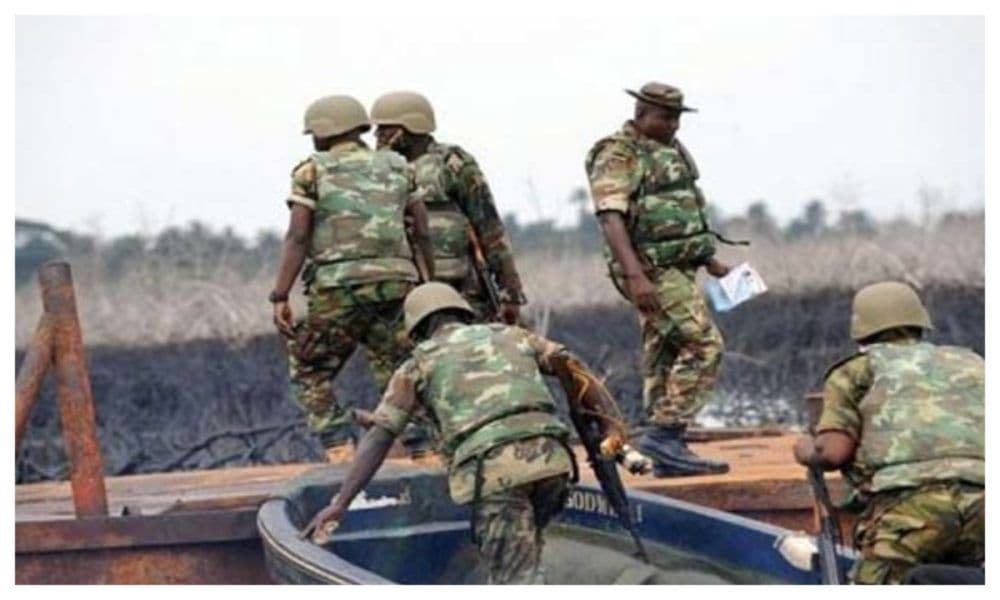
The Nigerian Navy uncovered nine illegal refining sites and 23 dugout pits in Bonny Local Government Area of Rivers State, recovering an estimated 104,000 litres of products suspected to be stolen crude oil.
The raid is the latest in a string of strikes under Operation Delta Sentinel, the Navy's campaign against oil theft in the Niger Delta. It lands at a moment when crude theft remains one of the largest drains on Nigeria's oil revenue, a problem the federal government has spent years and billions of naira trying to contain.
What was found
Personnel of Forward Operating Base Bonny carried out the operation following actionable intelligence, according to a Navy statement posted to its official X account on Thursday. The operation targeted illegal refining infrastructure concealed within the Wakama/Bolo and Aworkiri communities, aimed at stopping suspected oil thieves from expanding their operations.
Troops uncovered nine illegal refining sites comprising 23 dugout pits. Of those, eighteen pits held the estimated 104,000 litres of suspected stolen crude, while five newly dug pits, prepared for use but not yet active, were destroyed before they came online.
That distinction matters. Eighteen pits were already running. Five more were staged to follow.
The Director of Naval Information, Navy Captain Abiodun Folorunsho, said personnel also recovered eight locally fabricated refining pots and three large storage tanks, further disrupting the network's capacity to process stolen crude. The Navy said all recovered facilities and products were handled in line with existing anti-crude oil theft procedures.
No arrests were announced in the statement. No suspect names, no vessel seizures, no court referral. The release describes infrastructure destroyed, not individuals detained.
Related News
- Nigerian troops killed an ISWAP cameraman on July 12, the Nigerian Army says
- Japan has committed roughly $1 million to train at least 2,000 Nigerian teachers and school leaders in digital skills.
- A pipeline surveillance contract worth roughly 48 billion naira a year sits at the center of Nigeria's oil production recovery
A named spokesman, an operational report
The account came from Captain Folorunsho in a statement, who said the Bonny raid demonstrated the Navy's commitment to protecting Nigeria's oil and gas infrastructure and disrupting economic saboteurs. The discovery itself was disclosed in an operational report issued on Tuesday in Abuja, according to The Nation's account of the same statement, two days before the Navy's public social media post.
That gap, Tuesday's internal report to Thursday's public statement, is not explained. Whether the 48-hour lag reflects verification procedure, operational security, or simple scheduling is not addressed in any of the released material.
Folorunsho said the operation prevented the activation of new illegal refining locations and denied criminal networks the chance to expand illicit petroleum production. He is quoted directly: "Through intelligence-driven operations, the Service continues to reduce the ability of criminal groups to rebuild their networks while safeguarding the nation's economic assets."
That phrase, "rebuild their networks," is doing real work. It concedes the syndicates keep coming back.
A pattern, not an isolated raid
The Bonny operation is not the only Delta Sentinel action logged this month. On July 10, 2026, personnel aboard the Nigerian Navy Ship Pathfinder discovered and dismantled illegal refining sites in the Egbema axis of Ogba-Egbema-Ndoni Local Government Area, also in Rivers State. Criminal operators then attempted to resume production at those same locations, prompting continuous surveillance and a follow-up strike.
In that second operation, naval personnel recovered roughly 76,000 litres of suspected stolen crude and 50,000 litres of suspected illegally refined Automotive Gas Oil, concealed across seven dugout pits and reservoirs, pushing the combined recovery for that single site past 126,000 litres.
Two things follow from that timeline. First, destroying a refining site does not permanently remove it. Syndicates returned to the Egbema location within days. Second, the Navy's own reporting shows repeat strikes are now standard procedure, not exceptional follow-up.
Neither statement, on Bonny or Egbema, discloses the market value of the recovered products, the identity of any syndicate involved, or how the crude entered the illegal supply chain in the first place, whether siphoned from pipelines, diverted from flow stations, or sourced elsewhere. The Navy's own framing describes the material only as "products suspected to be stolen crude oil," a formulation repeated across every version of the statement reviewed, and one that stops short of confirming the crude's origin pending further testing or investigation.
What remains open
The Nigerian National Petroleum Company has not issued a statement tying the Bonny recovery to specific pipeline losses or flow station shortfalls in Rivers State. No figure has been published estimating the financial value of the 104,000 litres seized, nor of the additional volumes recovered at Egbema on July 10 and in the days following. The Ministry of Petroleum Resources has not said whether any of the nine Bonny sites will be referred for prosecution, or whether, as at Egbema, they will simply be watched for reactivation.
Add a Comment