


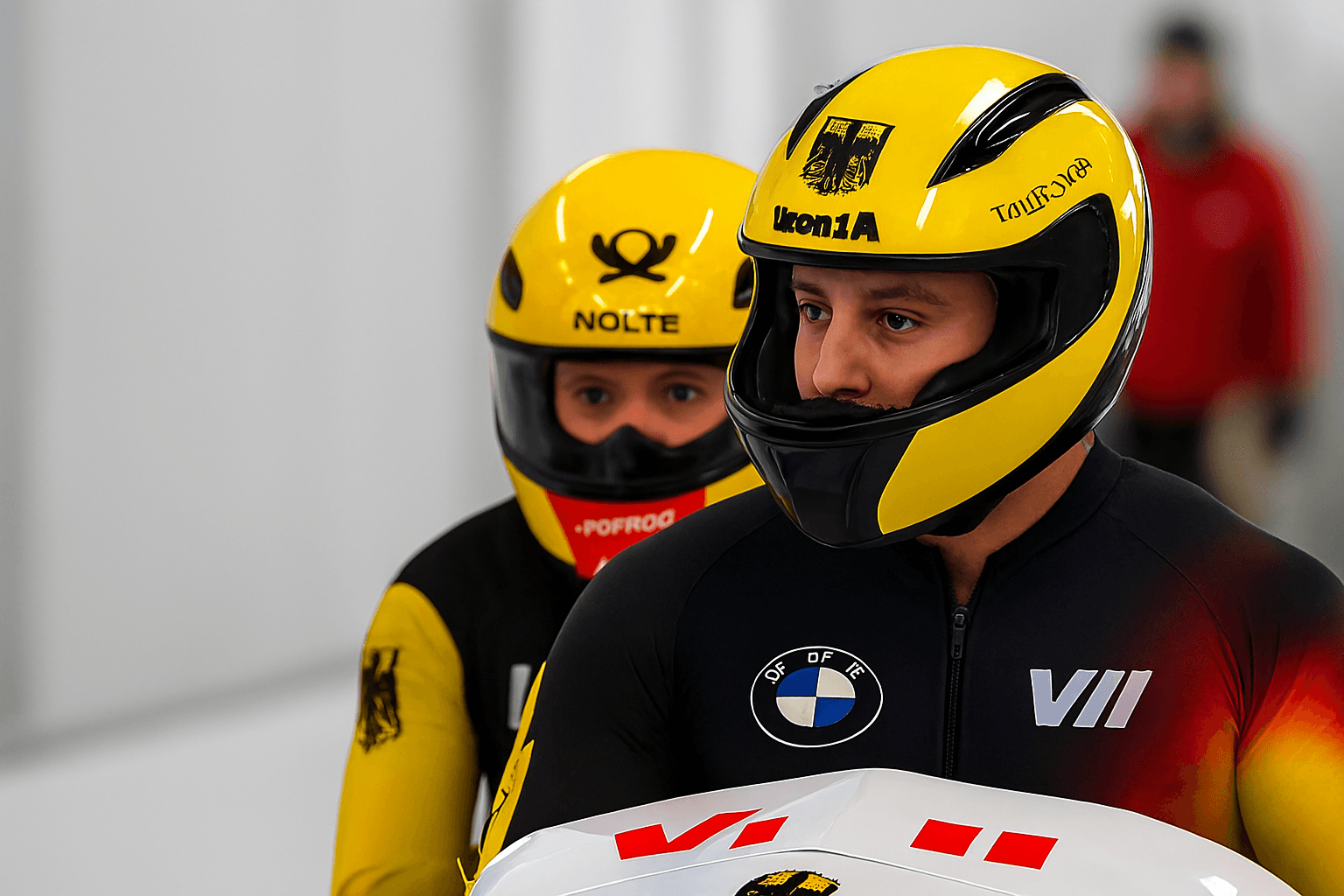
As the Olympic Winter Games Milano Cortina 2026 approach, bobsleigh is once again shaping the competitive narrative of the Winter Olympics. From 12 to 22 February, athletes will race for medals at the Cortina Sliding Centre, a new venue that will host all four Olympic bobsleigh disciplines and test competitors in ways few tracks have done before.
Germany arrives in Italy as the sport’s reference point. At the Beijing 2022 Winter Olympics, German teams claimed seven of the 12 bobsleigh medals available, including three gold medals. That performance reinforced a decade of sustained success built on technical expertise, athlete development and internal competition. The question now is whether that dominance can be repeated on unfamiliar ice, against a deeper and more internationally competitive field.
A new Olympic track with little margin for error
The Cortina Sliding Centre, informally named after Italian Olympic champion Eugenio Monti, represents one of the most significant unknowns of the 2026 Games. Unlike long established tracks in Germany, Austria or Canada, Cortina offers limited competitive history. Many athletes have only logged training runs rather than full race weekends on the course.
According to officials, the track was designed to reward clean driving and consistent lines rather than raw speed alone. Its combination of steep gradients, technical curves and long straight sections places equal emphasis on steering precision and start performance. Even minor mistakes could prove costly, particularly in multi heat events where fractions of a second accumulate quickly.
Organisers have confirmed record participation in the women’s monobob and two woman competitions. The men’s two man and four man events are also expected to feature one of the most diverse fields in Olympic history, with emerging programs from Asia and Europe challenging traditional powers.
That combination of a new venue and expanded global participation has introduced an element of uncertainty that has been largely absent from recent Games.
Friedrich seeks to extend a modern era of dominance
At the centre of the men’s competition is Francesco Friedrich, the most successful bobsleigh pilot of his generation. The German driver enters Milano Cortina 2026 as the reigning Olympic champion in both the two man and four man events, having defended his titles at PyeongChang 2018 and Beijing 2022.
A fifth Olympic gold medal would move Friedrich into unprecedented territory in the sport. His success has been defined not only by results, but by an approach that prioritises technical refinement and data driven preparation. Over multiple seasons, his teams have consistently produced the fastest start times and some of the cleanest runs on the World Cup circuit.
Related News
However, Friedrich’s path to history is complicated by intense competition from within his own team. Johannes Lochner finished the 2025 26 season at the top of the combined World Cup rankings and has repeatedly demonstrated the ability to outperform Friedrich under certain track conditions. Their rivalry has driven performance standards higher across German bobsleigh and remains one of the sport’s most closely watched dynamics.
Beyond Germany, several athletes continue to narrow the gap. Great Britain’s Brad Hall has improved his consistency across full seasons, while Austria’s Markus Treichl and South Korea’s Kim Jinsu have delivered podium level performances in recent World Cup events. While Germany remains favoured, the margin for error has grown increasingly slim.
Women’s competition reflects changing balance of power
In the women’s events, Germany also enters with strong credentials, led by Laura Nolte. The reigning Olympic champion in the two woman discipline, Nolte finished the 2025 26 season ranked first overall and has established herself as one of the most reliable performers in elite bobsleigh.
Nolte’s consistency across monobob and two woman events has made her a central figure in medal projections. However, competition within the German team remains fierce. Lisa Buckwitz has remained close in the rankings and continues to demonstrate exceptional start speed, a critical advantage on a track like Cortina.
Austria’s Katrin Beierl has also emerged as a regular contender, particularly in technical tracks where driving accuracy outweighs raw power. Meanwhile, the United States returns with one of the most experienced lineups in the field.
Beijing 2022 monobob medallists Kallie Humphries and Elana Meyers Taylor are both expected to challenge again, joined by reigning world monobob champion Kaysha Love. Team USA’s strength lies in depth rather than reliance on a single athlete, a factor that could prove decisive across a demanding Olympic schedule.
Why monobob could reshape expectations
One of the most significant developments in recent Olympic cycles has been the growth of women’s monobob. Unlike the two woman event, monobob uses standardized sleds, reducing the influence of equipment advantages and placing greater emphasis on driving skill and start execution.
At Milano Cortina 2026, monobob features a record number of qualified athletes. Analysts believe this discipline offers the clearest opportunity for upsets, particularly on a track where familiarity is limited. For emerging programs, monobob has become a pathway to Olympic relevance, and results in Cortina could influence how national federations allocate resources in future cycles.
Full bobsleigh schedule at Milano Cortina 2026
Bobsleigh competition will span 11 days, combining official training sessions with medal heats:
12 February: Men’s two man training heats one to two, women’s monobob training heats one to two
13 February: Men’s two man training heats three to four, women’s monobob training heats three to four
14 February: Women’s monobob training heats five to six, men’s two man training heats five to six
15 February: Women’s monobob competition heats one to two
16 February: Men’s two man competition heats one to two, women’s monobob competition heats three to four
17 February: Women’s two woman training heats one to two, men’s two man competition heats three to four
18 February: Men’s four man training heats one to two, women’s two woman training heats three to four
19 February: Men’s four man training heats three to four, women’s two woman training heats five to six
20 February: Men’s four man training heats five to six, women’s two woman competition heats one to two
21 February: Men’s four man competition heats one to two, women’s two woman competition heats three to four
22 February: Men’s four man competition heats three to four
What to watch as competition begins
Despite Germany’s status as the benchmark nation, bobsleigh remains one of the Winter Games’ most volatile sports. Weather conditions, ice quality and split second decisions can alter standings rapidly. On a new track like Cortina, adaptability may matter as much as past success.
The outcome of Milano Cortina 2026 could signal a shift in competitive balance or confirm the continuation of an era defined by German excellence. Either way, the sport enters the Games with more uncertainty and depth than it has seen in years.
When the first sleds launch down the Cortina ice in February, reputation will matter far less than execution.
Add a Comment