


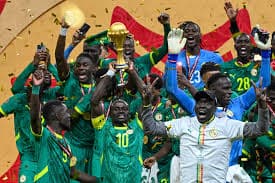
Senegal lifted the Africa Cup of Nations trophy on Sunday night after a tense and disorderly final that saw them defeat hosts Morocco 1 to 0 after extra time at the Prince Moulay Abdellah Stadium in Rabat. The victory delivered Senegal’s second continental title and capped a final dominated as much by officiating controversy as by decisive moments of quality.
The Teranga Lions, appearing in their fourth AFCON final and their first since winning the tournament in 2021, finally broke Moroccan resistance early in extra time through Pape Gueye. His goal settled a match that had repeatedly swung on fine margins and emotional flashpoints, leaving the home crowd stunned after more than two hours of drama.
Morocco entered the final chasing a rare achievement. Only a handful of nations have lifted the AFCON trophy on home soil, including Tunisia in 2004, Egypt in 2006, and Ivory Coast in 2023. Playing their seventh match in Rabat, the Atlas Lions also carried the physical toll of a demanding tournament, while Senegal benefited from a smoother route, having played all six previous matches in Tangier.
The opening stages reflected the tension of the occasion. Both teams approached cautiously, prioritising structure over risk. Senegal’s Sadio Mané and Morocco’s Brahim Diaz forced early saves, while set pieces became a recurring theme as neither side found space in open play.
Senegal threatened through Ismaïla Sarr and Nicolas Jackson, but Morocco goalkeeper Yassine Bounou responded confidently. At the other end, Édouard Mendy matched him save for save as Ayoub El Kaabi and Achraf Hakimi tested Senegal’s defensive discipline. El Hadji Malick Diouf anchored the back line effectively, limiting clear chances and frustrating Morocco’s attempts to stretch the game.
The match unraveled late in normal time. Senegal believed they had scored a stoppage-time winner when Idrissa Gueye struck the post and Sarr headed in the rebound. However, referee Jean-Jacques Ngambo of DR Congo disallowed the goal for a foul on Hakimi in the buildup. The whistle had already gone before the ball crossed the line, preventing any VAR review and sparking furious protests from the Senegal bench.
Moments later, VAR intervened at the opposite end, awarding Morocco a penalty for a foul by El Hadji Diouf on Diaz. Senegal coach Pape Thiaw reacted by instructing his players to leave the pitch in protest, an extraordinary scene that delayed the match for roughly 16 minutes. Only Mané remained on the field during the standoff.
When play resumed, Diaz attempted a chipped penalty that lacked conviction and was comfortably gathered by Mendy. The miss proved pivotal, swinging momentum decisively toward Senegal as the match moved into extra time.
Four minutes into the first extra-time period, Senegal finally found the breakthrough. Idrissa Gueye led a rapid counterattack and slipped the ball to Pape Gueye, who drove a left-footed shot into the top right corner, beyond Bounou’s reach. It was a goal born of composure after chaos, and it changed the trajectory of the final.
Morocco responded with urgency, introducing fresh attackers including Ilias Akhomach and Hamza Igamane. Waves of pressure followed, but Senegal defended resolutely. Mendy’s authority in goal and a series of timely blocks denied efforts from El Khannouss, El Aynaoui, and Youssef En-Nesyri.
Senegal also threatened to extend their lead, with Mané, Cherif Ndiaye, and Pape Gueye forcing Bounou into several sharp saves as the game stretched. Despite Morocco’s late push, the equaliser never came.
The win marked Senegal’s sixth victory of the tournament, their highest total in a single AFCON edition, and reinforced their status as one of Africa’s most consistent sides over the past decade. Beyond the controversy, the final underlined Senegal’s depth and defensive resilience, qualities that often decide knockout matches when attacking fluency is disrupted.
For Morocco, the defeat was bitter. The missed penalty, the late officiating calls, and the weight of expectation at home combined to deny them a first AFCON title since 1976. Still, reaching the final on home soil adds to a recent body of work that suggests sustained competitiveness at the highest level.
Add a Comment