


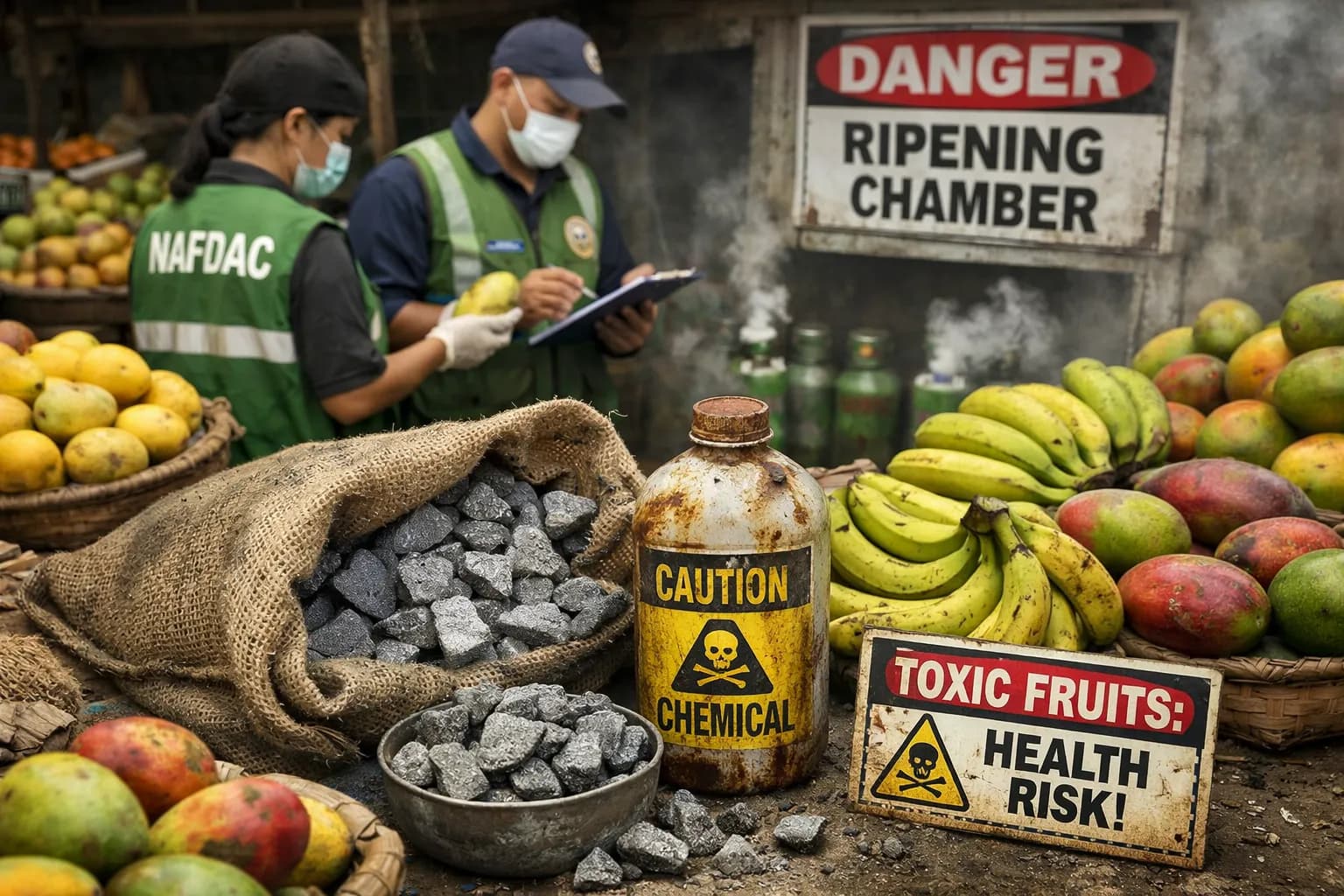
NAFDAC Warns of Dangerous Chemicals Used to Ripen Fruits, Raises Public Health Alarm
The National Agency for Food and Drug Administration and Control has uncovered the use of hazardous chemicals by some traders to artificially ripen fruits, triggering fresh concerns about food safety across Nigeria’s markets. According to the agency, substances not approved for food processing are being applied to bananas, plantains, mangoes, and other produce to accelerate ripening and improve appearance before sale. Officials warn that the practice poses serious health risks, particularly for children and people with underlying medical conditions.
National Agency for Food and Drug Administration and Control said recent enforcement operations in major produce hubs revealed the use of calcium carbide and other industrial agents, chemicals known to release acetylene gas when exposed to moisture. While acetylene can mimic natural ripening hormones in fruits, experts say residues from such substances may contain traces of arsenic and phosphorus, both toxic to humans.
What investigators found
According to statements released by NAFDAC and reported by Punch, enforcement teams seized multiple sacks of suspected ripening agents hidden in storage facilities where fruits were kept in enclosed spaces. Officials also discovered makeshift ripening chambers, often poorly ventilated, where fruits were exposed to chemical fumes for hours or days.
A senior NAFDAC official involved in the operation explained that the practice is driven largely by economic pressure. Traders seeking to reduce spoilage losses or meet sudden spikes in demand may resort to artificial ripening to push unripe produce quickly into the market. However, the official stressed that the short term profit comes at a significant public health cost.
Food scientists note that naturally ripened fruits develop flavor, color, and nutritional value through a gradual biological process involving ethylene gas produced by the fruit itself. Artificial chemical ripening, by contrast, may produce outward color changes without proper internal maturation, resulting in fruits that look ready to eat but may contain unsafe residues.
Health risks linked to chemical ripening
Medical experts warn that exposure to fruits treated with industrial chemicals can lead to a range of health complications. Short term effects may include headaches, dizziness, nausea, vomiting, and stomach irritation. In more severe cases, prolonged consumption has been associated with neurological symptoms and organ damage.
A toxicologist at a teaching hospital in Lagos said calcium carbide exposure has been linked to respiratory problems and irritation of the eyes and skin. Meanwhile, arsenic contamination, even in small quantities, can accumulate in the body over time and increase the risk of cancers, cardiovascular disease, and developmental issues in children.
Related News
- A Nigerian skate brand just became adidas' first official Nigerian collaborator.
- A senior ISWAP finance operative surrendered to Nigerian troops at 6:45 a.m. on July 25 along the Gamboru-Wulgo Main Supply Route in Borno State.
- Nigeria's reported digital payment fraud losses fell 52 percent last year, dropping to N25.85 billion from N52.26 billion in 2024.
Public health advocates also highlight a less discussed risk. Artificially ripened fruits may have reduced nutritional quality because the natural biochemical processes that enhance vitamins and antioxidants are interrupted. This means consumers may unknowingly pay for produce that is not only unsafe but also less beneficial nutritionally.
previous warnings
This is not the first time authorities have raised alarms about fruit ripening practices. In past years, both NAFDAC and agricultural extension agencies warned against the use of carbide stones, especially during peak harvest seasons when surplus produce floods markets. Similar crackdowns were reported in previous operations targeting warehouses in major commercial centers across Nigeria.
Globally, the issue has surfaced in several developing economies where cold storage infrastructure is limited and distribution chains are fragmented. Food safety regulators in parts of Asia and Africa have issued repeated advisories against the use of industrial chemicals on food.
What makes the current discovery significant is the scale and apparent organization of the activity. Officials say the chemicals were not being used sporadically by individual traders but distributed through supply networks, suggesting a systemic problem that may require coordinated enforcement and public education.
The timing is particularly sensitive as Nigeria faces rising food prices and supply chain disruptions linked to inflation and transportation costs. Consumers are increasingly dependent on affordable fruits as substitutes for more expensive food items. Any threat to fruit safety therefore has broad implications for nutrition and public confidence.
There are also economic consequences. If confidence in locally sold produce declines, retailers may experience losses while consumers shift toward packaged or imported alternatives, which are often more expensive.
A unique concern raised by food policy analysts is the potential impact on school feeding programs and informal street food vendors who rely heavily on market produce. Without routine screening mechanisms, chemically ripened fruits could enter institutional food systems that serve vulnerable populations.
What authorities and consumers should watch next
NAFDAC says it plans to intensify surveillance of fruit markets and storage facilities, working with state governments and agricultural agencies to identify offenders. Officials are also urging consumers to report suspicious practices and to wash fruits thoroughly before consumption, although experts caution that washing alone may not remove all chemical residues.
Food safety specialists advise consumers to look for signs of natural ripening, such as uniform color development, natural aroma, and texture. Fruits that appear bright outside but remain hard or tasteless inside may have been artificially ripened.
Some analysts argue that enforcement alone will not solve the problem. They suggest expanding access to safer ripening technologies, such as controlled ethylene chambers, and improving cold storage infrastructure to reduce the incentive for chemical shortcuts.
The discovery of dangerous chemicals used to ripen fruits underscores persistent gaps in food safety oversight and market regulation. While enforcement actions may curb the practice temporarily, long term solutions will require coordinated efforts involving regulators, traders, farmers, and consumers. The episode serves as a reminder that food security is not only about availability and price but also about safety and public trust.
As investigations continue, the key question is whether authorities can dismantle the supply networks behind the chemicals and prevent future recurrence. For now, consumers are advised to remain vigilant about the sources of their food and to support calls for stricter monitoring of produce entering local markets.
Add a Comment