


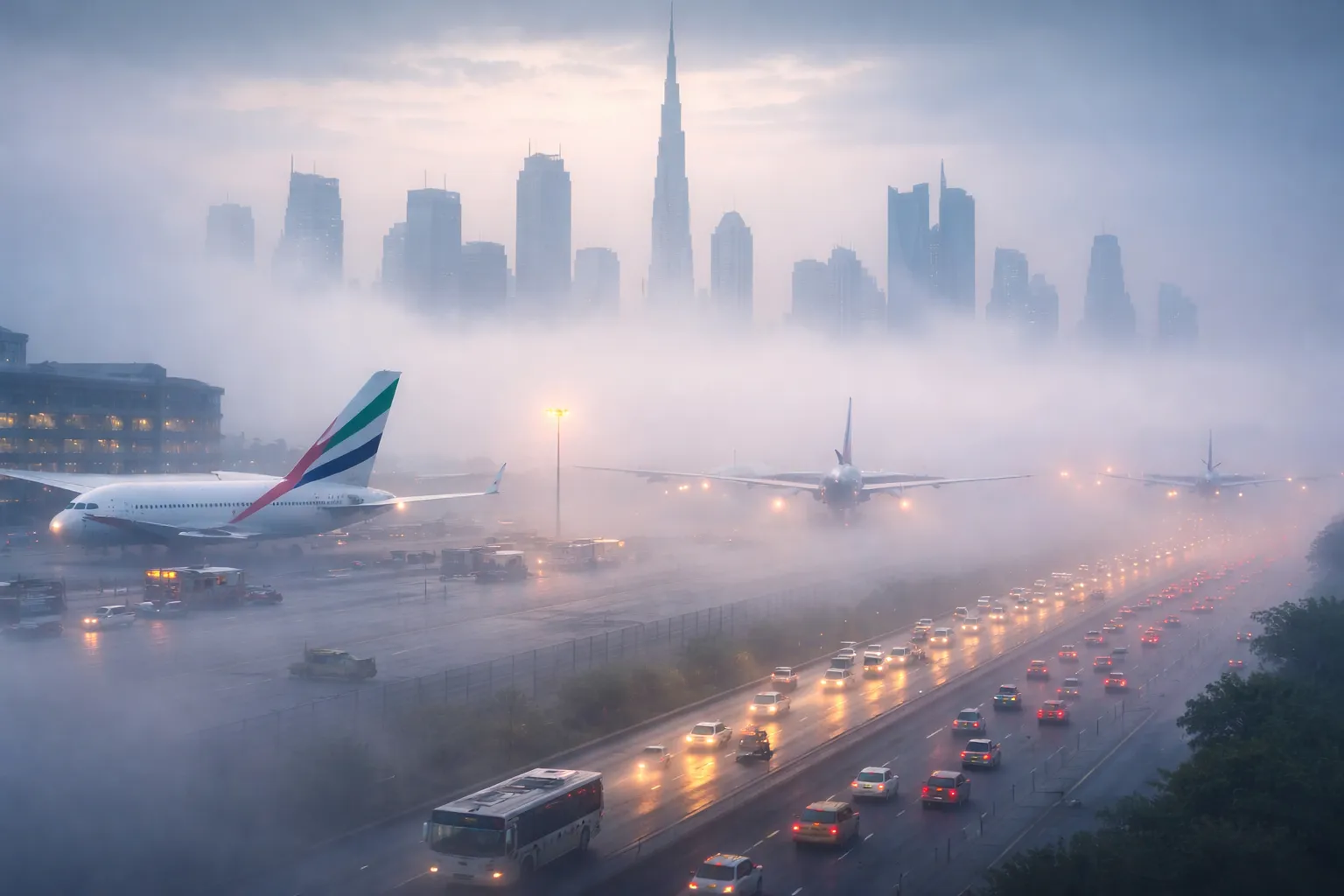
Dubai, February 24, 2026 — A thick blanket of fog covered large parts of the United Arab Emirates early Monday, reducing visibility to near zero on major highways and disrupting both air and road travel.
Motorists and airline passengers faced long delays across Dubai, Abu Dhabi, Sharjah, and Al Ain as authorities issued repeated safety warnings throughout the morning.
The National Centre of Meteorology (NCM) had earlier forecast a dense fog wave from 3 a.m. to 9 a.m., advising drivers to reduce speed and switch on fog lights while travelling.
Low Visibility Grounds Flights
At Dubai International Airport, one of the world’s busiest aviation hubs, several flights were delayed or temporarily diverted due to poor visibility. Airlines including Emirates Airline, flydubai, and Etihad Airways activated contingency plans as pilots waited for clearance to land.
In a statement, Emirates confirmed that “a number of flights experienced operational delays due to dense fog,” stressing that passenger safety remained the airline’s top priority. Etihad also announced minor disruptions at Abu Dhabi International Airport, where some early arrivals were redirected to Al Ain until visibility improved.
According to Dubai Airports, about 25 flights were affected between 4 a.m. and 8 a.m., though normal operations resumed by late morning.
Passengers described long waits and crowded terminals as schedules were adjusted. “We waited for almost three hours before boarding, but the airline staff kept everyone informed,” said Ramesh Singh, a tourist flying to Mumbai. “It’s not ideal, but safety comes first.”
Morning Commute Slows Across Emirates
The impact extended beyond airports. Major roads such as Sheikh Zayed Road, E311 Emirates Road, and the Abu Dhabi–Al Ain Road experienced long tailbacks as commuters reduced speed.
Related News
The Dubai Police said several minor collisions were reported before sunrise, though no serious injuries occurred. Patrols were stationed along fog-prone areas to manage traffic flow and guide motorists using flashing hazard lights.
In Abu Dhabi, authorities temporarily lowered speed limits on major highways to 80 km/h through the Abu Dhabi Police’s smart traffic system, which automatically adjusts digital road signs based on weather conditions.
Residents took to social media platform X (formerly Twitter) to share photos and videos of the fog covering skyscrapers and landmarks. “The Burj Khalifa completely disappeared in the mist this morning,” one user posted, while another praised the efficiency of emergency services in handling the situation.
Meteorologists attributed the fog to a combination of high humidity, light winds, and clear skies overnight conditions that encourage moisture condensation near the surface.
Senior NCM forecaster Ahmed Al Jallaf explained that the phenomenon is common during the UAE’s winter season, though this episode was unusually dense and widespread. “Humidity levels reached 95 percent in some areas,” he said, adding that visibility dropped below 100 metres in parts of Abu Dhabi and the outskirts of Dubai.
He noted that the fog began forming around 2:30 a.m. and gradually dissipated by 9:30 a.m. as sunlight warmed the air. The NCM expects similar early-morning fog patches to continue for the next two days, especially in inland and coastal regions.
Economic and Safety Impacts
Fog events, while temporary, carry significant economic implications for the UAE’s transport and logistics sectors. The country’s aviation industry handles thousands of passengers daily, and even short disruptions can affect schedules across Asia, Europe, and Africa.
According to aviation consultant Omar Al-Rashid, each hour of delay at major UAE airports can affect more than 4,000 passengers and cost airlines thousands of dirhams in rescheduling and crew management. “The systems are much better now than a decade ago,” he said. “Back then, a fog delay could last half a day. Today, coordination between air traffic control and airlines ensures faster recovery.”
On the roads, logistics firms also reported delivery delays, particularly for time-sensitive goods transported overnight from Jebel Ali Port to other emirates. Drivers were advised to pull over at rest stops until visibility improved.
The Ministry of Interior reminded road users that driving during fog requires headlights, hazard indicators, and maintaining extra distance. Officials also warned against using high beams, which can reflect off fog particles and further reduce visibility.
Residents React
Despite the inconvenience, many residents took the disruption in stride. Some posted photos of the fog-draped cityscape, calling it “surreal” and “beautiful but dangerous.”
“I left for work an hour early because I knew traffic would be bad,” said Fatima Hassan, a resident of Sharjah who commutes to Dubai daily. “The roads were quiet, but everyone drove slowly, which is good to see.”
Cafés and restaurants in coastal areas like Jumeirah Beach reported higher-than-usual foot traffic as locals stopped to enjoy the rare weather. “People came to take pictures — it’s not often we get this kind of scene,” said café manager Ali Rahman.
Looking Back and Ahead
Fog is not new to the Emirates, but its frequency has been rising over the past decade. Studies by the UAE University show that rapid urbanisation and heat-island effects in major cities have slightly altered local climate dynamics, making fog formation more likely during winter months.
In 2023, a similar weather event caused the temporary closure of sections of the E11 highway and the diversion of more than 30 flights from Dubai International Airport. Since then, authorities have invested in improved radar and satellite monitoring systems to provide earlier warnings.
Environmental specialists believe such incidents highlight the importance of continued investment in weather prediction and public awareness. “These fog waves remind us how sensitive modern infrastructure is to climate variability,” said Dr. Huda Salem, an environmental scientist at the Khalifa University. “Preparedness and real-time communication make the difference between disruption and disaster.”
Outlook for the Week
The NCM forecasts more fog patches through midweek, mainly before sunrise, followed by clear afternoons and mild temperatures. Visibility is expected to remain stable from Thursday onwards as humidity levels fall.
Authorities continue to advise motorists to follow traffic updates on radio and official social media channels. The Ministry of Interior reiterated that speed limits shown on electronic signs during fog conditions are legally enforceable.
For air travellers, Dubai Airports and Etihad have advised passengers to check flight status updates via official apps before leaving home.
“Fog is a natural part of the UAE’s winter story,” meteorologist Al Jallaf added. “What matters is how we respond with patience, preparation, and respect for safety.”
Add a Comment