


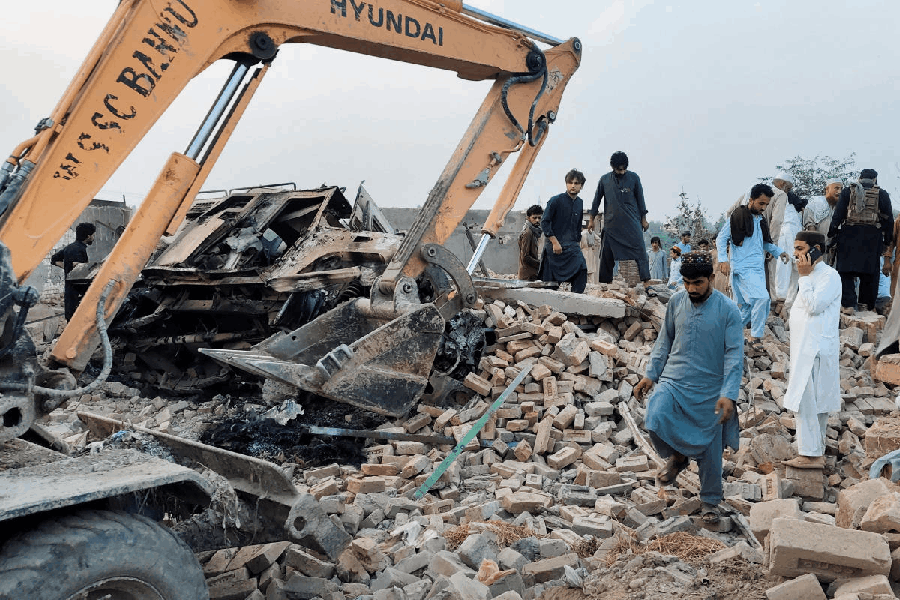
Twelve police officers were confirmed dead Saturday after militants detonated a vehicle-borne explosive at a police outpost in Bannu district, northwestern Pakistan, before ambushing reinforcement teams rushing toward the blast site, according to statements from local police officials.
By Sunday morning, the outpost was rubble.
Photographs circulated from the scene showed collapsed walls, burned vehicles, and debris spread across the compound. Rescue personnel and provincial emergency teams worked overnight to recover bodies from the destroyed structure while injured officers were transferred to government hospitals operating under emergency status orders issued in Bannu.
Police official Sajjad Khan said in an official statement that 12 bodies had been recovered from the collapsed police post and that three surviving personnel were rescued alive and taken for medical treatment. Another police official, who spoke anonymously because he was not authorized to brief reporters publicly, said militants first drove an explosive-laden vehicle into the compound before entering and firing on officers who survived the initial blast.
According to police accounts, the attack did not end with the bombing itself. Additional security personnel dispatched toward the scene were reportedly ambushed on approach roads surrounding the outpost. Officials acknowledged “some casualties” among those responding officers, though authorities had not publicly released a separate death figure for the ambush victims by Sunday afternoon.
Militant groups operating in Pakistan’s northwest increasingly structure attacks in phases designed to maximize casualties among first responders. Security analysts tracking violence in Khyber Pakhtunkhwa have documented repeated use of secondary assaults following initial explosions, particularly against police convoys and military rescue teams.
Police sources cited by local officials said militants used drones during portions of the attack. Authorities have not clarified whether the drones carried explosives, conducted surveillance, or coordinated militant movement around the outpost perimeter. Pakistani security agencies have previously warned about the growing use of commercial drone technology by militant factions operating near the Afghan border.
The trend is not isolated.
Related News
Data released in recent months by the Pakistan Institute for Conflict and Security Studies showed rising militant activity in northwestern Pakistan, particularly in districts bordering Afghanistan. The organization documented a sharp increase in attacks targeting police stations, checkpoints, and convoy routes after the collapse of ceasefire arrangements between Islamabad and factions linked to the Pakistani Taliban movement.
Bannu has become a recurring pressure point.
The district sits near strategic transit routes connecting Pakistan’s Khyber Pakhtunkhwa province to frontier regions bordering Afghanistan. Security officials have repeatedly described the area as vulnerable because militant groups can exploit difficult terrain, local smuggling corridors, and fragmented enforcement coverage across rural zones.
Saturday’s attack fit that pattern closely.
The militant coalition known as Ittehad-ul-Mujahideen claimed responsibility for the bombing and subsequent assault. Pakistani authorities have not publicly detailed the group’s operational structure or leadership composition. Militant alliances in the region often operate through loose coalitions involving multiple smaller factions rather than centralized command systems.
Islamabad continues accusing the Taliban administration in Kabul of allowing militants to organize attacks from Afghan territory. Pakistani officials have repeatedly argued that armed groups use cross-border safe havens to prepare operations before reentering Pakistan through mountainous frontier regions.
Taliban officials have maintained that militancy inside Pakistan represents an internal Pakistani security problem rather than a cross-border issue directed from Afghanistan. The dispute has intensified diplomatic tensions between the neighboring governments throughout the past year.
Military confrontation nearly followed earlier this year.
In February, Pakistani airstrikes inside Afghanistan triggered some of the worst border fighting between Pakistani forces and Taliban fighters in years. Islamabad stated at the time that the strikes targeted militant strongholds connected to attacks inside Pakistan. Taliban authorities condemned the operation and accused Pakistan of violating Afghan sovereignty.
Fighting along sections of the border later eased, but neither side announced a negotiated security arrangement addressing militant movement or enforcement coordination. That absence continues shaping security calculations on both sides of the frontier.
Our analysis of Pakistani Interior Ministry casualty releases and independent conflict trackers found that police personnel in Khyber Pakhtunkhwa increasingly bear the brunt of militant attacks rather than army units. In several districts, police outposts have become more exposed because they operate with lighter fortification standards and fewer armored reinforcements than military compounds.
Ambulances from rescue agencies and civil hospitals moved continuously through Bannu overnight after provincial authorities declared emergency conditions across government medical facilities. Officials have not yet published a complete list of the dead, and authorities are still working through identification procedures for some victims recovered from the collapsed structure.
The attack also highlighted the widening tactical gap between militant adaptation and local policing resources. Vehicle-borne explosives remain difficult for lightly equipped district police formations to stop, particularly when combined with coordinated ambush tactics and possible drone surveillance.
Pakistani security agencies now face renewed scrutiny over intelligence failures preceding the assault. Authorities have not disclosed whether threat warnings existed before the bombing or whether any intercepts suggested imminent attacks in Bannu district. Intelligence coordination failures have repeatedly emerged as a criticism after major militant incidents across northwestern Pakistan.
Pakistani military and police operations in border districts historically intensify after mass-casualty attacks on security personnel. Previous assaults on police facilities have been followed by raids, arrests, movement restrictions, and expanded surveillance operations targeting suspected militant support networks.
At least 12 police officers were killed after militants bombed a police post in Bannu and ambushed responding reinforcements.
Ittehad-ul-Mujahideen claimed responsibility for the coordinated assault.
Pakistani police sources said militants may have used drones during the operation, though authorities have not released technical details yet.
The attack reopened security tensions between Islamabad and the Taliban government over cross-border militant activity.
Why was the attack considered unusually dangerous?
Because it unfolded in stages. First the car bomb destroyed the outpost. Then militants reportedly attacked officers responding to the explosion. Police sources also mentioned drone involvement, which suggests planning beyond a single blast.
Who claimed responsibility?
A militant coalition called Ittehad-ul-Mujahideen. Pakistani authorities have not yet released detailed information about the group’s structure or membership.
Could this affect Pakistan-Afghanistan relations again?
Yes. Pakistan already accuses the Taliban government of allowing militants to operate from Afghan territory. Kabul denies that claim. Previous accusations earlier this year were followed by Pakistani airstrikes inside Afghanistan.
The next unresolved issue is whether Pakistan’s federal government authorizes expanded cross-border or counterinsurgency operations after the Bannu attack. No timetable has been announced publicly. But security officials now face pressure to explain how militants moved an explosive-filled vehicle, conducted a coordinated ambush, and allegedly deployed drones against police personnel without interception, particularly after February’s military escalation along the Afghan frontier.
Add a Comment