


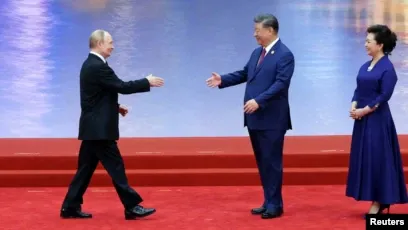
The visit, confirmed by the Kremlin and Chinese state media, marks Russian President Vladimir Putin’s 25th trip to China since taking office more than two decades ago. It comes days after Chinese leader Xi Jinping hosted U.S. President Donald Trump in Beijing, an unusually compressed sequence of high-level diplomacy that Chinese officials have framed as evidence of Beijing’s ability to engage competing global powers simultaneously.
The Kremlin says Putin and Xi plan to sign a joint declaration marking the 25th anniversary of the 2001 Sino-Russian Treaty of Friendship. Kremlin aide Yuri Ushakov told Russian media the document would outline support for what Moscow calls a “multipolar world” and “a new type of international relations.” Those phrases have become standard diplomatic language for both governments when criticizing U.S.-led alliances and sanctions policy.
Yet the visit is unfolding under pressure from two wars at once.
Russia remains locked in its fifth year of war in Ukraine. At the same time, the widening conflict involving Iran and the reported disruption of shipping through the Strait of Hormuz has pushed energy security to the center of Beijing’s calculations. China imports roughly 70 percent of its crude oil consumption, according to data from the International Energy Agency. Any sustained interruption in Gulf shipping routes immediately affects Chinese manufacturing, transport costs and industrial output.
Beijing and Moscow Revisit Energy Deals After 2,600-Kilometer Pipeline Talks
The most closely watched issue during the visit is expected to be the proposed Power of Siberia-2 gas pipeline, a 2,600-kilometer project designed to move Russian natural gas from the Yamal Peninsula through Mongolia into northern China.
Russian officials have pushed aggressively for the project since Western sanctions intensified after the 2022 invasion of Ukraine. The pipeline would redirect gas previously intended for European markets toward Asia, reducing Moscow’s dependence on customers in the European Union. China, however, has moved cautiously during negotiations, particularly on pricing terms and long-term purchase guarantees.
Anne-Sophie Corbeau of Columbia University Center on Global Energy Policy told RFE/RL that Power of Siberia-1 was already operating near full capacity in 2025, limiting Moscow’s short-term export flexibility. She also pointed to the smaller Far East pipeline project, expected to add 12 billion cubic meters annually beginning in 2027, as the next realistic increase in Russian gas exports to China.
Related News
- Nigerian Lives Lost Abroad: A Growing List of Deaths Leaves Families Seeking Answers Across Three Continents
- UN Records 9,788 Verified Cases of Conflict Sexual Violence in 2025 as Abuse Expands Across 21 Countries
- Israel Claims Killing of Hamas Commander Mohammed Awda Deepens Questions Over Gaza Escalation
Our analysis of customs data released by the General Administration of Customs of China shows bilateral trade between Russia and China exceeded $240 billion in 2025, with fossil fuel exports accounting for the largest share of Russian earnings. Oil shipments expanded sharply after European sanctions redirected Russian crude toward Asian buyers willing to purchase discounted cargoes.
China benefited financially.
But Beijing’s position is more complicated than Moscow often suggests publicly. Chinese policymakers have repeatedly avoided full dependence on any single energy supplier. Beijing continues importing substantial volumes from Saudi Arabia, Iraq and the United Arab Emirates despite the instability surrounding Hormuz.
Xi Jinping Balances Trump Diplomacy Against Russian Pressure
The sequencing of Xi’s meetings with Trump and Putin has drawn attention in Washington and European capitals because it illustrates how Beijing is attempting to manage competing relationships without formally aligning itself to either side.
Michael Kimmage, director of the Kennan Institute, described the diplomatic choreography as symbolic positioning. In comments to RFE/RL, he argued that hosting Trump one week and Putin the next allows Xi to present China as a state capable of engaging adversaries and partners simultaneously while maintaining strategic ambiguity.
That ambiguity serves Beijing.
China has avoided directly condemning Russia’s invasion of Ukraine while also stopping short of supplying overt military support that could trigger secondary sanctions from the United States or the European Union. Chinese state banks and manufacturers remain deeply exposed to Western financial systems and export markets. According to World Bank trade figures, the United States and European Union collectively remain more valuable to China economically than Russia.
We reviewed 2025 Chinese trade disclosures and found combined exports from China to the United States and European Union exceeded $1.1 trillion, more than four times China’s total trade volume with Russia. That disparity explains why Beijing’s diplomatic language often sounds more aggressive than its actual sanctions behavior.
Russian officials nevertheless continue portraying China as a strategic economic lifeline. Since 2022, Moscow has increased yuan-denominated transactions, expanded cross-border payment mechanisms and redirected commodity flows eastward after many Western companies exited the Russian market.
The dependency cuts unevenly.
Ukraine War Still Shapes the Beijing Talks
Although energy dominates immediate negotiations, the Ukraine war remains central to the relationship between Xi and Putin. Ukrainian drone strikes deep inside Russia have intensified pressure on Russian oil infrastructure over the past year, including attacks affecting refineries, storage depots and transport facilities near Moscow and western Russia.
Those attacks carry economic costs.
The Russian Finance Ministry has repeatedly revised revenue forecasts because energy exports remain critical to funding military expenditures. According to the Russian federal budget approved in late 2025, oil and gas revenues still account for roughly one-third of state income.
China understands that vulnerability.
Yet Beijing also recognizes the political risks of appearing too closely aligned with Moscow during a prolonged European conflict. Chinese officials continue presenting China as a potential mediator while avoiding direct criticism of the Kremlin. European diplomats have repeatedly challenged that neutrality claim, pointing to sustained Chinese purchases of Russian commodities and dual-use goods exports.
For Xi, the visit is partly about demonstrating continuity. For Putin, it is about proving Russia still possesses powerful international partners despite sanctions and diplomatic isolation from much of Europe. Neither side appears prepared to fundamentally alter the relationship. The dispute centers more on terms, leverage and timing than on ideology.
That distinction matters.
Putin’s 25th visit to China comes days after Xi Jinping hosted Donald Trump, and the scheduling appears carefully calculated.
China still needs Russian energy, but trade figures show Beijing remains economically tied far more heavily to the United States and Europe.
The Power of Siberia-2 pipeline remains stalled over pricing and contract terms despite years of negotiations.
The Ukraine war and the Iran conflict are now shaping the same diplomatic conversation inside Beijing.
Why is the Strait of Hormuz suddenly central to China-Russia talks?
Because China imports enormous volumes of Gulf energy. Any disruption there makes overland Russian oil and gas routes more attractive, at least temporarily.
Is China fully backing Russia now?
No. Beijing buys Russian energy and avoids condemning Moscow directly. But China is also careful not to trigger major Western sanctions against its banks and exporters.
Will Power of Siberia-2 finally be approved?
Possibly, but there is still no final agreement on pricing. Big pipeline projects can stall for years over that issue alone.
The unresolved question now is whether Beijing will commit to binding long-term pricing guarantees for Power of Siberia-2 before Russian export revenues tighten further under sanctions pressure. Negotiators from both governments are expected to continue discussions through late 2026, but no final investment framework has yet been filed with regulators in Russia, China or Mongolia, leaving billions of dollars in future gas revenue and transit rights still unresolved.
Add a Comment