


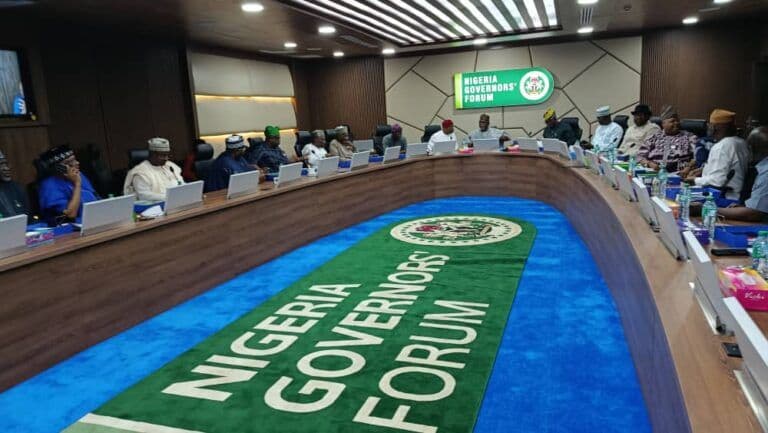
Nigeria's current minimum wage stands at N70,000, but state governors are already pressing for a new benchmark of N100,000.
The proposal came directly from the Chairman of the Nigeria Governors' Forum (NGF), AbdulRahman AbdulRazaq, who argued that many states now possess greater fiscal capacity following the removal of fuel subsidy. Speaking before President Bola Tinubu, the Kwara State governor said several states were already paying wages close to the figure being proposed.
The N70,000 minimum wage approved in July 2024 emerged after months of negotiations involving the Federal Government, labour unions and private sector representatives. At the time, government officials argued that the increase reflected prevailing economic realities while remaining financially sustainable.
Less than two years later, governors are publicly discussing another adjustment.
AbdulRazaq's argument rests largely on state finances. According to the NGF chairman, revenues flowing to state governments have improved substantially since the removal of petrol subsidy, allowing states to absorb higher wage obligations than many previously considered possible.
Speaking directly to Tinubu, he urged the President to support discussions on a new national wage floor.
“On the issue of minimum wage, most states are paying almost N100,000 today. I urge Your Excellency to let us have a discussion on moving the minimum wage to N100,000. We know we will get the normal support from you as we move ahead to implement that,” AbdulRazaq said.
The governor did not provide state-by-state payroll data during his remarks. Nor did he identify which states are already paying salaries near N100,000. Those details matter because minimum wage debates are ultimately determined by verified revenue, payroll obligations and workforce size rather than political declarations.
Related News
Still, the intervention is significant because it comes from the chairman of the umbrella body representing Nigeria's 36 state governors.
The governor linked his argument directly to the effects of subsidy removal, one of the most consequential economic decisions of Tinubu's administration. Since the policy took effect in May 2023, federal officials have repeatedly argued that money previously spent on fuel subsidies could be redirected toward infrastructure, social programmes and revenue allocations to subnational governments.
AbdulRazaq offered an unusually detailed account of how governors reacted when they first learned the subsidy would be removed.
According to him, the information reached governors while some of them were in China. He said the National Security Adviser and the Director-General of the Department of State Services informed him that the policy would proceed and that reversal was not being considered.
“I remember we were in China when I got a call from the National Security Adviser and the Director-General of the Department of State Services saying that fuel subsidy would be removed and there was no going back,” he said.
AbdulRazaq said he contacted fellow governors through NGF channels and found little enthusiasm for the proposal. He identified Lagos State Governor Babajide Sanwo-Olu and the Governor of Kaduna State among officials involved in discussions abroad over the likely consequences of implementation.
According to his account, governors believed the policy could trigger widespread unrest.
The governor said state leaders returned to Nigeria intending to persuade Tinubu to reconsider. Yet he claimed that after hearing the President explain his economic vision during a dinner meeting, governors concluded that implementation had become inevitable.
That account offers a rare glimpse into internal deliberations surrounding one of the administration's defining policies.
It also provides a benchmark.
AbdulRazaq said governors anticipated riots and instructed states to prepare for major security challenges. According to his remarks, security agencies were mobilised and State Security Council meetings convened because authorities expected significant public disorder following the announcement.
“We advised one another to call State Security Council meetings because we were expecting serious riots. We spent money and mobilised security agencies to secure our various states,” he said.
He stated that the feared nationwide unrest did not occur. According to his account, there were no riots and no major protests immediately following implementation.
That description reflects the governors' perspective. Independent assessments of public reaction would require examination of police reports, civil society records and protest data from the period following subsidy removal.
The economic argument remains central.
Labour unions have consistently maintained that workers' earnings have been eroded by inflation, rising transport costs and increased household expenses. Their position has been that salary adjustments must reflect the actual cost of living rather than government revenue alone.
Governors, meanwhile, appear increasingly focused on demonstrating that state finances have improved.
Our analysis of AbdulRazaq's remarks identifies one measurable claim. He stated that Kwara State has reduced its debt burden by about 40 per cent since subsidy-related revenue changes began affecting state allocations. He also cited Delta State as an example of a state that has cleared its debts completely.
If confirmed through debt management records and audited financial statements, they would represent tangible evidence supporting the governor's broader contention that some states are operating from a stronger fiscal position than before subsidy removal.
Yet major questions remain unanswered.
Higher revenue does not automatically translate into sustainable wage increases. States face varying obligations involving pensions, infrastructure, education, healthcare and debt servicing. A national minimum wage of N100,000 would create recurring expenditure commitments extending beyond current political cycles.
Whether governors can maintain such a wage level during periods of lower revenue growth will ultimately matter more than whether they can introduce it during a period of stronger allocations.
AbdulRahman AbdulRazaq publicly urged President Bola Tinubu to support increasing the minimum wage from N70,000 to N100,000.
The NGF chairman said governors from all 36 states now operate in a stronger revenue environment because of subsidy removal.
AbdulRazaq disclosed that governors initially expected widespread unrest and held security meetings before the policy took effect in 2023.
He also claimed Kwara State reduced its debt by about 40 per cent while citing Delta State as having cleared its obligations.
Has the minimum wage been increased to N100,000?
No. The proposal is a request from the NGF chairman. Any increase would require formal negotiations and approval through the appropriate legal and policy processes.
Why do governors say they can afford a higher wage now?
According to AbdulRazaq, state revenues improved after fuel subsidy removal. He argues that stronger allocations have reduced financial pressure on many states.
Do labour unions support another wage increase?
Labour unions have consistently argued that inflation and living costs require better worker compensation. Their exact position on N100,000 would depend on formal negotiations.
The next unresolved question is whether the Federal Government, organised labour and state governments will reopen wage negotiations before the current framework faces another review cycle. No formal timeline has been announced, no agreement has been signed, and the specific issue still in dispute is whether the national wage floor should remain at N70,000 or rise to N100,000.
Add a Comment