


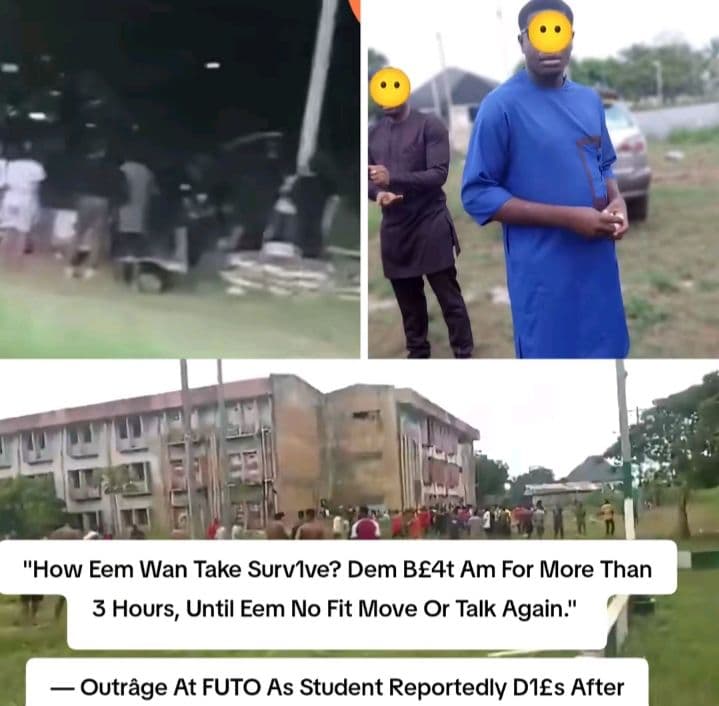
A 100-level student of the Federal University of Technology, Owerri (FUTO) reportedly died after being held by members of the Man O’ War organization over an allegation involving ₦13,000. The incident has triggered protests across the campus and renewed scrutiny of student security and disciplinary structures operating within Nigerian universities.
The student, identified in multiple reports as a Cybersecurity undergraduate, was allegedly accused of stealing ₦13,000 from a member of the organization on Friday. Witness accounts cited by news outlets claim he was taken into custody by Man O’ War cadets and held for several hours. Reports further allege that he was physically assaulted while detained. Authorities had not, as of publication, released a detailed official account establishing the exact sequence of events or the medical cause of death.
A 100-level FUTO student reportedly died after being detained over an alleged ₦13,000 theft accusation.
Student witnesses have alleged prolonged physical assault, but authorities have not yet publicly confirmed those claims.
Campus protests erupted within hours as students demanded accountability and an independent investigation.
Reports indicate that Man O’ War activities on campus have been suspended pending further inquiry.
According to accounts published on May 30, the student was apprehended after an allegation that he stole ₦13,000. Multiple reports state that he was held from Friday night and subjected to punishment or interrogation by cadets. Witnesses quoted by media organizations alleged that the detention lasted several hours and that attempts by other students to intervene were unsuccessful.
Several reports state that the student later became unresponsive while still in custody and was subsequently confirmed dead. At the time of reporting, no publicly released autopsy findings had been presented to establish the immediate cause of death.
Related News
Allegations of assault remain allegations until confirmed through police findings, medical examination, witness statements, and any available forensic evidence. The absence of an official investigative report means several critical facts remain unresolved, including who authorized the detention, whether force was used, and whether emergency medical assistance was sought in time.
News of the student's death spread rapidly across the university community. Reports show students gathering in large numbers and staging protests across the campus, demanding justice and transparency. Videos circulating online showed crowds of students expressing anger over the circumstances surrounding the death.
Students' concerns extend beyond a single incident. The allegation that a student could be detained by a campus-based organization over a relatively small theft accusation has intensified questions about oversight, authority, and accountability within university security arrangements.
Reports published on May 30 indicate that FUTO authorities moved to suspend Man O’ War activities on campus indefinitely while investigations continue. The university had not, at the time of those reports, released a comprehensive statement detailing the circumstances that led to the student's death.
The incident has drawn attention to the role of Man O’ War formations within tertiary institutions. A federal government visitation panel report covering FUTO's 2011-2015 period described the university's Man O’ War security outfit as part of its broader campus security structure and noted that it was populated by students. The report also stated that the university maintained disciplinary mechanisms for handling student misconduct.
If the allegations surrounding this case are substantiated, investigators will likely examine whether the cadets acted within any recognized authority, exceeded their mandate, or operated outside established disciplinary procedures. University disciplinary systems traditionally involve student affairs units, security departments, disciplinary committees, and law enforcement agencies where criminal allegations arise.
The central issue is not the theft allegation itself. It is whether any group operating on a university campus possessed the authority to detain and allegedly punish a student in a manner that witnesses claim preceded a death.
Several investigations are expected to determine criminal and administrative responsibility. Police investigators will need to establish the timeline of detention, identify all individuals involved, obtain medical evidence, and determine whether any criminal offences occurred. University authorities may also conduct internal disciplinary proceedings alongside any police inquiry. LThe Guardian Nigeria +1
Our analysis of publicly available reports found a consistent factual core across multiple publications: a 100-level Cybersecurity student was accused of stealing ₦13,000, was allegedly held by Man O’ War cadets, later became unresponsive, and his death triggered protests and demands for accountability. The disputed details concern what occurred during those hours in custody and who bears legal responsibility.
Has FUTO officially confirmed the cause of death?
No. As of the latest reports, authorities had not publicly released a detailed statement confirming the medical cause of death. Investigations are expected to address that question.
Were the assault allegations verified by police?
Not publicly. Witnesses and students made the allegations, but official investigative findings had not yet been released.
Has any action been taken against the Man O’ War group?
Reports indicate that Man O’ War activities at FUTO were suspended pending investigation. Public authorities had not yet announced any criminal charges at the time of reporting.
The next unresolved question is whether the police investigation in Imo State will produce criminal charges and, if so, against whom. No filing deadline has been publicly announced, no court proceeding had been identified in available reports, and the central issue still in dispute is whether the student's death resulted from unlawful detention, assault, or another cause that medical and forensic evidence has yet to establish.
Add a Comment