


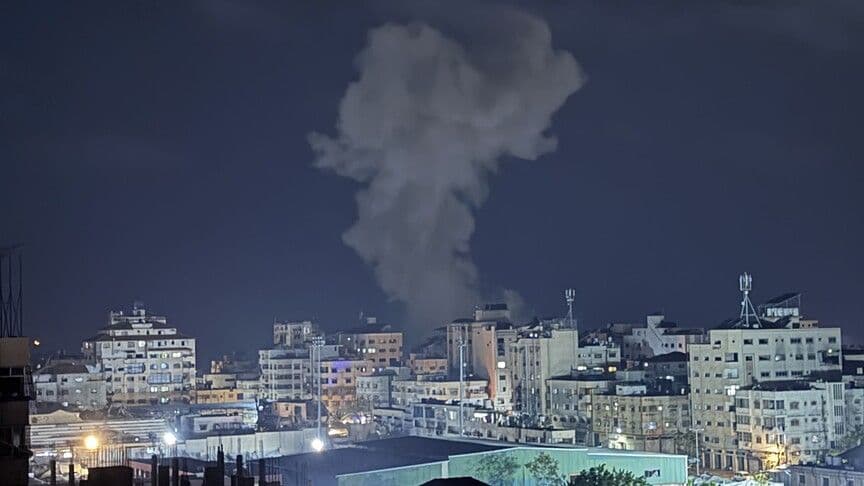
Israeli officials claimed Wednesday that Mohammed Awda was killed in an airstrike in northern Gaza Strip, marking the latest targeted killing announced by Israel during a conflict that has already left tens of thousands dead and much of Gaza’s civilian infrastructure damaged or destroyed.
The Israeli military said Awda had recently been selected as commander of Hamas’ armed wing. On Tuesday, Prime Minister Benjamin Netanyahu and Defence Minister Israel Katz publicly confirmed that Israeli forces had targeted him in an operation inside Gaza City.
Neither Hamas nor the Izz ad-Din al-Qassam Brigades issued confirmation of Awda’s death as of Wednesday evening. The absence of immediate acknowledgment is consistent with prior Hamas responses during wartime assassinations, particularly when command succession questions remain unresolved.
Gaza City Strike Hit Hours Before Eid al-Adha
The Israeli claims emerged after heavy bombardment struck densely populated sections of central Gaza City on the eve of Eid al-Adha, one of the most important holidays in the Muslim calendar.
Medical sources inside Gaza reported that at least one Palestinian woman was killed and several others were injured in the attacks. Local reports indicated that residential structures in crowded civilian districts sustained damage during the bombardment. Independent casualty verification remained difficult because foreign journalists continue to face severe access restrictions inside large parts of the enclave.
Holiday periods in Gaza have repeatedly coincided with intensified military activity since the war began in October 2023. Humanitarian agencies, including the United Nations Office for the Coordination of Humanitarian Affairs, have documented repeated displacement waves during religious observances when civilian movement patterns shift and shelters become more crowded.
Israeli officials framed the strike as part of ongoing operations targeting Hamas leadership and operational networks. The Israeli military has increasingly focused on leadership decapitation tactics after months of ground operations failed to fully dismantle Hamas command structures across northern and central Gaza, according to assessments published by the Washington Institute and Israeli security analysts interviewed by local media.
Related News
Israeli authorities have previously announced the killings of senior Hamas figures only for later uncertainty to emerge regarding identities, operational roles, or survival. In several earlier cases during the Gaza war, Hamas delayed public acknowledgment of commanders’ deaths for days or weeks.
Netanyahu Faces Domestic Pressure Inside the Knesset
The announcement also arrived during a volatile political moment for Netanyahu’s government. Israeli opposition figures and several political commentators have publicly warned that further military escalation in Gaza could overlap with domestic electoral calculations as coalition tensions intensify inside the Knesset.
Coalition disputes involving ultra-Orthodox military service exemptions and budget negotiations have increased speculation about possible early elections. Israeli media outlets including Haaretz and The Times of Israel have reported widening fractures within Netanyahu’s governing bloc during recent parliamentary sessions.
Public polling released in May by the Israel Democracy Institute showed declining approval ratings for the governing coalition amid continuing hostage concerns, military fatigue, and criticism surrounding post-war planning for Gaza. Opposition leaders, including Yair Lapid, have accused Netanyahu of prolonging military operations without presenting a stable political framework for ending the war.
Netanyahu has denied accusations that political survival influences battlefield decisions. Israeli government officials continue to argue that military pressure remains necessary to weaken Hamas leadership and secure hostage releases.
The broader war has produced casualty and destruction levels that international agencies describe as historically severe for the territory’s civilian population.
Palestinian health authorities in Gaza say more than 72,000 people have been killed and over 172,000 injured since October 2023. The figures cannot be independently verified in real time because of the collapse of much of Gaza’s administrative and medical infrastructure, though United Nations agencies and multiple humanitarian organisations have repeatedly stated that the casualty scale is credible within the constraints of wartime reporting.
Infrastructure losses are easier to document.
Satellite analysis and damage assessments conducted by the United Nations Satellite Centre and World Bank partners have estimated that approximately 90 percent of civilian infrastructure across Gaza sustained damage or destruction during the conflict. That includes housing blocks, roads, hospitals, water systems, schools, and municipal facilities.
Our analysis of reconstruction estimates published by the World Bank and United Nations Development Programme found projected recovery costs already exceeding tens of billions of dollars before accounting for continued strikes reported after the October ceasefire announcement referenced by Palestinian officials and regional mediators.
Recovery plans remain mostly theoretical.
Aid agencies continue warning that fuel shortages, border restrictions, and repeated displacement orders have slowed humanitarian operations. The World Food Programme and UNRWA have both reported difficulties maintaining consistent aid distribution corridors in northern Gaza during periods of intensified military operations.
Israeli Leadership Killings Have Produced Mixed Results
Israel has relied heavily on targeted assassinations during previous confrontations with Hamas and other Palestinian armed groups. Security officials argue that removing senior commanders disrupts operational planning, communications, and recruitment.
Military historians inside Israel remain divided on long-term effectiveness.
Research published by the Institute for National Security Studies in Tel Aviv following earlier Gaza conflicts found that leadership killings often produced temporary operational disruption but rarely eliminated militant organisational continuity entirely. Hamas has historically rebuilt command structures through decentralised leadership networks and regional brigades after senior figures were killed.
The Israeli military has announced the deaths of multiple Hamas political and military figures since October 2023, including brigade commanders, tunnel coordinators, and logistics officials. Yet Israeli security briefings have also acknowledged continuing armed resistance operations in several sectors where commanders had previously been declared eliminated.
The uncertainty surrounding Mohammed Awda’s exact operational status reflects that broader pattern. Israeli officials described him as the newly selected commander of Hamas’ armed wing, but no publicly released intelligence documents accompanied the claim. Hamas silence, at least for now, leaves independent confirmation incomplete.
Israel says Mohammed Awda was killed in a Gaza City strike, but Hamas has not confirmed the claim.
The strike happened during heavy bombardment hours before Eid al-Adha in densely populated civilian areas.
Netanyahu faces growing domestic political pressure as coalition disputes raise speculation about early elections.
Gaza casualty and infrastructure destruction figures continue rising while independent verification remains difficult.
Did Israel provide evidence Awda was killed?
Publicly, no detailed evidence has been released yet. Israeli officials announced the strike and identified Awda as the target, but no photographs, intercepted communications, or forensic confirmation accompanied the statement.
Why would Hamas delay confirming a commander’s death?
Operational reasons. Hamas has previously delayed announcements to manage succession, maintain internal communications security, or avoid revealing organisational disruption during active fighting.
Are the Gaza casualty numbers independently verified?
Not fully in real time. International agencies say conditions inside Gaza make precise verification difficult, but UN officials and humanitarian groups consider the scale of casualties and destruction broadly credible.
The next unresolved issue now sits before both military planners and political negotiators. Israeli officials continue linking battlefield operations to hostage recovery and Hamas dismantlement, while opposition lawmakers inside the Knesset press for clarity on elections and post-war governance. No formal deadline has been announced for dissolving parliament, but coalition disputes over military exemptions and wartime budgeting remain active as billions of dollars in reconstruction liabilities and hostage negotiation terms stay unresolved.
Add a Comment