


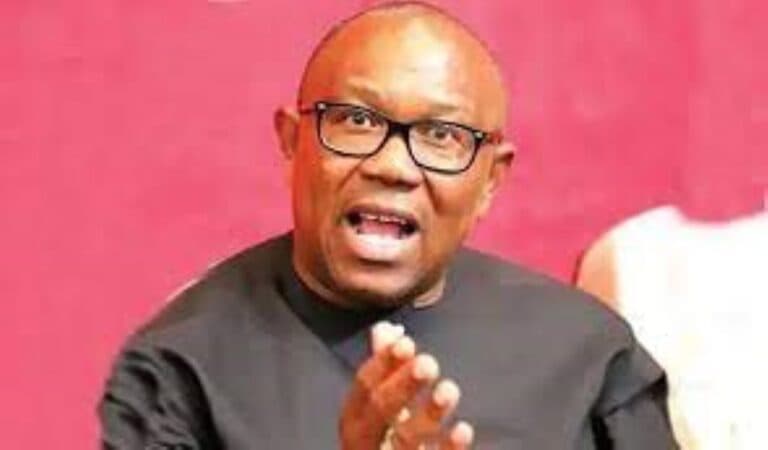
The allegation, posted Tuesday by the presidential candidate of the Nigeria Democratic Congress (NDC), escalates a dispute already building around the borrowing strategy of President Bola Ahmed Tinubu’s administration and the government’s handling of public finances.
Peter Obi Questions Tinubu Borrowing Surge as Nigeria’s Debt Nears N200 Trillion
The presidential candidate of the Nigeria Democratic Congress (NDC), Peter Obi, has accused the administration of Bola Ahmed Tinubu of expanding Nigeria’s debt burden without providing adequate explanations for how the borrowed funds have been deployed.
In a statement published Tuesday on his X account, Obi claimed Nigeria’s total public debt had risen to “approximately N200 trillion,” arguing that the pace of borrowing under the current administration exceeds the trajectory recorded during the presidency of Muhammadu Buhari.
According to data published by the Debt Management Office, Nigeria’s total public debt stood at N97.34 trillion as of December 2023, after the securitisation of Ways and Means advances from the Central Bank of Nigeria. Subsequent borrowing approvals by the National Assembly, combined with naira depreciation, have continued to push the debt profile upward through 2025.
Obi’s criticism focused less on the existence of borrowing itself and more on the mismatch between new debt accumulation and visible capital expenditure.
He alleged that the Federal Government borrowed N11.89 trillion between January and September 2025, exceeding its projected borrowing target of N10.34 trillion by roughly N1.54 trillion. Obi cited figures from the Federation’s Budget Office and argued that the deviation should have triggered detailed public scrutiny.
“For instance, data from the Federation’s Budget Office reveals that the Bola Tinubu government borrowed N11.89 trillion in the first three quarters of 2025, exceeding the planned borrowing target by about N1.54 trillion,” Obi wrote. “Under a responsible government, such an overshoot would necessitate rigorous scrutiny and explanation.”
Related News
The criticism lands at a difficult economic moment for the administration. Inflation has remained above 30 percent for much of 2025, according to figures released by the National Bureau of Statistics. Food prices have climbed sharply following the removal of fuel subsidies and exchange rate reforms introduced after Tinubu took office in May 2023.
Households are already absorbing the impact.
Obi argued that despite the increased borrowing, federal capital spending has remained comparatively weak. He claimed that only N3.10 trillion had been released for capital expenditure during the first nine months of 2025, against a budgeted N17.58 trillion.
If accurate, the numbers imply that only 17.66 percent of the planned capital allocation had been implemented during the period under review. Obi said the resulting difference, approximately N14.48 trillion, raises questions about where the remaining borrowed funds were directed.
Budget implementation data has become increasingly contentious under the current administration. The 2025 Appropriation Act projected heavy spending on infrastructure, power projects, transport rehabilitation and social interventions. Yet multiple ministries have reported delayed releases and stalled procurement schedules since the second quarter of the fiscal year.
We reviewed public budget implementation summaries released by the Budget Office and found repeated references to debt servicing obligations consuming a substantial share of federal revenue through 2025. The documents show recurrent expenditure and debt repayments continuing to outpace capital releases in several reporting windows.
The Tinubu administration has defended its borrowing strategy in previous public statements, arguing that inherited fiscal pressures, fuel subsidy liabilities and exchange rate instability required emergency financing measures. Officials from the Federal Ministry of Finance have repeatedly stated that infrastructure deficits and revenue shortfalls cannot be addressed without sustained external and domestic borrowing.
But the government’s position faces a credibility problem tied to transparency.
Nigeria’s public debt structure has become more complex over the last three years. Domestic borrowing through treasury instruments remains significant, while multilateral facilities from the World Bank and the African Development Bank continue to expand. Currency depreciation has also inflated the naira value of external debt obligations.
Analysts at Lagos-based investment firms have repeatedly warned that debt sustainability concerns are shifting from absolute debt volume to revenue efficiency. In practical terms, the question is no longer simply how much Nigeria owes. The larger concern is how much revenue remains after interest payments are deducted.
According to the Debt Management Office’s recent disclosures, debt servicing consumed more than 70 percent of federally retained revenue in several reporting periods between 2023 and 2025. That pattern has narrowed fiscal space for capital projects even as borrowing continues.
Obi’s statement reflects a broader opposition strategy ahead of the next electoral cycle. Economic management, inflation and insecurity are emerging as central attack lines against Tinubu’s administration. Yet the former Anambra governor also faces scrutiny over the precision of his own figures, particularly the claim that total debt is already nearing N200 trillion.
The latest independently published government debt data available publicly remains below that threshold, although pending securitisations, fresh borrowing approvals and exchange rate adjustments could substantially increase the total once updated numbers are released.
The Presidency had not issued a direct response to Obi’s Tuesday statement as of press time. Past responses from administration officials have accused opposition politicians of selectively presenting debt figures without accounting for inherited liabilities or ongoing infrastructure financing needs.
Nigeria’s 2025 budget was built on optimistic assumptions about oil production, exchange rate stability and revenue collection improvements. Several of those assumptions have faced pressure in recent quarters. Crude oil theft continues to affect output levels in the Niger Delta, while foreign exchange volatility has complicated debt planning and import costs.
The unresolved issue now moves beyond political messaging. The next critical test may emerge during federal budget performance hearings at the National Assembly, where lawmakers are expected to question ministries and fiscal agencies over borrowing implementation and capital releases for the 2025 fiscal year.
Peter Obi claims Nigeria’s public debt has risen by more than N100 trillion within three years under Bola Tinubu’s administration.
Budget Office figures cited by Obi show the Federal Government allegedly borrowed N11.89 trillion between January and September 2025, above its planned target.
Obi argues that only N3.10 trillion of the N17.58 trillion capital budget was implemented during the same period.
Debt servicing obligations continue to consume a large share of federal revenue, according to public fiscal disclosures.
Is Nigeria’s debt officially N200 trillion already?
Not officially. The latest publicly released Debt Management Office figures remain below that level. Obi’s claim appears to include more recent borrowing, currency effects and pending obligations that have not yet appeared in a final audited update.
Why does the borrowing issue matter now?
Because inflation is already high and government revenues remain weak. Citizens are paying more for food, fuel and transport while the government continues taking on new debt obligations.
Has the Tinubu administration explained the borrowing?
Partially. Finance officials have argued the government inherited severe fiscal pressures and needed financing to stabilise the economy. Critics say the explanations still do not account clearly for the gap between borrowing levels and capital project execution.
The unresolved question now sits with the National Assembly’s fiscal oversight committees and, potentially, the Federal High Court of Nigeria if future disclosure disputes escalate into litigation. The next budget performance hearings are expected before the third quarter closes, and lawmakers will likely demand explanations for the reported N14.48 trillion capital expenditure gap Obi says remains unaccounted for.
Add a Comment