


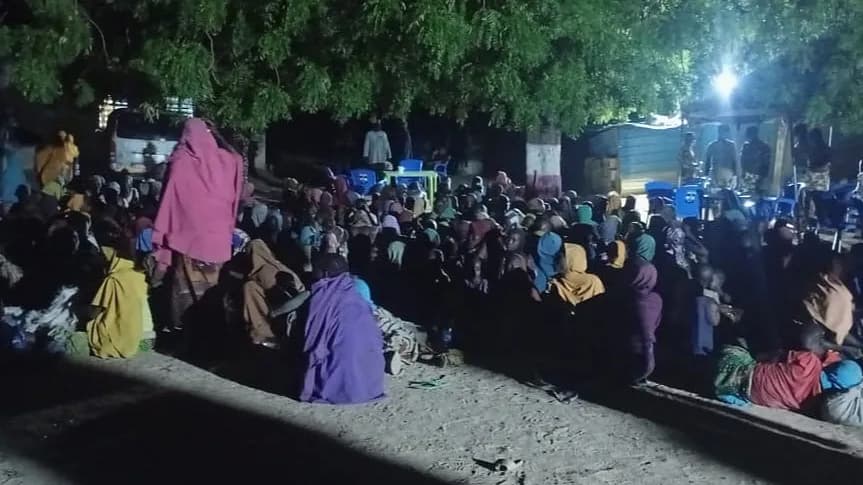
The Nigerian Army said it rescued 360 abducted civilians during an operation in the Mandara Mountains of Borno State, an area long used by Boko Haram fighters as a defensive sanctuary along Nigeria’s border region with Cameroon.
Military spokesperson Lieutenant Colonel Haruna Sani announced the operation on Sunday, describing it as a coordinated offensive targeting insurgent enclaves inside the mountainous terrain. According to the army, the rescued civilians included women and children abducted from multiple communities across northeastern Nigeria.
Two infants died afterward.
Sani said the infants died from exhaustion linked to the conditions of captivity and the evacuation process. The remaining rescued civilians were moved to secure locations for medical treatment and humanitarian screening, according to the military statement.
The Mandara Mountains have carried strategic importance for years. The terrain stretches across parts of southern Borno and northern Cameroon, with narrow pathways, caves, and elevated ridges that complicate surveillance and ground offensives. Nigerian security reports and regional intelligence assessments have repeatedly identified the area as one of Boko Haram’s remaining fallback positions after sustained military pressure around the Sambisa Forest corridor.
The geography favors insurgents.
Boko Haram and its splinter faction, the Islamic State West Africa Province (ISWAP), have adapted repeatedly since the peak of the insurgency between 2013 and 2015. Large territorial occupations became harder to sustain after multinational offensives involving Nigerian, Chadian, Nigerien, and Cameroonian troops. But security analysts at the Tony Blair Institute and the Institute for Security Studies have documented how both groups shifted toward mobile raids, kidnappings, improvised explosive devices, and taxation systems imposed on rural communities.
Kidnapping became financially useful.
Related News
The latest rescue operation reflects how abduction remains central to insurgent survival strategies across northeastern Nigeria. Civilians taken during village raids are often used for forced labor, ransom negotiations, recruitment, or logistical support inside remote camps.
United Nations agencies monitoring the Lake Chad Basin conflict have repeatedly warned that women and children remain especially vulnerable during mass abductions. UNICEF stated in previous assessments that children rescued from insurgent captivity frequently return with severe malnutrition, untreated illnesses, and trauma linked to prolonged exposure to violence.
The Nigerian military framed Sunday’s operation as evidence that intensified offensives are degrading insurgent capabilities. Last month, Nigerian authorities also announced that a joint operation involving cooperation with the United States eliminated 175 ISWAP fighters operating across parts of the Lake Chad Basin.
Independent confirmation remains difficult in northeastern Nigeria because journalists and humanitarian monitors often face restricted access to active operational zones. Casualty estimates released by security agencies during counterinsurgency operations are also rarely accompanied by full evidentiary disclosures, including battlefield imagery, forensic records, or independent civilian verification.
But the broader military escalation is visible.
Our analysis of official Defence Headquarters statements issued between January and May 2026 identified at least 14 separate announcements involving airstrikes, rescue missions, or clearance operations targeting Boko Haram and ISWAP positions in Borno State alone. Several referenced operations around Sambisa, Marte, Abadam, and the Mandara axis.
Yet the operational gains exist beside a more complicated reality. Boko Haram and ISWAP continue to conduct ambushes against military convoys, attack isolated communities, and plant explosives along rural transit routes despite repeated government declarations that the insurgency has been substantially weakened.
Data from the Armed Conflict Location and Event Data Project (ACLED) recorded hundreds of violent incidents linked to jihadist groups in northeastern Nigeria during the past two years, including civilian killings, raids on farming communities, and clashes with state forces. Borno State consistently accounts for a large concentration of those incidents.
Military recoveries therefore do not automatically translate into civilian stability.
Residents displaced by earlier violence continue to face pressure inside camps and resettlement communities across Maiduguri and surrounding local government areas. Humanitarian agencies including the International Organization for Migration have documented repeated shortages involving shelter, healthcare access, and food supply chains affecting displaced populations.
The United Nations Office for the Coordination of Humanitarian Affairs estimated earlier this year that millions across northeastern Nigeria still require humanitarian assistance because of conflict-related disruptions. Agricultural production remains unstable in several rural districts where farmers fear attacks during planting or harvest seasons.
Security experts also warn that rescue operations alone cannot dismantle insurgent networks if governance vacuums persist in isolated communities. Vincent Foucher, a researcher at the French National Centre for Scientific Research who has studied Boko Haram extensively, previously argued that military containment without sustained civilian administration allows armed groups to re-enter weakened regions after troop redeployments.
Nigeria has experienced that cycle repeatedly since 2010.
The military’s announcement regarding the rescued captives included no breakdown of how long the civilians had been held or from which specific communities they were abducted. That absence matters because tracking patterns of abduction can help establish whether insurgent groups are consolidating influence in new districts or returning to previously contested areas.
Several questions remain unanswered.
The death of two infants during evacuation also highlights the fragile physical condition many captives endure before rescue. Humanitarian workers operating in Borno have consistently reported high rates of dehydration, respiratory illness, and severe nutritional deficiency among civilians emerging from insurgent-controlled territory.
Medical intervention often begins immediately after extraction.
The Nigerian government has repeatedly promised expanded rehabilitation programs for civilians rescued from insurgent camps, including psychosocial support and reintegration assistance. But aid workers and local officials acknowledge that funding limitations and overcrowded facilities continue to strain those programs.
That burden is growing.
The Nigerian Army says 360 abducted civilians were rescued from Boko Haram camps in the Mandara Mountains of Borno State.
Two infants died after the operation, according to military spokesperson Haruna Sani.
Security data and independent conflict trackers show insurgent attacks continue across northeastern Nigeria despite intensified military offensives.
Humanitarian agencies say rescued civilians often return with severe medical and psychological trauma after prolonged captivity.
Why are the Mandara Mountains important?
Because the terrain is difficult to monitor and easy to defend. Boko Haram fighters have used the area for years as a movement corridor and fallback base near the Cameroon border.
Can the military’s casualty figures be verified independently?
Usually not completely. Journalists and aid agencies often cannot access active combat zones quickly enough to confirm battlefield claims in real time.
Does rescuing captives mean Boko Haram is collapsing?
No. It means one operation succeeded. Boko Haram and ISWAP still conduct attacks across parts of Borno and neighboring states according to conflict monitoring groups.
The next unresolved issue is whether Nigerian authorities can convert these repeated tactical operations into sustained civilian security before the next federal budget cycle. The National Assembly is expected to review fresh defence allocations later this year, including funding tied to counterinsurgency operations in Borno, while displaced communities continue waiting for guarantees that reclaimed areas can actually remain under state control.
Add a Comment