


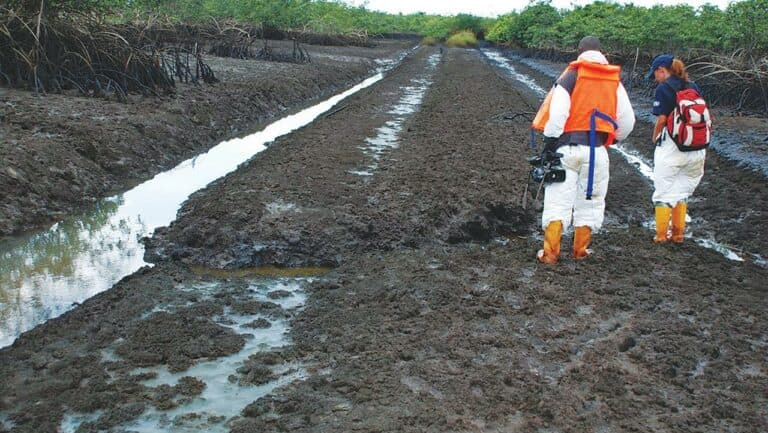
On June 2, 2016, Nigeria launched a $1 billion clean-up project in Ogoni land. Ten years later, large sections of contaminated soil and groundwater identified by the United Nations Environment Programme (UNEP) remain untreated.
The anniversary has revived scrutiny of the Hydrocarbon Pollution Remediation Project (HYPREP), the federal agency overseeing the exercise in Rivers State. The programme was inaugurated in Bodo by then Vice President Yemi Osinbajo on behalf of former President Muhammadu Buhari, following years of international pressure over oil pollution in Ogoni communities.
According to HYPREP’s December 2025 project scorecard, shoreline remediation reached 72.7 per cent completion. Mangrove restoration stood at 99 per cent. Soil and groundwater remediation, the core environmental concern identified by UNEP in 2011, remained at 39 per cent completion after a decade of operations.
The UNEP assessment that triggered the clean-up found benzene contamination in drinking water at levels it described as carcinogenic. The report documented widespread hydrocarbon pollution across Ogoni land, including destruction of mangrove ecosystems, fisheries and farmland. UNEP estimated at the time that full environmental restoration could take 25 to 30 years.
The programme was never designed as a quick intervention.
At the 2016 launch ceremony, UNEP Executive Director Achim Steiner said Ogoni communities had “paid a high price for the success of Nigeria’s oil industry.” His remarks reflected the central political argument behind the project: that Ogoni communities bore environmental damage disproportionate to the economic benefits derived from oil extraction in the Niger Delta.
Oil production in Ogoni land largely ceased in the early 1990s after prolonged protests led by activist Ken Saro-Wiwa and the Movement for the Survival of the Ogoni People (MOSOP). The conflict escalated into violent confrontations, internal communal tensions and the eventual execution of Saro-Wiwa and eight other activists by Nigeria’s military government in 1995.
HYPREP’s public records show substantial investment in infrastructure and social programmes beyond environmental remediation. The agency says 16 water facilities have been completed, supplying potable water to 42 communities. Public health interventions, specialist medical programmes and livelihood schemes have also been rolled out across Ogoni local government areas.
Related News
- At least six states were cited Tuesday by former Kano State governor Rabiu Musa Kwankwaso as evidence that Nigeria’s security crisis continues to spread despite years of expanded defence spending and repeated federal operations against armed groups.
- The attack began with gunfire near the hillside homes of a rural Federal Capital Territory settlement, according to residents who said armed men shot one man dead and abducted his younger brother before local vigilantes could stop them
- Enugu Teachers Protest Oyo Kidnappings as School Security Failures Spread Beyond Conflict Zones
In several communities, school renovation projects and vocational training centres have been commissioned under the Educational Support Programme. Scholarship schemes have sent Ogoni students abroad for specialised studies. HYPREP has also promoted skills acquisition programmes in mechatronics, cybersecurity and technical trades as part of its livelihood restoration strategy.
Our analysis of HYPREP’s published figures shows that groundwater and soil treatment, arguably the most technically difficult and expensive component of the exercise, is progressing far slower than mangrove restoration or shoreline remediation. That disparity raises questions about whether the programme’s environmental targets are keeping pace with its administrative expansion into social and infrastructure projects.
The procurement process has become part of the debate.
Multiple reports from Ogoni stakeholders and local monitoring groups point to delays linked to procurement approvals and equipment acquisition. Community leaders have also publicly disagreed over project siting and prioritisation among Ogoni clans and settlements.
Competition over access to oil-related benefits has historically fuelled divisions across parts of the Niger Delta. In Ogoni land, those tensions contributed to fractures within communities during the crisis years of the 1990s. Several former officials involved in Niger Delta peace initiatives have repeatedly warned that unresolved local disputes can slow implementation of remediation projects and weaken public trust.
Nigeria’s oil-producing belt contains multiple communities with long-standing pollution complaints tied to pipeline leaks, artisanal refining and decades of petroleum extraction. Environmental groups have consistently argued that the Ogoni framework could become a template for remediation elsewhere in the Niger Delta if the programme demonstrates measurable results.
The federal government initially presented the Ogoni clean-up as evidence that environmental accountability could coexist with oil production. Yet ten years later, the project remains suspended between two competing realities. On one side are visible infrastructure projects, restored mangrove areas and expanded public services. On the other is the slower task of removing deeply embedded hydrocarbon contamination from soil and groundwater systems.
UNEP warned in its original assessment that contaminated groundwater could continue spreading if remediation efforts were delayed or inconsistently applied. Environmental scientists familiar with Niger Delta pollution patterns have repeatedly argued that incomplete remediation can create the appearance of recovery without fully addressing long-term public health risks.
In several Ogoni communities, fishing and farming remain below pre-pollution levels despite restoration work. Local residents interviewed by civil society groups over the years have continued to complain about reduced yields, damaged wetlands and concerns over drinking water safety. HYPREP maintains that ongoing remediation and water interventions are gradually improving conditions.
The clean-up programme was originally designed as a joint funding arrangement involving the federal government and oil companies operating in the area, including Shell. Questions persist about long-term financing commitments as remediation enters its second decade, particularly if technical targets continue extending beyond initial timelines.
UNEP’s original recommendation anticipated a multi-decade exercise requiring sustained political backing and continuous technical oversight. Yet Nigeria has already seen several large-scale intervention programmes lose momentum after changes in political leadership, funding priorities or institutional disputes.
HYPREP says shoreline remediation reached 72.7 per cent by December 2025, but soil and groundwater treatment remains at 39 per cent after ten years.
UNEP’s original findings on carcinogenic contamination in Ogoni drinking water remain central to the clean-up debate in 2026.
Community disputes and procurement delays are slowing parts of the remediation process, according to stakeholder reports from Ogoni land.
The federal government is treating the Ogoni project as a possible model for environmental remediation across the Niger Delta.
Has the Ogoni clean-up been successful?
Partially. Mangrove restoration and water projects have advanced significantly. Soil and groundwater remediation, which UNEP identified as the most critical issue, is progressing more slowly.
Who is funding the clean-up?
The programme is funded through contributions involving the Federal Government of Nigeria and oil companies linked to operations in Ogoni land, including Shell.
Why is the project taking so long?
UNEP estimated from the start that full restoration could take up to 30 years. Hydrocarbon contamination in wetlands and groundwater systems is technically difficult and expensive to remove.
The next unresolved question is whether the federal government and HYPREP can maintain financing and political support long enough to complete the remaining 61 per cent of soil and groundwater remediation. No binding final deadline has been publicly fixed, and there is still no independent public accounting of the total remediation cost already spent versus the original $1 billion framework announced in 2016.
Add a Comment