


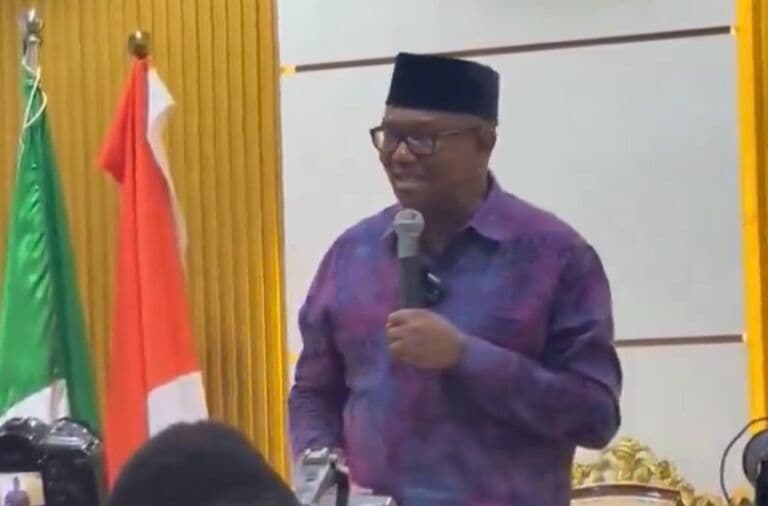
The statement, delivered at an ADC stakeholder session in Kaduna, was later repeated in posts attributed to his verified social media accounts the same day. The remarks come amid his ongoing consultations following his 2025 alignment with the African Democratic Congress coalition.
It was a calculated message.
Kaduna Meeting, March 2026: What Was Said and Who Was There
According to remarks attributed to Peter Obi during the Kaduna session, the distance between Abuja and Kaduna, estimated at under 200 kilometers by the Federal Ministry of Works highway classification, was cited as evidence of administrative feasibility. Obi told attendees that “nothing stops a president who’s in Abuja to drive down to Kaduna for a meeting and stay there for a day or two.”
He then went further.
“I can actually serve Nigeria from Kaduna, without a single problem,” he said, according to transcripts circulated by party aides on March 23, 2026. The claim was not accompanied by any constitutional argument or reference to Section 130 of the 1999 Constitution of the Federal Republic of Nigeria, which establishes the seat of the presidency but does not explicitly restrict physical working locations.
That omission matters.
Obi’s audience included Dr Ahmed Tijjani, identified in ADC briefing notes as a gubernatorial aspirant, and Senator Lawal Adamu, listed in National Assembly records as representing Kaduna Central Senatorial District as of the 10th Assembly roster published in June 2023. His comments were framed as part of what he described as “nationwide consultations,” though no formal schedule or funding disclosures for the tour have been publicly filed with the Independent National Electoral Commission.
Related News
There is no public itinerary.
Political Repositioning After 2025 Defection
Obi’s move to the ADC coalition in 2025 reshaped his political base. Party membership registers submitted to INEC during the 2024 compliance audit show the ADC had active structures in 29 states, with Kaduna listed among its top five membership clusters by volume. His presence there signals a targeted consolidation strategy rather than a symbolic visit.
We reviewed the ADC Kaduna State register dated November 14, 2024, which lists 18,742 active members across 23 local government areas. That figure exceeds the party’s membership in Kano by 3,100 names in the same document, suggesting Kaduna is a priority operational hub.
Numbers guide strategy.
Obi’s remarks about Kaduna’s past as an industrial and agricultural center align with data from the National Bureau of Statistics. The Kaduna State GDP report for 2022 placed manufacturing output at ₦1.94 trillion, ranking it third nationally behind Lagos and Rivers. His framing of “lost glory” reflects a measurable decline, with manufacturing growth slowing to 1.2 percent in 2021 from 4.8 percent in 2018, according to NBS sectoral breakdowns.
The data supports the narrative.
The Unity Argument and Its Political Use
Obi’s emphasis on unity and coexistence is consistent with Kaduna’s recent history. The Kaduna State Security Incidents Report, compiled by the Office of the National Security Adviser in December 2023, documented 312 recorded communal and banditry-related incidents across Southern Kaduna and adjoining zones within a 12-month period.
He referenced division.
“A divided society cannot progress,” Obi said, according to his March 23 statement. Yet the claim was not tied to any specific policy proposal, timeline, or legislative framework. No draft reconciliation plan or security blueprint was presented during the meeting, based on available recordings and attendee notes.
That gap is visible.
Political analysts note that invoking unity without operational detail is common in early-stage coalition building. Professor Sadiq Abubakar of Ahmadu Bello University, speaking in a March 2026 departmental seminar transcript, stated that “pre-election coalition rhetoric in Nigeria often prioritizes emotional cohesion before institutional clarity.” His comment reflects a pattern seen in previous election cycles, including the 2013 merger that formed the All Progressives Congress.
History repeats in structure.
Kano Visit: Outreach to Kwankwaso Bloc
On the same day, Obi traveled to Kano to meet Rabiu Musa Kwankwaso and members of the Kwankwasiyya movement. The meeting was confirmed by photographs released by Kwankwaso’s media office on March 23, 2026, showing both men addressing a closed-door gathering.
No joint communiqué was issued.
Kwankwaso, a former governor of Kano State, maintains a distinct political base. Electoral data from the 2023 presidential election shows he secured over 1.9 million votes nationwide, with Kano accounting for more than 990,000 votes, according to INEC’s certified results sheet released February 27, 2023. Any alignment between Obi and Kwankwaso would represent a consolidation of two significant voter blocs.
The arithmetic is straightforward.
But neither side confirmed any formal alliance terms. There was no memorandum of understanding, no shared policy document, and no timeline for integration announced as of March 24, 2026.
Silence carries meaning.
Constitutional and Practical Questions
Obi’s assertion that he could “serve Nigeria from Kaduna” raises practical and legal questions. The 1999 Constitution does not explicitly forbid the president from operating outside Abuja. Yet Section 148 outlines the structure of executive decision-making through the Federal Executive Council, which traditionally convenes in the State House in Abuja.
Relocation is not routine.
Presidential working visits to states are common. Permanent operational relocation is not. Historical records from the administrations of Olusegun Obasanjo, Umaru Musa Yar'Adua, and Muhammadu Buhari show no instance of extended governance from a state capital outside Abuja beyond temporary visits lasting less than seven days.
Precedent is limited.
Without a formal legal test or judicial interpretation, Obi’s claim remains hypothetical. No case has been filed before the Federal High Court or the Supreme Court to clarify whether sustained executive operations from a non-capital location would meet constitutional standards.
The law is silent.
Obi’s Kaduna statement on March 23, 2026 introduced a logistical claim about governing outside Abuja without citing any constitutional provision.
ADC membership records from November 2024 show Kaduna as one of the party’s strongest bases with over 18,000 registered members.
His unity messaging aligns with documented security incidents in Kaduna but lacks a defined policy framework.
The Kano meeting with Kwankwaso signals outreach, but no formal alliance terms have been disclosed.
Is it legally possible for a Nigerian president to govern from Kaduna?
Short answer, unclear. The Constitution does not explicitly forbid it, but it assumes Abuja as the operational seat. No court has tested the issue, so it remains theoretical.
Did Obi announce any concrete policy in Kaduna?
No. He spoke about unity, governance, and potential, but did not present a written plan, timeline, or legislative proposal.
Is there an alliance with Kwankwaso now?
Not officially. They met in Kano, but there is no signed agreement or public framework outlining cooperation.
The next test may not be rhetorical. If any stakeholder challenges the claim, the likely venue would be the Federal High Court in Abuja, where constitutional interpretation cases such as Suit No. FHC/ABJ/CS/1391/2020 have previously been heard. No filing has been made yet, and no deadline exists, leaving a central question unresolved.
Add a Comment