


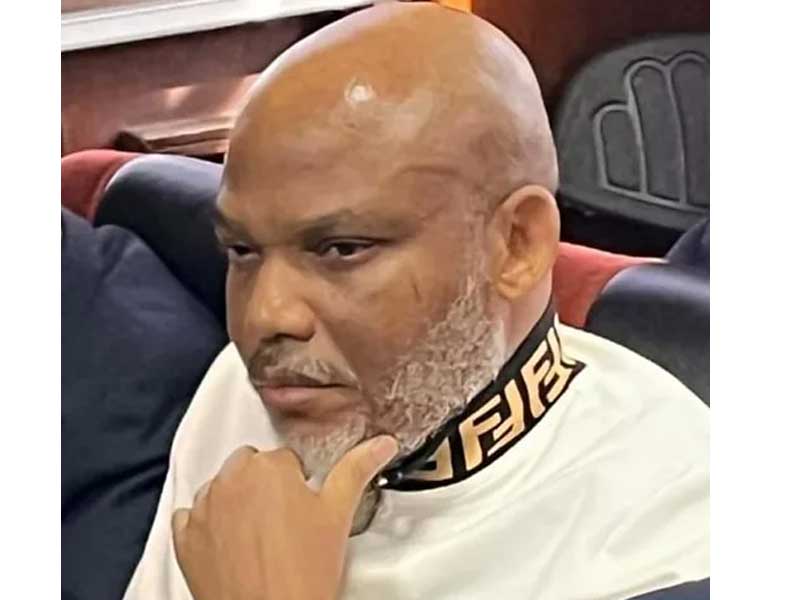
Nnamdi Kanu, leader of the proscribed Indigenous People of Biafra, is now facing life imprisonment after the Federal High Court in Abuja convicted him on all seven counts of terrorism. According to court records and reporting by Punch and other Nigerian outlets, the outcome might have been different if the separatist agitator had chosen to present a defence or retained legal counsel through the final stages of the trial.
A decade-long legal journey ends in conviction
Justice James Omotosho delivered the judgment last Thursday, bringing an end to a legal confrontation that began in 2015 when Kanu was first arrested in Lagos by the Department of State Services. He was later arraigned at a Magistrate Court in Wuse before the case moved through several judges at the Federal High Court, including Justices Ahmed Mohammed, John Tsoho and Binta Nyako.
Throughout this period, Kanu repeatedly accused the judges of bias and insisted he could not be tried on terrorism allegations. However, Justice Omotosho ruled that the separatist leader had used violence and threats to pursue his campaign for an independent Biafra, noting that self-determination becomes unlawful when it relies on actions defined as terrorism under Nigerian law.
Extraordinary rendition and legal twists
Kanu’s trial took a dramatic turn in 2021 after his controversial return from Kenya, which he described as an extraordinary rendition. Justice Nyako, before recusing herself in 2024, struck out eight of the 15 amended charges and directed him to defend the remaining seven.
The Court of Appeal later dismissed all outstanding charges and discharged him, citing the illegality of his rendition. However, the Supreme Court reversed that decision in 2023, holding that although the federal government acted improperly, the alleged wrongdoing did not nullify the charges. It ordered Kanu to return to the Federal High Court to complete his trial.
The case was reassigned to Justice Omotosho in early 2025.
Prosecution evidence and the defendant’s refusal to enter a defence
During the trial, the DSS called five witnesses and presented numerous documents and videos. These included Kanu’s broadcasts that allegedly encouraged attacks on security personnel, threatened destruction of public infrastructure and enforced sit-at-home orders across the Southeast. According to the prosecution, these directives resulted in deaths, injuries and widespread economic disruption.
When the prosecution closed its case, Kanu declined to open a defence, despite what the judge described as repeated pleas and warnings. He insisted the court lacked jurisdiction, arguing that the charges were based on a repealed law and that his rendition invalidated the proceedings.
Related News
Justice Omotosho rejected each argument. He explained that since the original terrorism charge was filed in 2015 under the Terrorism Prevention Act 2013, later amendments did not affect its validity. He added that fleeing the country after being granted bail meant that Kanu’s manner of re-arrest could not stop the trial.
A strategic choice that proved costly
Observers say Kanu’s decision to discharge several legal teams may have severely damaged his case. The IPOB leader removed Senior Advocates of Nigeria Mike Ozekhome and Kanu Agabi at different stages, before finally dismissing all counsel in October 2025 and choosing to represent himself.
Court transcripts show that Justice Omotosho suspended proceedings at times to allow Kanu to file applications, yet the defendant still refused to present evidence or call witnesses. At earlier stages, he had listed more than 20 witnesses, including former Defence Minister T. Y. Danjuma, but eventually abandoned that plan.
Legal scholars interviewed after the judgment noted that defendants who rest their case on the prosecution’s evidence run significant risks, especially in criminal matters. According to criminal law experts, the court is permitted to rely entirely on unchallenged prosecution evidence when a defendant provides no alternative narrative.
Court findings and sentencing
Justice Omotosho concluded that the prosecution had proved all seven counts beyond reasonable doubt. These included making broadcasts intended to intimidate the public, issuing threats that forced sit-at-home orders in the Southeast, inciting violence against security personnel and illegally importing a radio transmitter.
The judge stated that some offences carried a maximum sentence of death but said he opted for life imprisonment out of what he described as “mercy,” while emphasising the scale of violence linked to Kanu’s broadcasts.
He also ordered that Kanu be held in protective custody due to security concerns arising from past prison breaks. The court further directed that he be denied access to computer devices unless closely monitored by the Office of the National Security Adviser.
Ethnic and political reactions
The ruling has sparked mixed reactions. Some critics argue that the judgment reinforces feelings of marginalisation in the Southeast, pointing to the fact that violent non-state actors in other parts of the country often evade prosecution. Supporters of the verdict say the court followed due process and that Kanu’s refusal to defend himself weakened his position.
Human rights advocates note that the case raises broader questions about due process, extraordinary rendition and the balance between national security and civil liberties.
Final analysis
After nearly ten years of proceedings, appeals and political debate, the court’s decision reflects both the complexity of Kanu’s legal journey and the consequences of his strategic choices. Legal experts suggest the outcome might have been different had he mounted a defence or allowed experienced counsel to represent him.
As the case moves into its post-judgment phase, it continues to shape national conversations around justice, security and the long-standing tensions surrounding the Biafra movement.
Add a Comment