


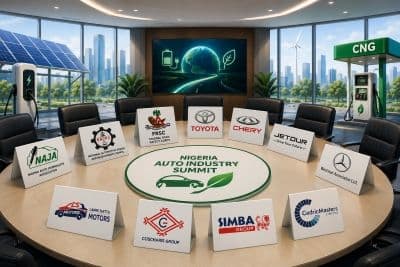
Nigeria's third Auto Industry Summit will convene July 30 at the Radisson Hotel in Ikeja, Lagos. The Federal Road Safety Corps' Corps Marshal will deliver the keynote address.
The summit lands as the Tinubu administration pushes its Presidential Compressed Natural Gas Initiative, a program aimed at weaning transportation off petrol dependence. Whether that policy push translates into manufacturing investment, or remains a talking point at industry gatherings, is the question stakeholders are set to confront in Ikeja.
The Nigeria Auto Industry Summit (NAISU 2026) is organized by the Nigeria Auto Journalists Association (NAJA) in partnership with the National Automotive Design and Development Council (NADDC). It is scheduled to begin at 10:00 a.m. on Thursday, July 30, 2026, at 22 Isaac John Street, GRA, Ikeja.
This year's theme is direct: "Nigeria's Clean Mobility Future: The EV and CNG Journey Under the Bola Tinubu Administration." The framing ties the summit's outcomes explicitly to a sitting government's policy record, raising the stakes for what gets said, and what gets promised, in the hotel's conference rooms.
Confirmed attendees include Weststar Associates Limited, TNL, Jetour, Carloha Nigeria, Simba Group, Cedric Masters Group, Coscharis Motors and LSM. Government agencies and private sector organizations round out the list, though the organizers have not published a full attendee roster or expected headcount.
The FRSC Corps Marshal's keynote will focus on road safety, regulatory reform, and what the organizers describe as the "safe integration" of electric and CNG-powered vehicles into Nigeria's transport system. Other keynote speakers are expected to address safety standards, infrastructure requirements, and the policy initiatives organizers say are necessary to accelerate the clean mobility transition. No full speaker list beyond the Corps Marshal has been released.
A Chairman's Framing, and a Planning Committee's Claims
NAJA Chairman Theodore Opara said ahead of the event that the summit has "evolved into a credible platform for policy dialogue and industry engagement." He tied this year's edition to what he called a critical period, one in which Nigeria is "pursuing cleaner energy alternatives and implementing reforms aimed at reducing transportation costs, promoting local vehicle manufacturing and encouraging investments in sustainable mobility."
Related News
- Nigeria's reported digital payment fraud losses fell 52 percent last year, dropping to N25.85 billion from N52.26 billion in 2024.
- Nigerian Navy destroys nine illegal refining sites, recovers 104,000 litres of suspected stolen crude in Bonny
- Nigerian troops killed an ISWAP cameraman on July 12, the Nigerian Army says
Opara's comments, delivered in a statement circulated ahead of the summit, do not specify which reforms he means beyond the PCNGI. He said the summit's theme "reflects the growing importance of electric mobility and CNG adoption" and framed the gathering as a venue for "practical solutions" to accelerate the transition. He did not name a target date, investment figure, or measurable benchmark against which the summit's success could later be judged.
Rasheed Bisiriyu, chairman of the NAISU 2026 Planning Committee, said preparations were complete. He described an "impressive lineup of speakers, exhibitors and stakeholders" without naming most of them beyond the companies already confirmed. Bisiriyu said the summit would go beyond government EV and CNG policy to cover financing, infrastructure development, local manufacturing, technology transfer, and consumer adoption.
"We are pleased with the level of support and interest shown by stakeholders across the automotive ecosystem," Bisiriyu said. He added that participants "should expect insightful discussions that will contribute to the future of mobility in Nigeria." That is a statement of intent, not a commitment to any specific deliverable.
Neither Opara nor Bisiriyu specified what, if any, formal communique or policy recommendation document will emerge from the July 30 session, or to whom it would be submitted.
The Policy Backdrop
The summit is positioned against the backdrop of the Presidential Compressed Natural Gas Initiative, a federal program designed to reduce petrol dependence and lower transportation costs. The PCNGI has been cited by industry observers, according to the summit's own promotional materials, as the policy anchor for this year's theme. The materials do not cite specific PCNGI conversion numbers, vehicle counts, or funding figures tied to the initiative's current implementation.
Planned discussion topics listed by organizers include electric vehicle infrastructure, CNG conversion, investment opportunities, financing models, local content development, road safety, consumer awareness, and the policy frameworks needed to advance what they term Nigeria's "clean mobility agenda." That is a broad mandate for a single-day event running from a 10:00 a.m. start.
Organizers said they expect the summit to produce "far-reaching recommendations" capable of supporting government efforts to modernize the automotive industry and attract investment. They also expressed hope that Nigeria could position itself as a "leading mobility hub" on the continent. Neither claim is attached to a specific metric, timeline, or prior benchmark from the summit's first two editions.
This is the third iteration of NAISU. The event's growth or attendance figures from its 2024 and 2025 predecessors were not included in materials reviewed for this article, leaving no baseline against which to measure whether this year's summit represents an expansion, a plateau, or a contraction in industry engagement.
The gap between stated ambition and disclosed detail is the throughline here. A national policy theme, a government keynote speaker, and a list of eight confirmed corporate participants are on the record. What remains undisclosed is a specific timeline for any recommendations to reach the Tinubu administration, a funding commitment tied to the PCNGI's expansion, or a mechanism by which NAJA and NADDC intend to track whether Thursday's discussions produce any measurable change in Nigeria's EV or CNG adoption rates over the coming year. Whether the FRSC Corps Marshal's keynote address introduces any new regulatory framework, or simply restates existing road safety guidance, will not be clear until the summit convenes on July 30.
Add a Comment