


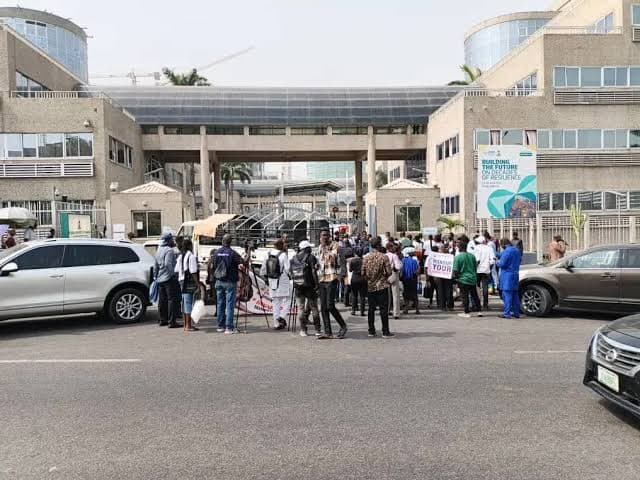
The Federal Government has released N152 billion to contractors amid mounting pressure over an estimated N4 trillion backlog of unpaid contract obligations, following fresh protests at the headquarters of the Federal Ministry of Finance in Abuja.
The Ministry of Finance confirmed the payment on Tuesday, explaining that prolonged delays were largely the result of verification procedures required under existing financial regulations. The announcement came a day after aggrieved contractors shut down access to the ministry’s offices, demanding immediate settlement of outstanding debts.
The protest marked the latest escalation in a dispute that has simmered for months, reflecting broader tensions between the government’s fiscal constraints and contractors’ growing financial distress.
Protests reignite over delayed payments
On Monday, contractors under the umbrella of the Indigenous Contractors Association of Nigeria, AICAN, converged on the Ministry of Finance in Abuja, blocking entrances and disrupting official activities. The group said its members were collectively owed more than N4 trillion for completed and ongoing federal government projects.
According to reports from the protest scene, contractors accused the government of failing to honour multiple payment assurances, despite submitting required documentation and undergoing verification processes.
The demonstration followed a similar protest in December 2025, when contractors accused the government of reneging on earlier commitments to clear verified arrears before the end of the year.
Ministry cites verification and due process
Related News
- NDIC begins paying depositors of 46 failed microfinance banks, promises to beat 30-day legal deadline
- Nigerian equities added N3.156 trillion in value this week, closing Friday's session at a market capitalisation of N147.102 trillion
- Malaysia Courts Nigeria’s Halal Industry as Trade Hits $664 Million
In a statement issued in Abuja on Tuesday, the Ministry of Finance defended the pace of payments, stressing that contract disbursements must pass through several layers of verification to safeguard public funds.
“The process of payment for contracts goes through various verification processes in line with extant laws and regulations, to protect taxpayers’ money and ensure accountability and transparency,” the ministry said.
While acknowledging the strain delays have placed on contractors, the ministry urged continued dialogue rather than confrontation.
“While the Ministry acknowledges the financial strain the delay in payment has caused contractors, we also plead for continuous dialogue and engagement for effective resolution of all conflicts,” the statement added.
The ministry also raised concerns about the conduct of some protesters, noting that staff had faced intimidation during demonstrations.
“FMF assures all contractors of our continuous support and openness to constructive dialogue and urge all contractors to respect the process and the personnel of the FMF, who have had to endure different levels of intimidation and harassment,” it said.
According to the ministry, payment requests are being processed “in line with due process in a timely and consistent manner,” though it did not give a timeline for clearing the remaining arrears.
Contractors dispute scale of payments
However, contractor representatives insist that government statements do not reflect realities on the ground.
AICAN President, Mr. Jackson Nwosu, told journalists that the renewed protest was triggered by worsening cash flow pressures among contractors who borrowed heavily to execute public projects.
He said many members are now facing loan defaults, asset seizures, and mounting interest penalties due to prolonged non payment.
“The government has failed to honour the agreement to pay contractors whose project details had been submitted and verified,” Nwosu said. “Payments finalised before the closure of the payment portal at the end of December never reflected in our accounts.”
Nwosu also rejected claims circulating in official circles that up to 80 percent of contractor debts had been settled. According to him, actual payments are far lower.
“At best, only 30 to 40 percent of payments have been made. Warrants stopped coming in May 2025, yet contractors continue to execute projects without corresponding payments,” he said.
He added that ongoing project execution without funding has pushed total liabilities beyond N4 trillion, deepening financial exposure across the construction sector.
Background to the debt crisis
Nigeria’s contractor debt problem has accumulated over several budget cycles, driven by a mix of delayed releases, project rollovers, and revenue shortfalls. While contracts are often awarded based on annual appropriations, actual cash backing frequently lags due to fiscal pressures, particularly in periods of high debt servicing and subsidy related spending.
In recent years, tighter revenue conditions and efforts to control deficit financing have further slowed capital releases, leaving contractors to rely on bank loans to sustain project execution.
According to analysts, the result is a growing disconnect between project approvals and payment capacity, with contractors effectively financing public infrastructure at commercial interest rates.
Why the issue matters now
The timing of the latest protests is significant. With the 2026 budget cycle approaching and capital allocations under scrutiny, unresolved contractor debts risk undermining future project delivery and investor confidence in public procurement.
Delayed payments also carry broader economic implications. Construction and infrastructure development are major drivers of employment and local supply chains, and prolonged liquidity stress among contractors can ripple across the banking sector through rising non performing loans.
An Abuja based public finance analyst noted that partial payments, while helpful, may not be enough to stabilize the sector.
“Releasing N152 billion shows responsiveness, but compared to a N4 trillion exposure, it barely scratches the surface,” the analyst said. “Without a clear repayment schedule, contractors and lenders remain in uncertainty.”
What to watch next
Key stakeholders will be watching whether the government provides a transparent breakdown of verified claims and a realistic timeline for settling outstanding obligations. There are also growing calls for structural reforms, including stricter project approval controls and escrow backed funding mechanisms to prevent future arrears.
For now, AICAN has indicated it remains open to dialogue, but warned that further protests could follow if payments continue to stall.
The Ministry of Finance, meanwhile, faces the challenge of balancing fiscal discipline with the urgent need to restore confidence among local contractors who form the backbone of public infrastructure delivery.
Add a Comment