


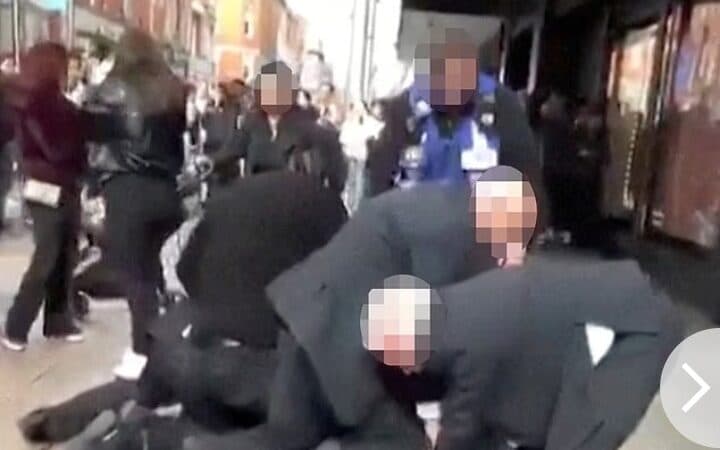
That sequence, captured on mobile phone footage outside a department store on Dublin’s Henry Street last Friday, has now triggered protests outside Ireland’s parliament, renewed scrutiny of private security practices, and a politically charged debate over race and immigration in the country.
Irish police confirmed that Mr Sakila, a 35-year-old Congolese immigrant, became unresponsive after security personnel detained him shortly after 5 p.m. over an alleged shoplifting incident. He was later pronounced dead in hospital. Authorities also confirmed that a man in his 80s sustained injuries during the confrontation.
Henry Street Footage Turned a Shoplifting Detention Into a National Flashpoint
The footage circulating online shows at least five men pinning Mr Sakila face down on the pavement outside a department store on Henry Street, one of Dublin’s busiest retail corridors. Witnesses can be heard shouting as the restraint continued for several minutes.
Irish police have not publicly identified the security personnel involved or disclosed whether any of them have been suspended pending investigation. Authorities confirmed that a post mortem examination has been completed, but investigators said the findings would not yet be released for what police described as “operational reasons.”
That wording drew immediate criticism from protesters gathered outside the Irish parliament on Thursday. Demonstrators carried placards reading “Justice” and “No cover up, no delay,” while others referenced the Irish phrase “Céad míle fáilte,” commonly translated as “a hundred thousand welcomes.”
According to statements reported by the Daily Mail and Irish broadcaster RTE, several protesters directly compared the footage to the 2020 killing of George Floyd in Minneapolis, where former police officer Derek Chauvin was later convicted of murder and manslaughter and sentenced to more than 22 years in prison.
David Kaliba, identified as a former schoolmate of Mr Sakila, told reporters the incident represented “a George Floyd moment” for Ireland. Kaliba said he attended school with Mr Sakila in north Dublin and described him as “quiet and shy.” He also stated that Mr Sakila had previously worked in information technology before recently experiencing homelessness.
Related News
- Nigerian Lives Lost Abroad: A Growing List of Deaths Leaves Families Seeking Answers Across Three Continents
- UN Records 9,788 Verified Cases of Conflict Sexual Violence in 2025 as Abuse Expands Across 21 Countries
- Israel Claims Killing of Hamas Commander Mohammed Awda Deepens Questions Over Gaza Escalation
The comparison carries legal weight as well as symbolism. In the Floyd case, prosecutors relied heavily on bystander video footage, restraint duration timelines, and expert testimony regarding positional asphyxia. Irish investigators have not disclosed whether similar forensic reviews are underway in the Sakila case.
Micheál Martin Faces Pressure Over Ireland’s Oversight of Private Security
Micheál Martin described the footage as “deeply disturbing” and called for a thorough investigation into the circumstances surrounding Mr Sakila’s death. But the government’s response has exposed a broader issue that predates the incident itself, oversight of private security personnel operating in crowded commercial areas.
In Ireland, licensed private security officers operate under regulation from the Private Security Authority. Yet public scrutiny of restraint techniques used by non-police personnel has remained limited compared to oversight mechanisms governing Garda officers.
Our analysis of Irish media archives from 2021 through 2026 identified multiple complaints involving force used by retail security staff in Dublin city centre. Few escalated into nationally reported investigations involving fatalities.
Authorities have not clarified whether the restraint method seen in the footage complied with existing training protocols or whether the guards involved had received instruction concerning prolonged prone restraint. Medical studies and police reform reviews in both the United States and United Kingdom have repeatedly warned that face-down restraint can increase the risk of respiratory distress, particularly when multiple individuals apply body weight simultaneously.
Yet no official timeline has been released.
The Garda Síochána Ombudsman Commission, which investigates complaints involving Irish police, has not publicly indicated whether it will assume any oversight role. That leaves unresolved questions about who ultimately examines the conduct of the security personnel shown in the footage.
Immigration Tensions in Dublin Were Already Rising Before Sakila’s Death
The protests following Mr Sakila’s death unfolded against a backdrop of escalating tension around immigration policy in Ireland. Anti-immigrant demonstrations have increased across parts of Dublin and other Irish cities over the past two years, particularly around housing shortages, asylum accommodation, and public services.
Councillor Yemi Adenuga, widely recognised as Ireland’s first elected Black female public official, said the government had failed to properly integrate the country’s growing immigrant population. She described the current atmosphere as “a recipe for chaos, anarchy and apathy.”
That assessment reflects demographic changes documented by Ireland’s Central Statistics Office. Census data released in recent years showed continued growth in the number of foreign-born residents, particularly in Dublin and surrounding counties.
But integration policy has struggled to keep pace.
Laure Zoya, vice president of the Congolese Community in Ireland, told RTE that many immigrants were now living in fear following the incident. She stated that “the Ireland that they knew 30 years ago is no longer the same.”
Her comment points to a broader shift in public debate. Ireland historically projected an international image associated with emigration rather than inward migration. That reality has changed significantly over the past two decades as immigration levels increased alongside labour demand and asylum applications.
Investigators Now Face the Question the Video Cannot Answer Alone
The footage establishes the duration and visibility of the restraint. It does not independently establish the medical cause of death.
Irish police confirmed that a post mortem examination has been completed, but investigators are withholding the findings. Authorities have also not disclosed toxicology results, witness statements, or whether any criminal inquiry has formally begun against the security staff involved.
Those omissions are now shaping public distrust.
We reviewed statements released by Irish police and government officials since Friday and found repeated references to a “thorough investigation,” but no indication of investigative deadlines, prosecutorial review timelines, or independent oversight procedures tied specifically to the restraint itself.
For many protesters outside parliament, the case now extends beyond one confrontation on Henry Street. The demonstration became a public test of whether Irish institutions will examine the death with the same scrutiny applied in comparable international cases involving restraint and race.
Video footage showing five men restraining Yves Sakila for nearly five minutes transformed a local shoplifting allegation into a national political issue in Ireland.
Irish authorities completed a post mortem examination but are withholding findings, leaving the central medical questions unresolved days after the death.
The case has intensified scrutiny of how private security staff in Dublin are trained, monitored, and investigated after violent incidents.
Protesters and immigrant advocacy groups are linking the incident to wider tensions around race, immigration, and public trust in Irish institutions.
Was Yves Sakila arrested by police?
No. Irish police said private security personnel detained him outside a department store before officers arrived.
Have the security guards been charged?
Authorities have not announced charges, suspensions, or arrests involving the guards shown in the footage.
Why are people comparing this to George Floyd?
Because the video shows a prolonged face-down restraint involving multiple men. Protesters see visual similarities. Legally, the investigations are still separate matters with different jurisdictions and evidence standards.
The unresolved issue now sits with Ireland’s coronial and investigative process. Police have not disclosed when the post mortem findings will be released, whether prosecutors will assess potential criminal liability, or whether the family of Yves Sakila intends to pursue civil action in the Irish High Court over the restraint that preceded his death on Henry Street.
Add a Comment