


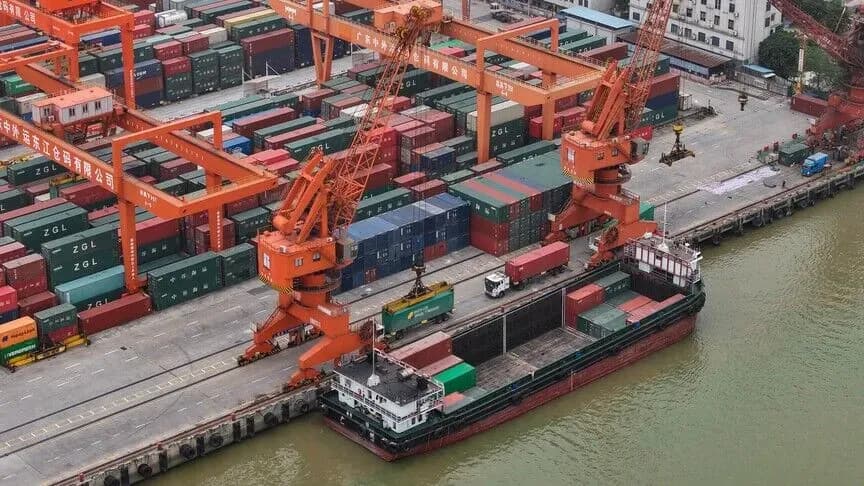
The figure, $196.6 billion at current exchange rates, marks a record for the period and comes as Beijing faces mounting criticism over trade imbalances with African economies. The claim matters because it lands amid a broader argument China is making to the continent: that its zero-tariff policy, not extraction, is driving the relationship.
Chinese Foreign Ministry spokesperson Lin Jian disclosed the figure Monday at a regular press briefing in Beijing. He was responding to a question about the impact of China's zero-tariff policy for African nations. "The total trade volume achieved faster growth and is expected to reach an even higher level by the end of this year," Lin said.
Capital goods and intermediate goods made up about 75% of China's exports to Africa in the period, Lin said. He used that breakdown to make a specific argument: that Chinese shipments support the continent's industrialization and agricultural modernization, not just consumer demand. No independent breakdown of the remaining 25% was offered at the briefing.
Lin did not disclose the trade balance between China and Africa for the period, only the combined two-way figure. That omission matters because the trade imbalance is precisely the subject Lin spent part of the briefing dismissing.
Asked about criticism over that imbalance, Lin rejected the framing outright. Such narratives, he said, were "merely traps designed by those with ulterior motives aimed at disrupting friendly cooperation between China and Africa." He did not name who he believed was setting the traps.
The zero-tariff policy
The policy Lin credited with the growth extends zero-tariff treatment to all African countries that maintain diplomatic ties with Beijing. That framing carries its own condition. Countries without diplomatic relations with China, most notably Eswatini, the only African state that recognizes Taiwan, fall outside the arrangement. Lin's briefing did not address Eswatini specifically.
Lin said China remained committed to what he called high-level opening-up, despite what he described as global challenges including regional conflicts and rising unilateralism and protectionism. He did not name specific countries or policies when referencing unilateralism, though the phrase has featured in Chinese Foreign Ministry statements referencing U.S. trade measures throughout 2026.
Related News
Looking forward, Lin said China would expand market access for what he called high-quality African products and would work to inject momentum into building an "all-weather China-Africa community with a shared future for the new era." That phrase is a standing formulation in Chinese Foreign Ministry rhetoric on Africa policy, not a new commitment specific to Monday's briefing.
The $196.6 billion figure describes total two-way trade, combining Chinese exports to Africa and African exports to China. It does not, on its own, indicate which side benefited more from the growth. Lin's remarks addressed the composition of Chinese exports (the 75% capital and intermediate goods figure) but offered no comparable breakdown of what Africa exported to China in return.
That gap is the same one African trade officials and analysts have raised for years: that the continent's exports to China remain concentrated in raw materials and unprocessed commodities, while Chinese exports to Africa increasingly include manufactured and intermediate goods. Lin's briefing did not include commodity-level export data that would confirm or refute that pattern for the first half of 2026.
No African government or regional trade body was quoted in the briefing responding to Lin's characterization of the imbalance criticism as a "trap." The briefing, as reported, reflects only the Chinese Foreign Ministry's position.
The unresolved question is what the actual trade balance was for the first half of 2026, a figure Lin's briefing did not disclose. China's General Administration of Customs typically publishes country and continent-level trade breakdowns, including bilateral balances, in its periodic trade bulletins. Until that data is published and reviewed, Lin's claim that the growth benefits African industrialization rather than compounding a raw-materials imbalance remains an assertion from one side of the ledger, not a demonstrated outcome.
Add a Comment