


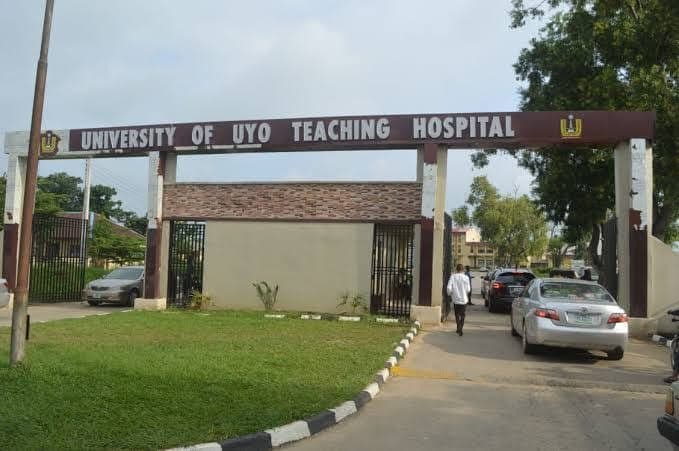
Resident doctors at the University of Uyo Teaching Hospital, Uyo, have formally announced their participation in the nationwide industrial action declared by the National Association of Resident Doctors, intensifying pressure on the Federal Government over unresolved welfare and professional concerns in the health sector.
The Association of Resident Doctors at UUTH said it would join the strike scheduled to commence on Monday, January 12, 2026, following resolutions reached at an emergency general meeting held in Uyo, Akwa Ibom State, on Thursday.
According to a communiqué issued after the meeting and made available to journalists in Uyo on Friday, the association resolved to fully align with the directive of the national body. The document was signed by the association’s President, Dr Ekomobong Udoh, and its General Secretary, Dr Kenneth Ikott.
The resident doctors also announced plans to stage a peaceful protest within the hospital premises from 9am on Monday as part of the initial phase of the action.
Decision follows national directive
According to the communiqué, the emergency meeting was convened to review resolutions issued by the National Association of Resident Doctors after its Extra-Ordinary National Executive Council meeting, which was held virtually on Saturday, January 2, 2026.
The UUTH chapter said members deliberated extensively on the national body’s position before agreeing to comply fully with the directive.
“The centre fully supports the implementation of the NARD NEC meeting resolutions,” the communiqué stated. “The congress immediately agreed to participate in the NARD TIC 2.0 from 12 noon on Monday, in line with the NEC directive, and will undertake a peaceful protest by 9am on Monday within the UUTH premises.”
The strike has been tagged TICS 2.0, short for Total, Indefinite and Comprehensive Strike, reflecting the association’s intention to withdraw services nationwide until its demands are fully addressed.
Reasons behind the industrial action
Speaking on the decision, Dr Udoh said the strike followed the Federal Government’s failure to fully implement a Memorandum of Understanding signed with resident doctors in November 2025.
According to him, the agreement was expected to resolve several longstanding issues affecting resident doctors across federal teaching hospitals and medical centres. However, he said progress on implementation had been slow and incomplete, prompting the renewed industrial action.
He added that the strike would remain in force until the government meets the association’s minimum demands.
“This action is guided by the principle of accountability,” Udoh said. “No implementation, no going back.”
The slogan has since become the rallying cry of resident doctors nationwide, signalling their determination to sustain the strike until concrete outcomes are achieved.
According to the association, one of the central demands is the reinstatement of the FTH Lokoja Five, a group of resident doctors whose dismissal has remained a contentious issue within the health sector.
Other demands include the payment of outstanding promotion and salary arrears owed to resident doctors across several institutions.
The doctors are also calling for the full implementation of the approved professional allowance table, with all arrears captured in the 2026 federal budget. They are seeking official clarification from the Federal Ministry of Health on issues relating to skipping and entry-level placement, alongside the issuance of relevant circulars to chief medical directors and hospital managements.
Additional demands listed in the communiqué include the reintroduction and implementation of the Specialist Allowance, as well as the resolution of salary delays and arrears affecting house officers. This includes the issuance of a clear pay advisory to prevent recurring delays.
The association further called for the recategorisation of membership certificates and the issuance of certificates after Part I examinations by the National Postgraduate Medical College of Nigeria.
Other unresolved issues include the commencement of locum and work-hours regulation committees, as well as the resumption and timely conclusion of the Collective Bargaining Agreement process between the government and resident doctors.
The latest strike adds to a long history of industrial actions by resident doctors in Nigeria, many of which have centred on welfare, remuneration, training conditions, and workplace safety.
Over the past decade, the National Association of Resident Doctors has embarked on several nationwide strikes, often citing unfulfilled agreements by successive administrations. While some actions have led to partial concessions, many doctors argue that implementation gaps remain persistent.
Health policy analysts note that resident doctors occupy a critical position in Nigeria’s public health system, forming the backbone of service delivery in teaching hospitals. Their absence, even temporarily, often leads to the suspension of outpatient clinics, elective surgeries, and specialist consultations.
The timing of the strike is particularly significant, coming at a period when public hospitals are already under strain from workforce shortages, rising patient loads, and budgetary pressures.
According to public health experts, prolonged disruptions could deepen access challenges for patients who rely heavily on tertiary healthcare facilities for specialised treatment.
Dr Aminu Lawal, a health systems analyst based in Abuja, said recurring strikes point to deeper structural issues.
“Industrial actions like this are often treated as isolated labour disputes, but they reflect systemic weaknesses in planning, funding, and accountability,” Lawal said in an interview. “When agreements are signed without realistic implementation timelines, distrust builds, and strikes become cyclical.”
Implications and what to watch next
As the strike begins, attention will turn to the Federal Ministry of Health and relevant government agencies to see whether emergency negotiations can prevent a prolonged shutdown of services.
Observers will also watch how hospital managements manage emergency care during the strike, as resident doctors have traditionally maintained skeletal services for life-threatening cases.
Another key issue is whether the dispute will spill into other segments of the health workforce, including consultants and allied health professionals, who have previously expressed solidarity with resident doctors during similar actions.
For patients, advocacy groups have called for urgent dialogue to minimise the impact on care delivery while addressing doctors’ legitimate concerns.
The decision by resident doctors at the University of Uyo Teaching Hospital to join the nationwide strike underscores growing frustration within Nigeria’s medical training system over unimplemented agreements and unresolved welfare issues.
As the industrial action begins on Monday, January 12, 2026, the coming days will test the government’s willingness to engage decisively with resident doctors and address longstanding grievances that continue to disrupt healthcare delivery across the country.
Add a Comment