


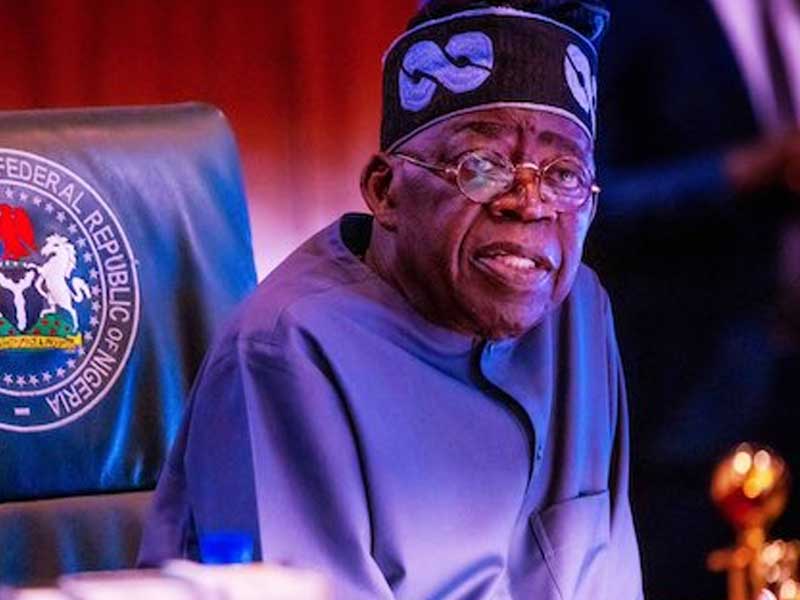
President Bola Tinubu has described the Nigerian Exchange’s rise beyond N100 trillion in market capitalization as a defining moment for the country’s economy, saying the milestone reflects renewed investor confidence and the early payoff of wide-ranging economic reforms.
In a statement issued by his Special Adviser on Information and Strategy, Bayo Onanuga, the President commended corporate Nigeria, market operators, and individual investors for their role in pushing the Nigerian Exchange Group to the historic threshold. He urged Nigerians to see the achievement as an opportunity to deepen participation in the domestic economy rather than rely on speculative or offshore assets.
According to Tinubu, the NGX performance signals a fundamental shift in how Nigeria is perceived by global investors, moving the country from the margins of capital markets to a destination where value is increasingly being identified and priced.
“With the Nigerian Exchange crossing the historic N100 tn market capitalization mark, the country is witnessing the birth of a new economic reality and rejuvenation,” the President said.
Stock market performance outpaces global peers
The N100 trillion valuation comes after a strong year for equities in 2025, during which the NGX All-Share Index delivered a return of 51.19 per cent. This performance exceeded the 37.65 per cent recorded in 2024 and placed Nigeria among the best-performing stock markets globally.
Tinubu noted that Nigeria’s equity returns in 2025 outpaced those of major developed market indices such as the S&P 500 and the FTSE 100, while also surpassing several emerging market peers within the BRICS+ grouping.
Market analysts say the rally reflects a combination of repricing, improved earnings outlooks for large companies, and renewed foreign interest following reforms in the foreign exchange and monetary policy frameworks.
“Nigeria is no longer a frontier market to be ignored; it is now a compelling destination where value is being discovered,” the President said, adding that stock market performance often mirrors broader economic confidence.
Related News
Corporate earnings and sector resilience
The President attributed the market surge partly to strong performances across multiple sectors, including industrials, banking, and technology. According to him, listed companies have demonstrated an ability to adapt to structural changes while improving efficiency and profitability.
He cited the localization of supply chains by major industrial firms and the resilience of the banking sector, particularly in areas of digital transformation and risk management.
“From blue-chip industrial giants that have localized their supply chains to a banking sector that has demonstrated resilience and technological innovation, Nigerian companies are proving that the country can deliver strong returns on investment,” Tinubu said.
Capital market operators note that improved disclosure standards, stronger corporate governance, and recapitalization efforts in the financial sector have also helped boost investor confidence.
Reforms, inflation trends, and currency stability
Tinubu linked the NGX milestone to broader macroeconomic reforms introduced by his administration, acknowledging that the policies initially created economic pressure but are now yielding measurable results.
According to the President, tighter monetary policy and the removal of distortionary financing practices, particularly the elimination of ways and means funding, have contributed to improved monetary stability and reduced pressure on the naira.
“After the initial headwinds that followed our reforms, we are finally seeing a bend in the inflation curve,” he said.
He noted that inflation, which peaked at a 24-month high of 34.8 per cent in December 2024, declined steadily to 14.45 per cent by November 2025. Tinubu attributed the trend partly to increased investment in agriculture, improved food supply chains, and monetary tightening.
The President added that inflation is projected to fall below 10 per cent by the end of the year, a development he said would support stronger consumer purchasing power and faster GDP growth.
External balances and reserve strength
Beyond domestic indicators, Tinubu highlighted improvements in Nigeria’s external position. He disclosed that the country recorded a current account surplus of $16 billion in 2024.
According to projections from the Central Bank of Nigeria, the surplus is expected to rise to $16.94 billion in 2025 and further to $18.81 billion in 2026.
Foreign exchange reserves have also exceeded $45 billion, providing the Central Bank with greater capacity to manage currency volatility. Tinubu said the naira has stabilized compared to earlier periods marked by sharp fluctuations and speculative pressure.
Economists say reserve accumulation and a more transparent FX framework are critical for sustaining foreign portfolio inflows into equities and fixed-income markets.
Infrastructure, social sectors, and investor sentiment
The President pointed to progress in infrastructure and social services as further evidence of a broader economic turnaround. He referenced ongoing expansion of rail networks, the completion of key arterial roads, and efforts to modernize Nigeria’s ports to reduce trade bottlenecks.
Tinubu also cited improvements in healthcare delivery, declining costs associated with medical tourism, and expanded access to education through the Nigeria Education Loan Fund. Universities, he added, are receiving increased research grants to strengthen innovation and skills development.
Policy analysts say these non-market reforms matter to investors because they influence long-term productivity, workforce quality, and the sustainability of economic growth.
While Nigeria has experienced stock market rallies in the past, analysts note that the current surge differs in scale and context. The N100 trillion valuation comes amid structural reforms, improved fiscal discipline, and a clearer monetary policy direction.
Some analysts caution, however, that sustaining market momentum will depend on continued policy consistency, corporate earnings growth, and the ability to translate capital market gains into real economic benefits for households and small businesses.
The next phase to watch, they say, is whether increased market capitalization leads to more initial public offerings, deeper retail investor participation, and stronger long-term financing for infrastructure and manufacturing.
Call for citizen participation
In closing, Tinubu urged Nigerians to see the capital market as a vehicle for national development rather than short-term speculation.
“Nation-building is a process, not a destination,” he said. “Hard work, sacrifices, and the focus of its citizens build a nation.”
He described the N100 trillion milestone as a message to the international community that Nigeria’s economy is resilient and productive, pledging to continue reforms aimed at transparency, equity, and growth. He added that historic tax and fiscal reforms, which came into full implementation on 1 January, would further support economic expansion.
Add a Comment