


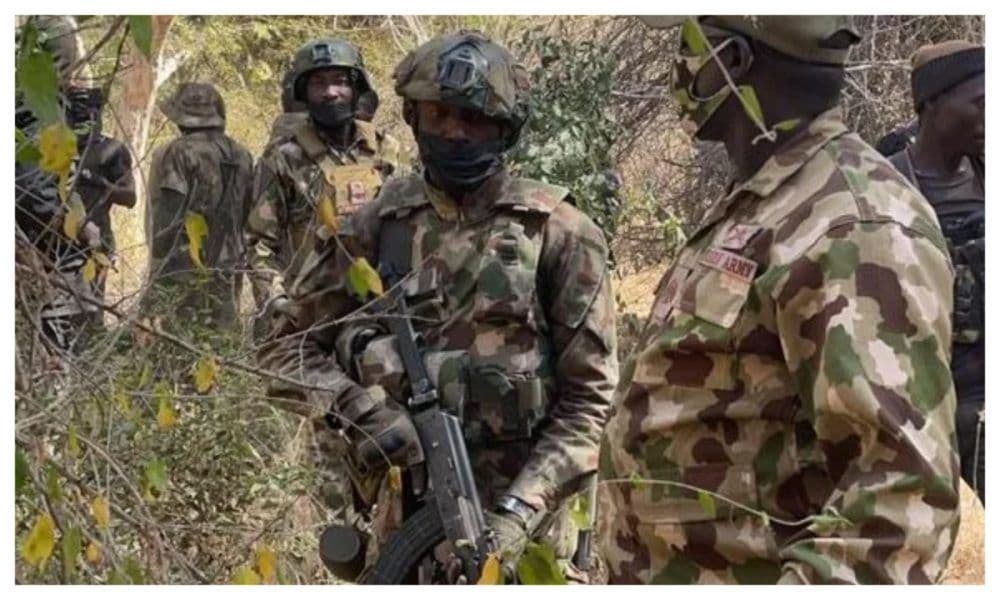
Troops killed 12 suspected militants during a late-night battle in Kirawa, Borno State, according to operational accounts released Saturday by security sources involved in Operation HADIN KAI.
The confrontation began around 11:00 p.m. on May 22 near Nigeria’s border with Cameroon, an area that has repeatedly served as a movement corridor for fighters linked to the Islamic State West Africa Province (ISWAP) and remnants of Boko Haram factions. Security analyst Zagazola Makama first disclosed the incident through his X account, citing military and intelligence sources familiar with the operation.
According to the operational account, militants approached troop positions from the Cameroon axis during ongoing clearance efforts under Operation Desert Sanity V and related siege operations conducted by the Joint Task Force North East. Troops reportedly identified the movement before the attackers reached defensive lines, then responded with coordinated ground fire supported by intelligence surveillance assets and air support.
The Nigerian military has not publicly released casualty photographs, names of the dead militants, or independent battlefield verification. But the figures cited by sources remain consistent across multiple operational summaries circulated Saturday within security reporting networks covering the Lake Chad conflict zone. Initial battle damage assessments reportedly placed militant fatalities at 12, with several additional fighters escaping across the border carrying gunshot wounds.
That detail matters because casualty disclosures from counterinsurgency operations are often incomplete during the first 24 hours after combat. Nigerian military statements in previous operations have occasionally revised casualty estimates upward or downward after follow-up exploitation missions and terrain sweeps. In this case, officials said exploitation operations were still ongoing as of Saturday morning.
Kirawa sits near a porous border corridor where armed groups routinely exploit weak territorial monitoring between northeastern Nigeria and northern Cameroon. The region has long functioned as a logistical pathway for fighters transporting weapons, fuel, food supplies, and improvised explosive device components between temporary camps around the Lake Chad basin. According to data published by the acleddata.com, Borno State remains the epicenter of insurgent violence in Nigeria despite years of sustained military offensives.
Nigerian and Cameroonian forces cooperate through the Multinational Joint Task Force (MNJTF), a regional coalition established to combat extremist movements operating around Lake Chad. Yet operational coordination across borders still faces delays tied to intelligence sharing, terrain access, and national command structures. Security officials involved in prior operations told reporters last year that militants frequently retreat across loosely monitored crossing routes immediately after attacks.
Sources said the attackers withdrew toward Cameroon after encountering heavier firepower than expected. Military officials claimed troops recovered AK-47 rifles, rocket-propelled grenade components, ammunition rounds, and unspecified combat materials abandoned during the retreat. No inventory totals were publicly released, and the military did not specify whether explosives specialists were deployed afterward to inspect recovered equipment for booby traps or improvised devices.
Related News
Our analysis of prior Operation HADIN KAI briefings between January and April 2026 found repeated references to “neutralized terrorists” without accompanying detainee figures or forensic identification updates. That reporting pattern limits independent assessment of whether the dead belonged specifically to ISWAP, Boko Haram splinter groups, or mixed criminal networks operating along border communities. In this case, officials described the assailants broadly as suspected ISWAP/Boko Haram militants.
ISWAP and Boko Haram factions have diverged significantly in structure and targeting strategy over the last several years. ISWAP cells have increasingly prioritized military installations, taxation systems, and logistical routes around Lake Chad. Boko Haram remnants linked historically to the late Abubakar Shekau faction have more frequently targeted civilians through raids and forced displacement campaigns. Security researchers at the issafrica.org have documented continuing overlap between both factions despite ideological and leadership fragmentation.
Military officials said ISR assets supported the Kirawa operation. ISR refers to intelligence, surveillance, and reconnaissance capabilities, typically involving aerial monitoring platforms, signal tracking, and coordinated battlefield observation. Nigerian military authorities have increasingly relied on drone surveillance and aerial reconnaissance since expanding counterinsurgency modernization efforts after 2021.
Several local government areas across Borno still experience intermittent attacks despite repeated offensives announced under operations such as Desert Sanity, Lake Sanity, and HADIN KAI. Humanitarian agencies working in the northeast continue documenting civilian displacement linked to insecurity around border settlements. According to the unocha.org, more than 2 million people remain displaced across northeastern Nigeria due to conflict-related instability.
Security officials involved in Saturday’s briefing described the area as “calm yet unpredictable,” language frequently used in internal operational reporting when commanders expect possible retaliatory movement from surviving cells. Troops reportedly retained their positions after the battle and continued pursuit operations aimed at preventing regrouping among retreating fighters.
Counterinsurgency analysts monitoring the Lake Chad basin have repeatedly warned that insurgent factions increasingly test military positions through probing attacks rather than sustained territorial assaults. Those attacks often seek intelligence about troop response times, reinforcement patterns, and aerial surveillance coverage. Without independent battlefield footage or after-action documentation, it remains difficult to determine whether the Kirawa assault represented a failed infiltration attempt or a deliberate reconnaissance operation by insurgent elements.
Troops involved in Operation HADIN KAI said they killed 12 suspected militants during a May 22 clash near Kirawa in Borno State.
Security sources said the attackers crossed from the Cameroon axis before troops responded with air-backed firepower.
Military officials confirmed one Nigerian soldier was injured, but they reported no equipment losses during the operation.
The battle highlights how insurgent groups still exploit border corridors around Lake Chad despite years of multinational operations.
Was this officially confirmed by the Nigerian military?
Partially. Security sources tied to Operation HADIN KAI provided the details, and the reporting aligns with operational briefings circulated Saturday. But the military has not yet released a full formal after-action statement with names, images, or court-verifiable evidence.
Why is the Cameroon border mentioned repeatedly?
Because insurgent groups move across that corridor constantly. Fighters use the border terrain to retreat, regroup, transport supplies, and avoid direct pursuit after attacks.
Does killing 12 fighters significantly weaken ISWAP?
Not automatically. These groups absorb losses regularly. What matters more is whether commanders, logistics operators, or bomb-makers were among the casualties. No identities have been released yet.
The unresolved question now is whether Nigerian and Cameroonian forces will conduct coordinated follow-up raids across the Kirawa corridor before surviving fighters reorganize. No timetable has been announced by the Multinational Joint Task Force, and military authorities have not disclosed whether additional surveillance authorizations or cross-border pursuit permissions are under review.
Add a Comment